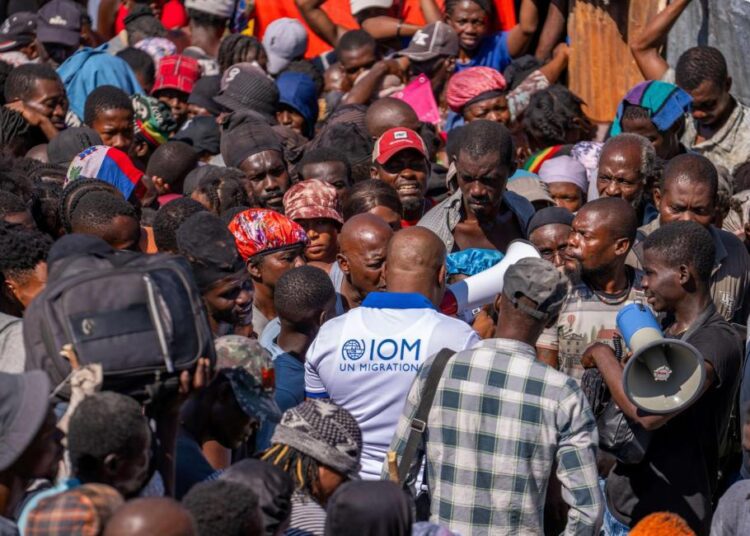
Haiti’s displacement crisis is increasingly moving beyond the country’s capital, with new data from the International Organization for Migration (IOM) showing that communities once viewed as relatively safer are now absorbing some of the sharpest increases in people fleeing violence.
The latest IOM assessment places the number of internally displaced people across Haiti at nearly 1.5 million, highlighting the scale of a crisis that is no longer concentrated primarily in Port-au-Prince.
Nearly 80% of those displaced are now living outside the capital.
The changing pattern also raises concerns about the availability of safe areas for families forced from their homes.
Artibonite has emerged as one of the clearest examples of that shift. Between May and August 2026, displacement in the department increased by 16% over a three-month period, making it the area with the most significant rise recorded in the latest assessment.
The increase carries particular significance because parts of Artibonite had previously been regarded as comparatively safer destinations for people escaping insecurity elsewhere. Escalating violence has now weakened that relative sense of safety, generating new displacement within an area that had itself become a refuge for vulnerable families.
Elise Verron, Senior Emergency Coordinator with IOM Haiti, described the situation as a crisis in which several pressures are occurring simultaneously rather than unfolding in separate stages.
“What we are witnessing in Haiti is not a crisis that moves from emergency to recovery. Violence, displacement, food insecurity, forced returns and climate risks are all unfolding at the same time, placing enormous pressure on families and communities.”
Elise Verron
These pressures means displacement is increasingly becoming a cycle rather than a single movement from an insecure area to a safer destination. Families who have already fled violence can face renewed insecurity after arriving in communities that lack the capacity to absorb large numbers of new residents.
“The displacement trends show that this crisis is expanding geographically. Communities that were already struggling to meet their own needs are now carrying an even greater burden.”
Elise Verron
The trend in Artibonite illustrates how the widening crisis is placing pressure on Haiti’s internal support systems. As more people leave areas affected by armed violence, the burden is transferred to communities where housing, livelihoods, healthcare and other essential services are already constrained.
Displacement Meets Haiti’s Climate and Humanitarian Pressures
As Haiti approaches the Atlantic storm season, the displacement is growing, putting already vulnerable families at further risk.
Displaced populations, many of whom are residing with host families in informal settlements, collective sites, or other places that provide little shelter from harsh weather, are seriously threatened by hurricanes, tropical storms, flooding, and landslides.
Due to the fact that many households’ resources have already been exhausted by displacement, the vulnerability is especially serious.
“For families already displaced by violence, a major storm could trigger another humanitarian emergency. Many households have few resources to withstand additional shocks, and communities hosting displaced families are already under considerable strain.”
Elise Verron
IOM’s latest assessment presents Haiti’s displacement crisis as a widening national challenge rather than an emergency confined to the capital.
IOM is seeking USD 60 million under its crisis response plan to reach 6.4 million people. The organisation is calling for sustained investment in life-saving assistance, recovery efforts, stronger local systems and measures that can help communities withstand the combined effects of insecurity, displacement and climate-related shocks.
The appeal comes as Haiti faces a humanitarian landscape shaped by several crises operating simultaneously. Violence continues to uproot families, while food insecurity and limited livelihoods make recovery more difficult. Forced returns add pressure to border communities, and the hurricane season introduces the possibility of additional emergencies affecting people already living in vulnerable conditions.
Haiti’s current challenge is therefore not simply the number of people displaced, but the shrinking availability of secure and adequately resourced places where those families can rebuild their lives.
The latest IOM assessment points to a crisis that is becoming broader in geography and more complex in its causes. Unless insecurity, humanitarian needs and climate-related vulnerabilities are addressed together, displacement could continue to place pressure on communities far removed from the areas where the crisis initially intensified.
READ ALSO: BBC Shares First Look at ‘Open Water’ with Jimoh and Gift