
Floodwaters in Thailand’s capital, Bangkok, began receding today following days of heavy rainfall, although several neighbourhoods and major roads remained submerged as authorities continued drainage and relief operations.
Intermittent rain persisted across the city, but officials said improving conditions had allowed them to accelerate efforts to drain floodwaters from affected communities. Four major canals had reached dangerously high levels over the weekend, limiting their capacity to accommodate runoff from surrounding neighbourhoods.
The flooding affected approximately 329,000 households, representing about 700,000 people, according to the Bangkok Flood Control Center. Deputy Governor Tavida Kamolvej said that the city had experienced widespread disruption, with several communities struggling to cope with rising water levels.
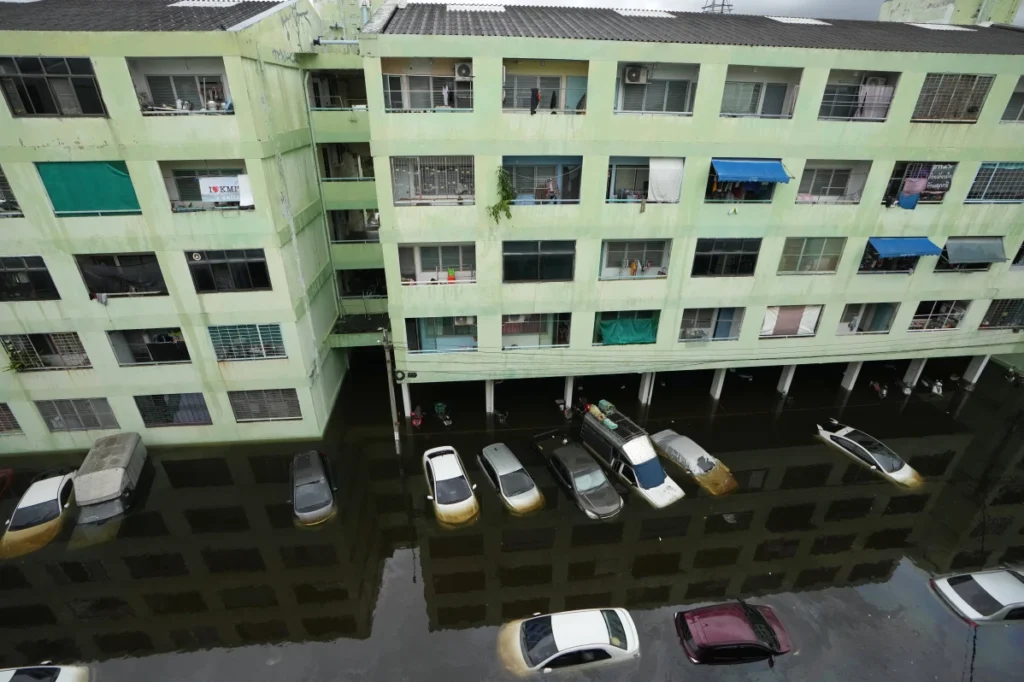
Thai media reported two flood-related deaths in Bangkok and at least 10 nationwide as authorities continued to assess the impact of the disaster.
Bangkok Governor, Chadchart Sittipunt declared a flood emergency across all 50 districts on Saturday, although the severity of the flooding varied considerably across the capital.
Authorities have prioritised assistance for vulnerable residents, particularly older people and persons with disabilities, providing essential supplies and arranging evacuations where necessary.
Nearly 7,000 people were staying in emergency shelters as city officials worked to assist displaced residents and restore access to affected communities.
Eastern Bangkok was among the hardest-hit areas, with several neighbourhoods experiencing extensive flooding. In Bang Kapi district, water remained around knee-deep near a railway station and a shopping mall on Monday, forcing residents and shoppers to wade through flooded streets despite intermittent rainfall.
Some shoppers continued visiting businesses in the affected area, carrying groceries and other purchases through the water. Others relied on a small boat provided by the shopping mall to travel to and from the nearby railway station.
The flooding has also disrupted businesses, transportation and supply chains, with panic buying contributing to shortages of food and other essential goods in some areas.
Several enterprises have experienced staffing shortages as employees struggled to reach their workplaces, adding to the operational difficulties caused by the flooding.
Thailand’s Prime Minister, Anutin Charnvirakul visited a heavily flooded housing estate in Bang Kapi on Sunday night, walking barefoot through the water with his trousers rolled up as he inspected conditions and helped distribute relief supplies.
The visit came as authorities intensified efforts to reach affected communities and provide assistance to residents facing prolonged disruptions.
The flooding has also affected operations at Bangkok’s Suvarnabhumi Airport, where staff shortages contributed to a significant backlog of passenger luggage.
The Thai Air Force announced that it was deploying 69 ground personnel to assist airport operations and help clear the accumulated baggage. “This deployment is a vital mission to care for, assist, and facilitate travelers — including tourists from around the world — ensuring smooth operations and preventing delays in ground services, thereby upholding the nation’s positive image,” the air force said.
The airport had previously attributed the backlog to insufficient personnel to support ground-handling operations and problems involving some baggage carts.
The disruptions delayed several departing flights and left arriving passengers waiting longer than usual for their luggage. The airport said baggage from several flights remained undelivered as staff worked to address the backlog.
In response to the widespread disruption, the Thai government declared special holidays on Monday and Tuesday for state offices, while advising state enterprises, financial institutions, private businesses and hospitals to determine whether their operations needed to continue.
The measures were intended to help manage the disruption and reduce difficulties associated with movement across affected areas.
However, concerns remain over further rainfall, with Thailand’s meteorological agency forecasting heavy to very heavy downpours in several parts of the country.
The agency warned residents, particularly in northern, central and eastern Thailand, to prepare for possible flash floods, overflowing rivers, forest runoff and landslides. Communities near waterways, foothills and low-lying areas were identified as particularly vulnerable.
Although Bangkok was expected to receive less rainfall than other parts of the country, authorities remained cautious as drainage operations continued and water levels gradually declined.
The flooding has also highlighted the challenges of maintaining essential services during prolonged periods of heavy rainfall, particularly in densely populated urban areas where disruptions to transport and employment can have far-reaching consequences.
Meanwhile, neighbouring Cambodia and Myanmar have also experienced severe weather, with heavy rainfall triggering flooding and landslides and prompting evacuations in several areas.
Myanmar, Cambodia Report Deaths and Mass Evacuations After Heavy Rains
Heavy rainfall has triggered deadly flooding and landslides in Myanmar and widespread inundation in Cambodia, compounding the impact of severe weather across Southeast Asia.
In Myanmar, at least 10 people were killed and dozens remained missing after heavy rains triggered flooding and landslides in the southern coastal region of Tanintharyi, according to local media reports.
Dawei township recorded 346 millimetres of rainfall on Monday, equivalent to 13.62 inches, breaking an 80-year-old rainfall record.
Myanmar’s Meteorology Department warned that conditions could deteriorate further as the storm front moved closer to Yangon, raising concerns about additional flooding and potential landslides.
In Cambodia, flash floods affected at least 10 provinces, impacting 44,889 families and forcing nearly 4,000 people to evacuate, according to disaster management officials.
Authorities have continued monitoring affected communities and implementing measures to limit further damage.
In Siem Reap province, home to the historic Angkor temple complex, the agency responsible for managing the archaeological park said it was operating water gates and diversion systems to reduce the risk of flooding.
The developments underscore the regional impact of the heavy rainfall, with authorities in Thailand, Myanmar and Cambodia continuing emergency operations amid forecasts of further severe weather.
READ ALSO: A Rocha Ghana Disputes Mahama’s Position On Galamsey Measures, Calls For Review