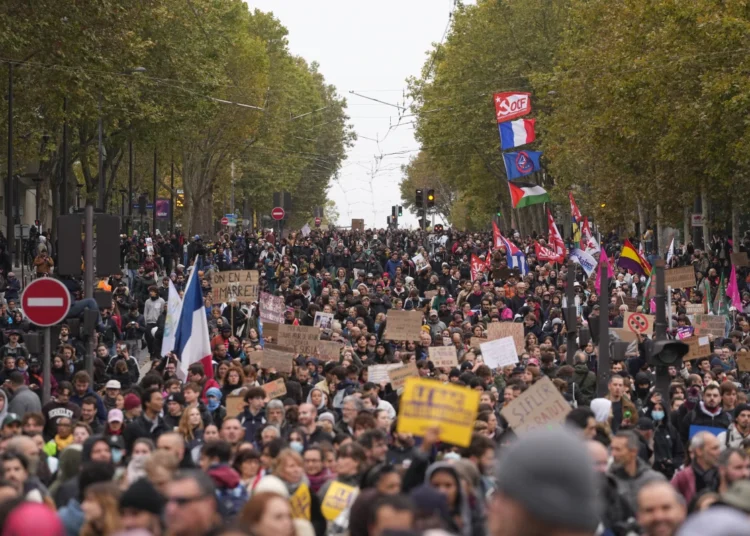
Thousands of students, workers and trade union members marched across France on Saturday to protest inadequate school funding and rising living costs, as authorities imposed restrictions on demonstrations and tightened security following a weekend of unrest.
Police used tear gas in Lyon, where local authorities had banned the rally, while officers in Clermont-Ferrand deployed tear gas and stun grenades to push back demonstrators attempting to reach the city centre, according to French media reports.
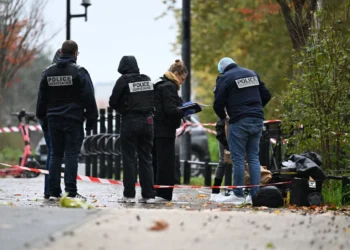
In Paris, authorities restricted the march to the southeastern edge of the capital, away from the city centre, as the government sought to prevent a repeat of the looting, vehicle fires and attacks on public buildings reported the previous weekend.
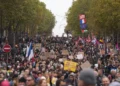
Several thousand demonstrators gathered at Porte d’Italie early in the afternoon and marched under the leadership of trade unions, followed by protesters wearing raincoats and carrying flags and handmade placards. The turnout was smaller than previous Saturday, when more than half a million people reportedly took to the streets nationwide.
Authorities reported that approximately 3,000 shops across the country had been damaged or looted during the previous weekend’s unrest, prompting heightened security measures for the latest demonstrations.
Interior Minister Laurent Nuñez said up to 70,000 police officers would be deployed across France, supported by helicopters, armoured vehicles and water cannons.
Authorities Restrict Protests Amid Security Concerns
French authorities have introduced restrictions on demonstrations in several cities, arguing that the measures are necessary to protect businesses, public buildings and urban centres from further violence.
In Paris, police changed the planned route on Friday, replacing the proposed march from Bastille to Nation with a route between Porte d’Italie and Porte de Vincennes.
At Bastille, the original starting point, officers used a megaphone to instruct people to leave or risk a €135 fine.
Rallies in other cities, including Lyon, Nice and Montpellier, have also been banned by local authorities. Police used tear gas in Lyon on Saturday morning, while officers in Clermont-Ferrand used tear gas and stun grenades against demonstrators trying to reach the city centre.
The restrictions have drawn criticism from trade unions, which argue that the bans infringe on freedom of expression, a right protected by the French Constitution.
The government, however, has defended the measures as necessary to prevent further damage and protect residents and businesses after the previous weekend’s unrest.
The security response has also affected cultural institutions and public events. Major Paris museums, including the Louvre, the Orsay Museum, the Picasso Museum and the Grand Palais, were closed on Saturday. The Grand Palais is currently hosting a major exhibition dedicated to the work of Paul Cézanne.
Art Basel, one of the world’s leading contemporary art fairs, opened to the public on Friday but cancelled its weekend programme amid concerns about potential unrest.
The combination of protest restrictions, police deployments and closures reflects the authorities’ efforts to limit disruption as demonstrations continue across the country.
Students Demand More University Places and Funding
Alongside opposition to rising living costs, education funding has emerged as a central issue in the protests, with student organisations calling for more university places, additional teachers and improvements to school and university infrastructure.
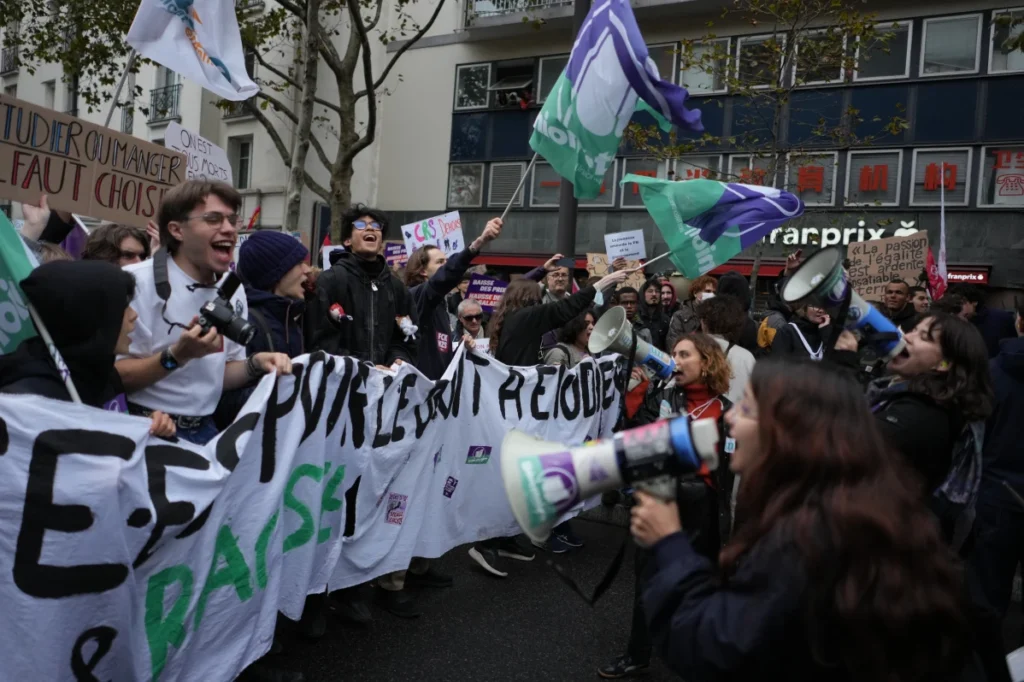
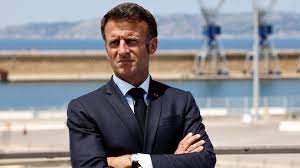
French President Emmanuel Macron met high school representatives on Friday, who said he had promised to overhaul the university admissions system.
Student groups are demanding 250,000 additional places in higher education and an end to selection through Parcoursup, France’s national university admissions platform.
Their joint 10-point plan also calls for more teachers and repairs to schools and universities.
The demands come amid concerns over teaching time lost because absent teachers were not replaced. According to Education Ministry figures, public middle and high schools lost 15.4 million teaching hours during the 2024–2025 school year, representing 7.5 per cent of scheduled teaching time.
Students are also seeking financial relief as everyday expenses rise. Their proposals include an additional €200 a month in student grants and a freeze on rents in public student accommodation.
The demands place pressure on the government to address both the quality of education and the financial challenges facing students, many of whom rely on public support to pursue higher education.
Protests Add to Pressure on Macron
The demonstrations come at a difficult political moment for Macron, whose popularity has fallen to its lowest level since he took office in 2017, according to the supplied report.
Thousands also marched peacefully in Orléans, south of Paris, on Saturday to protest against the far right, as Marine Le Pen’s National Rally held a two-day congress in the city.
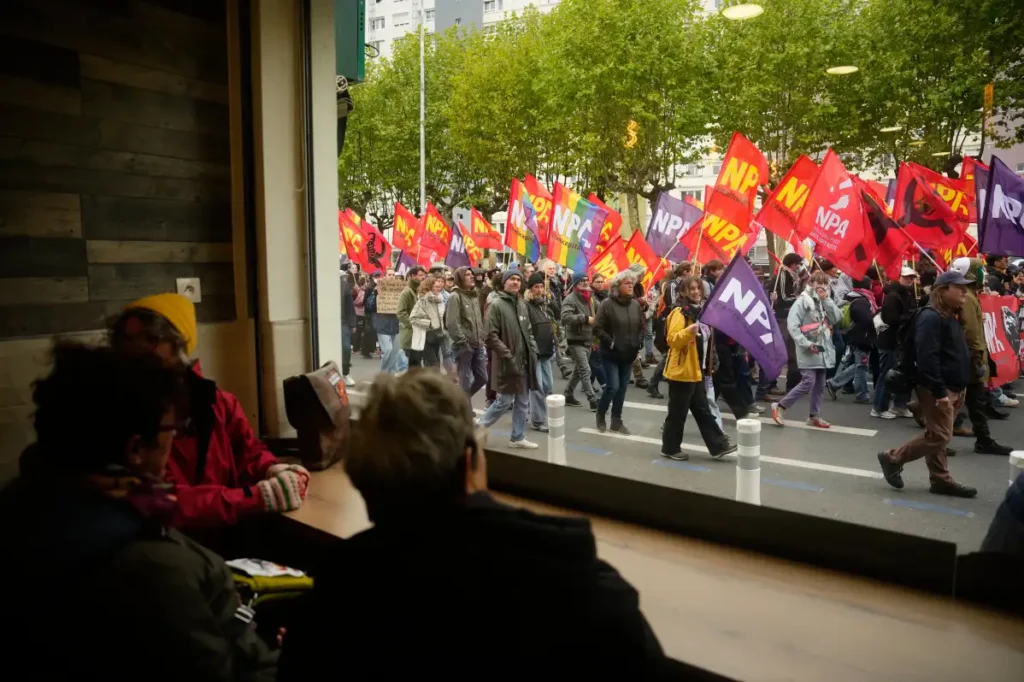
The parallel demonstrations highlighted the range of political and social concerns driving public mobilisation, from education and living costs to opposition to far-right politics.
The latest marches were smaller than the previous weekend’s nationwide demonstrations, but continued unrest and the cancellation of public events indicate that concerns over security, education and living costs remain unresolved.