Minerals Commission Chief Executive Officer, Mr. Isaac Tandoh, representing the Minister for Lands and Natural Resources, Hon. Emmanuel Armah-Kofi Buah (MP), has called for a decisive shift in Africa’s mining sector from raw extraction to deep value addition at the Egypt Mining Forum.
Speaking on behalf of the sector minister, Mr. Tandoh asserted that long-term economic resilience and true wealth creation across the continent depend directly on retaining mineral value locally rather than continuing the historical pattern of bulk raw commodity exports.
His intervention at the high-level gathering signaled Ghana’s intent to lead regional mining reforms, placing industrial beneficiation and domestic processing at the core of the country’s economic agenda.
“The era of simply exporting our raw wealth must transition into a model of active industrialization, where local value addition, processing, and beneficiation keep the economic benefits within our borders. Our goal in Ghana is to be the premier mining investment hub in Africa, not just by our resource abundance, but through policy certainty, transparency, and a commitment to responsible, sustainable mining. But as we welcome global partners, we are ensuring that the Ghanaian people are equitable beneficiaries of this wealth.”
Minerals Commissio
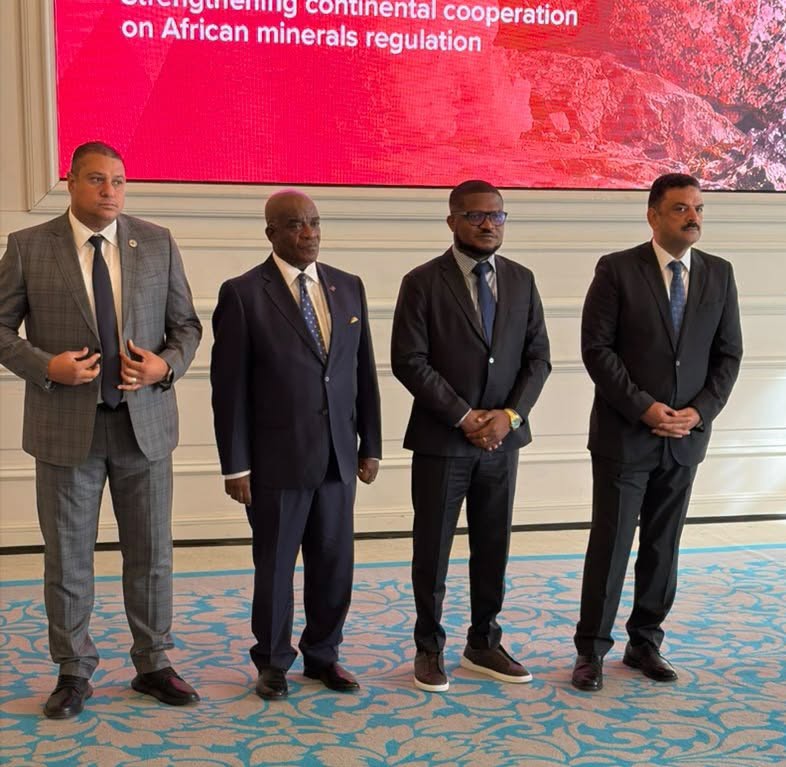
The Ministerial & CEO Roundtable, hosted jointly by the Africa Minerals Strategy Group and the Egypt Mining Forum under the central theme “From Exploration to Markets: Strengthening Africa’s Geological Data, Mineral Value Chains, Responsible Sourcing and Long-term Supply Chain Security,” provided a platform for African ministers, regulatory heads, and international investors to negotiate new frameworks for resource sovereignty.
Expanding on his initial call, Mr. Tandoh detailed how traditional extraction models have historically exposed African economies to global commodity price volatility while depriving host nations of downstream employment and industrial growth.
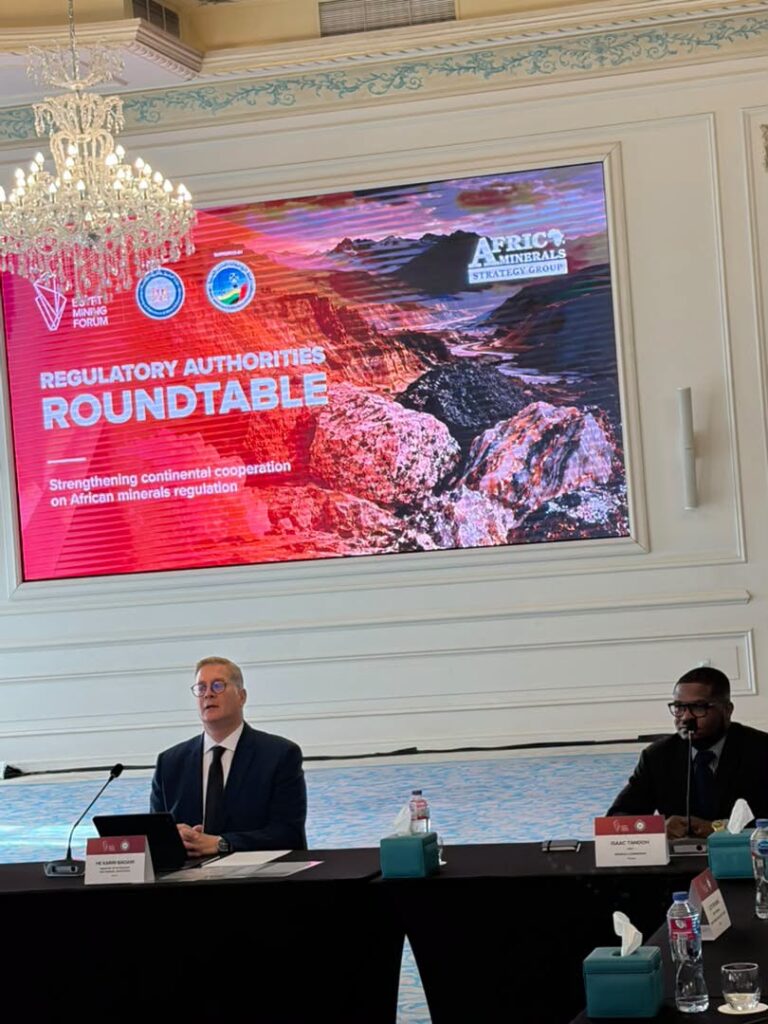
He presented Ghana’s strategic roadmap, which combines robust legal and regulatory frameworks with aggressive promotion of local processing facilities for gold and critical energy-transition minerals such as lithium.
Furthermore, he highlighted the Commission’s digital transformation agenda under his leadership, pointing to the deployment of the Mining Cadastre Administration System (MCAS) to formalize artisanal and small-scale mining while enhancing administrative transparency.
Bridging the Structural Deficit: The Economic Imperative for Value Addition
For decades, the structural paradox of Africa’s extractive industry has been defined by a disproportionate imbalance: holding over 30 percent of the world’s global mineral reserves while capturing less than 10 percent of the total financial value generated along the global supply chain.
This structural deficit stems from an outdated colonial economic architecture that positioned African states primarily as crude material providers while foreign processing centers reaped high-margin revenues, manufacturing profits, and skilled technical employment.
As the global energy transition accelerates demand for green metals like lithium, cobalt, manganese, and nickel, repeating this historical pattern poses a severe economic risk to the continent’s long-term industrial ambitions.
Establishing regional value-addition infrastructure is no longer merely an economic ambition; it is an urgent structural necessity to insulate national currencies, reduce balance-of-payment deficits, and absorb growing youth populations into high-value engineering, digital, and technical occupations.
Without localized smelting, refining, and manufacturing capabilities, African nations remain vulnerable to external trade shocks and restrictive international carbon policies.
Transitioning from primary extraction to intermediate and finished industrial production enables mineral-rich countries to build integrated domestic supply chains, retain fiscal revenues, and build structural linkages with manufacturing, construction, and technology sectors.
Digital Governance and Regulatory Frameworks as Investment Catalysts
Modernizing regulatory mechanisms and modernizing geological data infrastructure serve as critical foundations for securing investor confidence while maintaining national regulatory integrity.
The deployment of digital governance solutions exemplified by Ghana’s Mining Cadastre Administration System (MCAS) demonstrates how technological integration simplifies licensing processes, eliminates operational bottlenecks, and enforces strict Environmental, Social, and Governance (ESG) compliance standards.
Transparent, digital-first administrative platforms mitigate political risk, curb corrupt practices, and establish clear operational guidelines necessary to attract ethical, long-term capital from institutional investors.

Simultaneously, stringent regulatory enforcement must address structural loopholes that undermine local participation laws and erode national revenue collection.
Chief among these challenges is the practice of “fronting” the deceptive arrangement where local entities act as legal proxies for unregistered foreign operators to bypass statutory ownership rules.
By enforcing a systematic crackdown on these illegal proxy arrangements, regulatory authorities protect legitimate business investments and ensure that legal mandates for local participation deliver actual economic gains to domestic businesses and workers.
Formalization and Regional Integration for Sustainable Extractive Security
Bringing small-scale mining operations into the formal economic framework is essential for achieving broad-based economic empowerment and environmental management in rural mineral-rich communities. Unregulated, informal extraction frequently leads to severe ecological degradation, loss of state revenue, and community instability.
Transforming small-scale operators into formalized cooperatives provides miners with direct access to technical support, legal trade routes, modern equipment, and structured financial services.
This path integrates rural populations directly into the mainstream economy, transforming informal work into a sustainable, regulated, and environmentally responsible industry.

Ultimately, individual national reforms must align with a unified regional strategy to build true continent-wide resource security and global market leverage.
Participating nations at the Egypt Mining Forum reinforced this collaborative vision, emphasizing that fragmented policy approaches leave individual African states at a disadvantage during negotiations with multinational conglomerates and international buying blocks.
By aligning regulatory standards, harmonizing trade policies, and sharing geological intelligence under regional coalitions like the Africa Minerals Strategy Group, the continent can establish integrated cross-border supply chains.
This unified front positions Africa not as a passive supplier of raw materials, but as a dominant, highly competitive player in the global industrial economy.
READ ALSO: COCOBOD Seeks GH¢16.3bn From Domestic Market