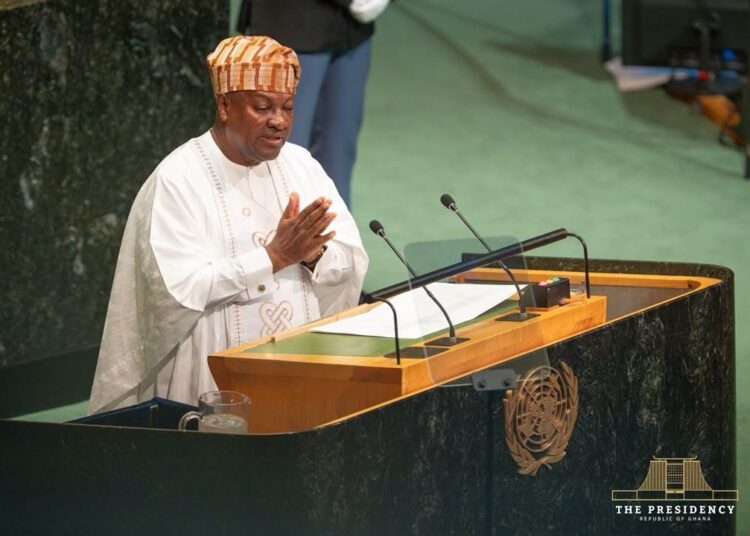
President John Dramani Mahama has issued a stern warning to global powers that Africa will no longer allow itself to be treated as a passive site for resource exploitation.
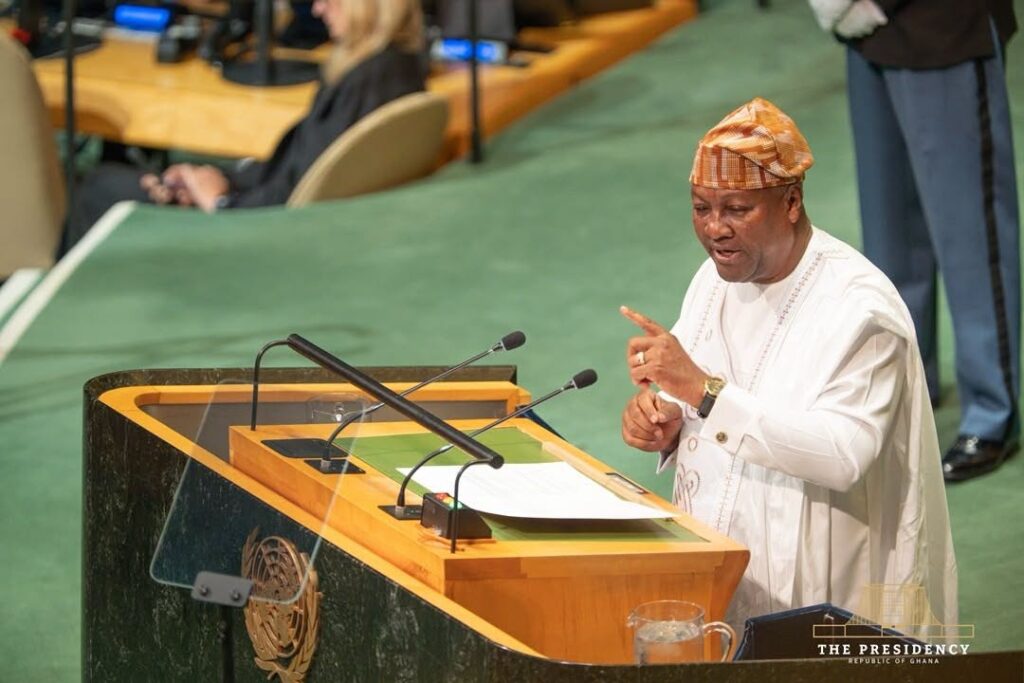
Speaking at the 81st United Nations General Assembly, he declared that the continent is determined to break away from traditional extractive models and manage its wealth independently.
President Mahama stressed that the era where foreign nations unilaterally extract raw materials without building local capabilities has officially come to an end.
“Critical mineral extraction in Africa must not replicate the colonial-era exploitation. We will process our minerals at home. We will build local industries that create dignified jobs for our youth, and we will retain the value of our natural resources in Africa.”
President John Dramani Mahama
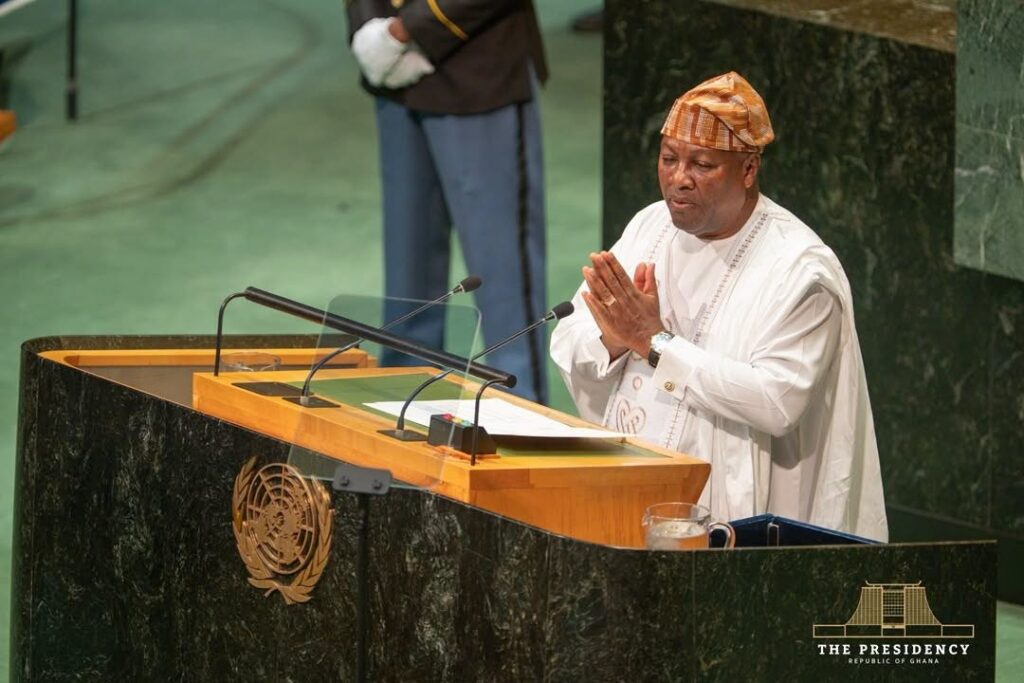
While expanding on his assertion, President Mahama outlined how international financial structures and historic trade imbalances have systematically disadvantaged developing states.
He explained that long-term, affordable, and accessible concessionary financing is urgently required so African nations can invest directly in industrial development, human capital, and climate resiliency.
Rather than seeking hand-outs, the continent demands an equitable global framework that respects its economic sovereignty, safeguards its domestic supply chains, and accelerates structural transformation across the region.
Imperative for Resource Sovereignty
The warning issued by President Mahama comes at a crucial turning point for the global energy transition. Modern technology and green energy systems rely heavily on critical minerals such as lithium, cobalt, nickel, manganese, and rare earth elements resources that Africa possesses in vast abundance.
Historically, foreign industrial giants extracted these raw ores at low cost, shipped them overseas for processing, and resold the high-value finished products back to the continent at exorbitant prices.
This legacy of raw material export left host communities with severe environmental degradation, economic vulnerability, and minimal job creation.By demanding an end to this cycle, President Mahama highlighted that true economic independence requires retaining the value chain within domestic borders.
Establishing local refining, smelting, and manufacturing infrastructure ensures that natural wealth translates into tangible domestic capital. Without in-country value addition, African nations risk remaining locked at the bottom of global supply chains while foreign powers reap the financial and technological rewards of the green transition.
Economic Engines and Continental Integration
To resist external pressures and curb economic fragmentation, African leaders are increasingly turning toward regional integration as a shield against raw material exploitation.
Central to this strategy is the African Continental Free Trade Area (AfCFTA), headquartered in Accra, Ghana. The trade agreement serves as the primary engine for driving intra-African commerce, fostering industrial diversification, and establishing regional value chains.
Rather than exporting unprocessed ores to distant markets, member states can now leverage integrated markets to supply raw inputs to neighboring processing hubs.
This interconnected economic structure strengthens regional supply chains and provides individual nations with greater collective bargaining power when negotiating mineral rights with multinational conglomerates.
Furthermore, localized industrial processing shields emerging economies from volatile international commodity markets, ensuring stable revenues that can be reinvested into national infrastructure, education, and social safety nets.
Safeguarding Multilateralism and Global Order
Beyond economic policy, President Mahama linked the exploitation of natural resources to the broader breakdown of the international rules-based order.
He warned against a growing shift toward unilateralism and power politics, asserting that unchecked foreign interference threatens stability across resource-rich regions.
Drawing parallels to historical precedents, he cautioned that international institutions must uphold foundational principles rather than allowing powerful nations to dictate global terms through coercive practices.
To secure a sustainable future, global governance structures must undergo fundamental reform to reflect modern geopolitical realities.
President Mahama reaffirmed that respect for multilateralism, national sovereignty, and international law remains essential for equitable development.
By standing firm against unfair extraction practices and demanding equal partnership on the world stage, Africa is positioning itself not as an arena for geopolitical competition, but as an active, self-reliant leader in the global economic landscape.
READ ALSO: Ghana’s Gas Security Hinges on Reservoirs, Infrastructure and Demand