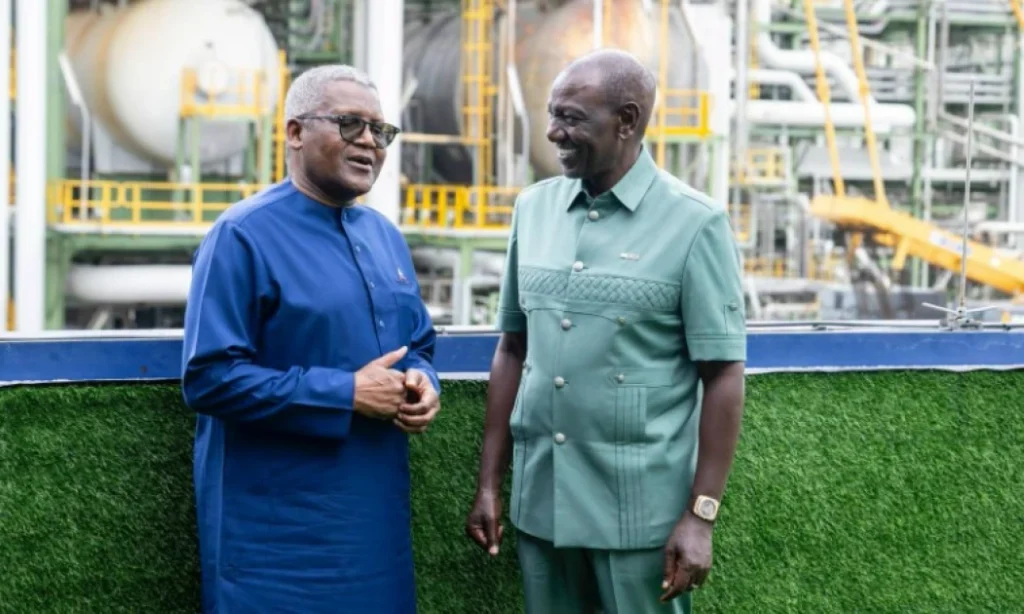
African heads of state and former Nigerian President Olusegun Obasanjo have joined Nigerian billionaire Aliko Dangote and Kenya’s President William Ruto for the groundbreaking of a $16 billion oil refinery in Lamu, Kenya, in a major push to expand Africa’s capacity to process its own natural resources.
The project, which is expected to become East Africa’s largest refinery by capacity, is designed to process up to 700,000 barrels of crude oil per day when construction is completed within 40 months.
William Ruto hosted the ceremony in the coastal town of Lamu, where he was joined by the Presidents of Uganda, Ethiopia, Togo and Benin, alongside Obasanjo.
Rwanda, Burundi, South Sudan and Tanzania also sent senior delegations to represent their heads of state.
At the ceremony, Dangote framed the refinery as part of a broader continental industrialisation agenda, arguing that African countries must move beyond exporting unprocessed resources.
“Africa must industrialize Africa,” Dangote stated, stressing that the continent cannot be “exporting what it has and importing what it needs.”
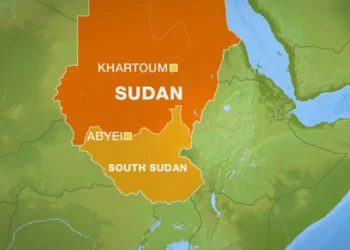
The project is expected to draw crude from oil-producing countries in and around East Africa, including Uganda and South Sudan. Uganda is developing plans to export its crude through Tanzania, while South Sudan’s oil exports currently depend heavily on infrastructure running through Sudan.
Dangote argued that the refinery would have a sufficiently large regional market, pointing to East Africa’s overall petroleum consumption as evidence that the facility would not depend solely on Kenya’s domestic demand.
At full capacity, the refinery is expected to process more crude than the region currently has the capacity to refine locally, potentially changing the flow of petroleum products across East Africa and reducing reliance on refined fuel imports from outside the region.
Africa possesses significant oil, gas, minerals and agricultural resources, yet many countries remain heavily dependent on imports of processed products derived from those resources. Refining crude locally is therefore viewed by proponents as a means of retaining greater value within African economies, creating industrial jobs and developing supporting infrastructure.
Dangote pointed to his experience with the Lekki refinery in Nigeria as evidence that large-scale African industrial projects can be developed and replicated.
“This is Africa coming together to build Africa. Today we are not simply breaking ground for a refinery; we’re breaking ground for a new chapter in Africa’s industrial journey to a brighter future.”
Aliko Dangote
The Lamu refinery is expected to become Kenya’s largest infrastructure project since independence, surpassing the $5.1 billion Standard Gauge Railway.
Its proposed capacity also places the development at the centre of East Africa’s ambitions to strengthen energy security while creating greater integration among countries that produce, transport, refine and consume petroleum.
Yet the scale of the project has also generated questions over its environmental and social consequences, particularly among communities living around the Lamu site.
Lamu Refinery Faces Land and Environmental Questions
The industrial ambitions surrounding the refinery have been accompanied by concerns from some local residents and environmental campaigners over land compensation and the potential impact of the project on the coastal ecosystem.
Ahead of the groundbreaking ceremony, some residents took to the streets demanding additional compensation for land being used for the development.
Dangote rejected the protests and argued that his company had taken only the portion of land required from what had been made available by the government.
Speaking in an interview, he dismissed the demonstrations as opposition driven by local marketers and international interests, while insisting that the refinery would proceed as planned and be ready by 2030.
“To come and say some people are demonstrating, demonstrating about what? Have you ever seen people demonstrating against themselves in terms of development?”
Aliko Dangote
According to Walid Ali, co-founder of the Save Lamu campaign group, environmental concerns remained a central issue for residents.
“We are asking for the findings from the environmental impact assessment so that we can see what mitigation measures are being proposed. This is not the first project where we have seen environmental concerns being overlooked.”
Aliko Dangote
The promoters of the refinery have highlighted employment as one of its major benefits.
Dangote noted that the project could create 60,000 jobs at the height of construction, with economic benefits expected to extend beyond those directly employed at the site.
“Are we going to bring robots? Of course, the people will benefit,” he stated.
Meanwhile, critics have questioned why a refinery of such scale is being developed in Kenya, which does not produce crude oil, rather than in countries such as Uganda or Tanzania, which are positioning themselves as oil exporters.
The project’s promoters argue that Lamu offers strategic advantages that influenced the decision.
Dangote revealed that the refinery was initially considered for Tanzania’s coastal town of Tanga but was ultimately moved to Lamu because of the area’s deeper waters, solid ground capable of supporting heavy industrial equipment, and access to the deep sea.
Uganda’s planned oil exports and South Sudan’s existing petroleum production could provide potential sources of crude, while neighbouring countries would constitute part of the market for refined products.
Rwanda, Burundi, Tanzania and South Sudan are among the countries expected to be represented in the wider regional discussions surrounding the development.
READ ALSO: Plane Makes Emergency Landing In Saudi Arabia After Pilot Brawl