
The National Petroleum Authority (NPA) has reaffirmed its regulatory support for investment in Ghana’s liquefied petroleum gas (LPG) market as Puma Energy Ghana expands its participation in the Cylinder Recirculation Model (CRM).
The Authority’s position comes as Puma Energy, through its LPG subsidiary Pumagas, deepens its involvement in the CRM ecosystem, including the rollout of new branded cylinders and a wider network of distributors and dealers.
The development is significant because the success of Ghana’s CRM goes beyond increasing the number of LPG cylinders in circulation.
It depends on building a commercially viable distribution system capable of improving access, strengthening safety and encouraging sustained private-sector investment in LPG.
Regulation And Private Capital
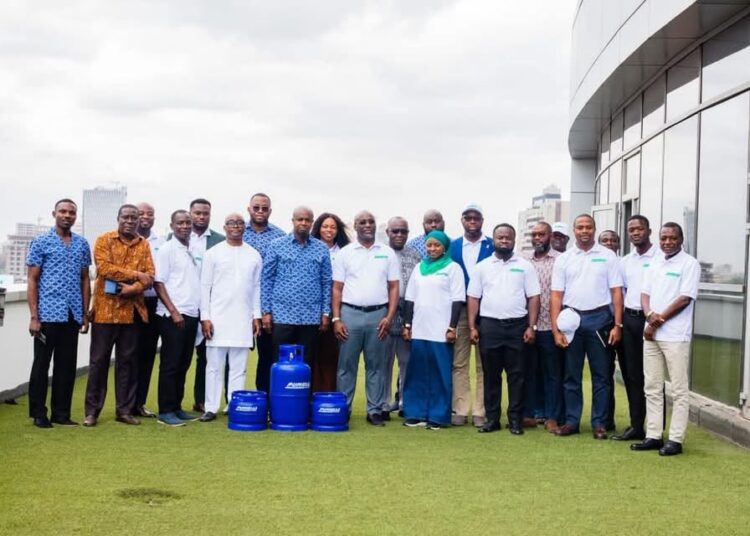
A delegation from Pumagas, led by Puma Energy General Manager Lanzeni Coulibaly, paid a courtesy visit to NPA Chief Executive Godwin Kudzo Tameklo, where the company formally introduced its subsidiary and selected distributors and dealers.

The engagement also provided an opportunity for Puma Energy to present its new branded cylinders to the NPA.
For the regulator, the interaction underscores the importance of maintaining a predictable operating environment as private companies commit capital to Ghana’s downstream petroleum infrastructure.
Mr Tameklo reaffirmed the Authority’s commitment to supporting legitimate industry participants while maintaining regulatory oversight.
“The Authority remains committed to providing continuous regulatory support to legitimate industry players and creating the enabling environment for sustainable investment in Ghana’s downstream petroleum sector.”
NPA Chief Executive Godwin Kudzo Tameklo
The emphasis on responsive, efficient and transparent regulation is particularly relevant to the CRM because the model requires coordination among importers, bottling facilities, cylinder owners, distributors, dealers and consumers.
CRM Needs More Than Cylinders
Puma Energy’s investment illustrates one part of the infrastructure challenge facing Ghana’s LPG market.
The introduction of branded cylinders can help strengthen the visibility and distribution footprint of a participating company, but the broader objective of the CRM is to reshape how LPG reaches consumers.
Under the model, consumers are not expected to depend primarily on refilling cylinders at traditional retail points. Instead, filled cylinders are distributed through exchange points, with empty cylinders collected and returned into the supply chain.
That model requires investment not only in cylinders but also in storage, transportation, distribution networks, safety systems and consumer access points.
Puma Energy’s engagement with distributors and dealers therefore matters because the effectiveness of the investment will ultimately depend on how efficiently the physical network connects LPG supply with households and other users.
Investment Must Support Market Reliability
The NPA’s regulatory position also highlights a broader issue facing Ghana’s downstream petroleum sector: private investment can only deliver its full value where regulation and commercial incentives work together.
For LPG, this means investors need clarity around the rules governing cylinder ownership, distribution, safety and market participation.

At the same time, consumers need a system that provides reliable access without compromising safety or making LPG economically unattractive compared with competing fuels.
The CRM has consequently become an important component of Ghana’s wider effort to expand LPG consumption.
Greater LPG penetration could help diversify household energy use, while reducing reliance on traditional cooking fuels.
But achieving that objective requires the distribution system to be sufficiently developed to make LPG accessible beyond the areas where conventional infrastructure is already concentrated.
Regulatory Confidence Matters
Puma Energy’s engagement with the NPA also signals the role of regulatory confidence in attracting longer-term capital into the sector.
Downstream petroleum investments often involve infrastructure and equipment with long operating lives. Investors therefore need some certainty that regulatory requirements will remain sufficiently predictable to allow them to plan and recover their investments.
For the NPA, supporting investment does not remove its responsibility to enforce standards. Instead, the challenge is to ensure that regulation provides both investor certainty and effective consumer protection.
That balance will become increasingly important as more players participate in the CRM and the number of cylinders, distributors and exchange points expands.
LPG Investment And Energy Transition
The investment also sits within Ghana’s broader energy-transition agenda.
While LPG remains a petroleum product, its expansion can form part of a gradual shift in household energy use where it displaces more traditional and carbon-intensive cooking fuels.

This makes the commercial development of LPG relevant not only to the downstream petroleum industry but also to Ghana’s wider energy policy objectives.
The immediate question, however, is whether investments such as Puma Energy’s can translate into a distribution system that is genuinely accessible and commercially sustainable.
For the NPA, the priority will be maintaining the regulatory environment needed for legitimate investment while ensuring that the expansion of the CRM is accompanied by appropriate safety, infrastructure and market standards.
Puma Energy’s growing participation therefore represents more than a new cylinder rollout. It is another test of whether Ghana can use private capital and regulatory coordination to build an LPG distribution system capable of supporting wider consumer adoption and strengthening the resilience of the downstream energy market.
READ ALSO: BYD Seagull Shocks EV Market With Rear-Wheel Drive