Ghana’s economy continues to expand, but a less visible measure of the recovery points to a more demanding test. The International Monetary Fund expects real GDP growth to moderate from 6.0 percent in 2025 to 4.8 percent in 2026, while real GDP per capita growth is projected to slow from 4.0 percent to 3.0 percent.
That difference matters because aggregate GDP measures the size of the economy, while GDP per person adjusts the expansion for population growth. IMF estimates put Ghana’s population growth at 1.8 percent in both 2025 and 2026. The economy can therefore continue growing strongly even as the additional real output generated per resident rises more slowly.
The distinction does not mean Ghanaian living standards are falling. A 3.0 percent increase in real GDP per capita remains positive. It means average real output per resident is projected to rise more slowly, making jobs, productivity and the distribution of income increasingly important to how households experience the recovery.
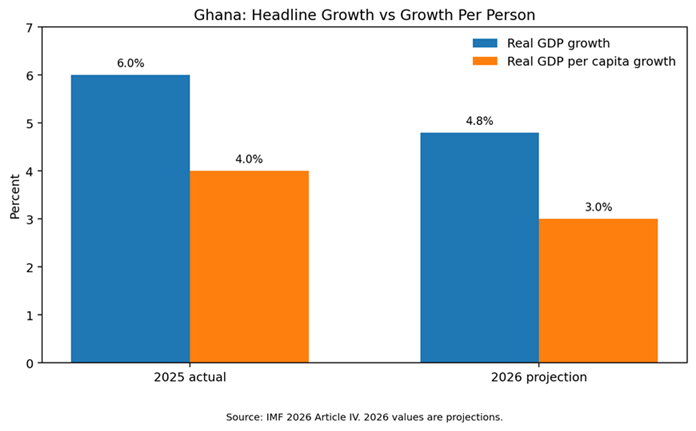
Feature graphic: Ghana’s headline growth is projected to moderate alongside a sharper slowdown in growth per person. Source: IMF 2026 Article IV.
Headline Growth Holds
Ghana Statistical Service estimates indicate that real GDP expanded by 6.0 percent year on year in the second quarter of 2026, taking first-half growth to about 6.2 percent. Vaultz’s Q2 GDP analysis showed that services and information and communication technology were major drivers of the expansion.
A strong first half does not automatically determine the annual outcome. Growth can moderate later in the year, and the IMF’s 4.8 percent forecast incorporates fiscal consolidation, global uncertainty and other expected headwinds.
The more important question is what happens beneath the headline. National output can rise because more labour and capital are being used, because productivity is improving, or through both. For households, the quality of growth depends heavily on whether those gains translate into more productive employment and stronger real incomes.
Per Person Momentum
Real GDP per capita is useful precisely because it introduces population into the growth story. It does not measure household income directly, and it does not show how national income is distributed. It can therefore rise even when particular groups or regions experience little improvement.
But it remains an important macroeconomic signal. When per capita growth slows from 4.0 percent to 3.0 percent, the economy adds real output per resident more slowly than in the previous year. Sustaining rapid gains in material welfare therefore becomes more demanding unless productivity, employment quality and purchasing power strengthen.
The IMF country report places this slowdown within a still-positive medium-term outlook. It expects headline growth to move back towards Ghana’s estimated potential of around 5 percent after 2026, provided macroeconomic stability is maintained and structural reforms support private investment and productivity.
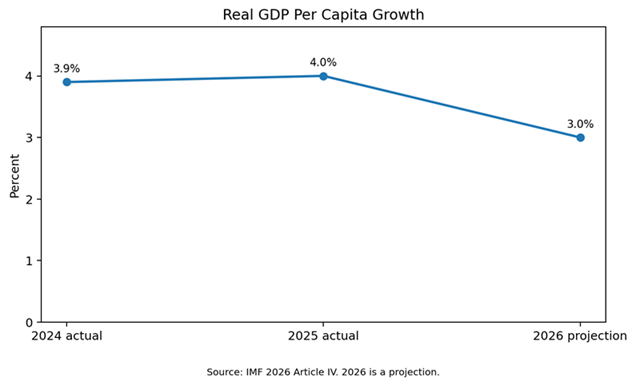
Real GDP per capita growth is projected to ease to 3.0% in 2026 after 4.0% in 2025. Source: IMF 2026 Article IV.
Jobs Define Quality
The World Bank reached a similar conclusion in its August Ghana Economic Update. It described the recovery as significant but incomplete, noting that growth had not yet generated enough quality jobs to absorb an expanding working-age population. The Vaultz’s recovery challenge analysis highlighted the same tension between macroeconomic stabilisation and household-level opportunity.
A 5 percent growth rate can have very different labour-market effects depending on where expansion occurs. Growth in ICT, mining or other capital-intensive activities can lift national output without creating employment at the same rate as manufacturing, construction, agriculture or labour-intensive services.
Ghana needs high-productivity sectors. The challenge is to create stronger links between them and the rest of the economy so that technology, infrastructure, finance and investment raise productivity across a wider base.
Productivity Becomes Decisive
This also connects with The Vaultz’s productivity test, which examined evidence that Ghana’s long-run growth has relied heavily on adding labour and capital rather than consistently extracting more output from each unit of those inputs.
As population continues to expand, productivity becomes increasingly important to maintaining strong per-person growth. Better skills, reliable infrastructure, efficient logistics, access to finance, technology adoption and stronger institutions allow the same workforce and capital stock to generate more output.

Without those gains, headline GDP can keep increasing while great per-person improvements become harder to sustain.
Recovery Faces Test
Ghana therefore enters this phase of the recovery with two truths at the same time. The economy remains resilient, and a 3.0 percent rise in real GDP per person would still represent positive growth in average real output per resident. But the projected slowdown from 2025 shifts the standard by which growth should be judged.
The next test is not simply whether Ghana records 4.8 percent, 5 percent or 6 percent headline GDP growth. It is whether economic expansion generates enough productivity, decent employment and real income growth to outpace population increases and broaden the gains across households.
For Ghana’s recovery, GDP growth remains essential. The harder question is whether real output per resident continues rising fast enough, and whether those gains are reflected broadly in productive jobs and real incomes.
READ ALSO: ICT Powers Ghana’s 6% Second-Quarter Growth