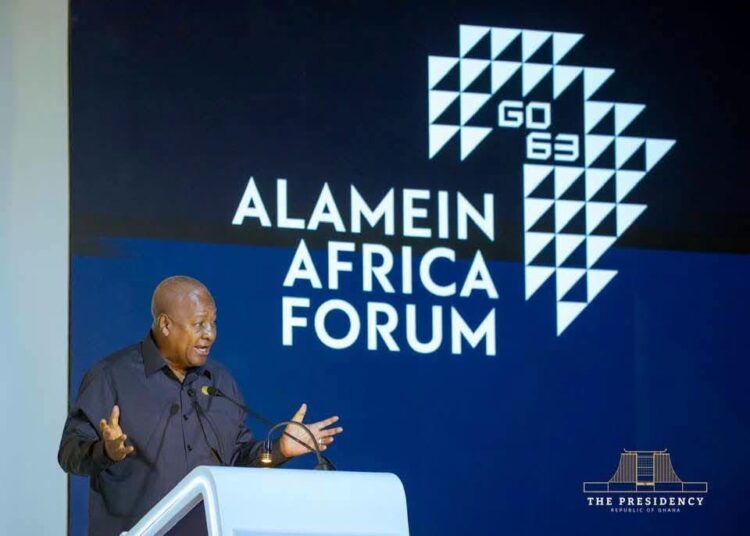
Ghana’s Minister for Trade, Agribusiness and Industry, Hon. Elizabeth Ofosu-Adjare, joins President John Dramani Mahama and other African leaders, business executives, investors and development partners at the maiden Alamein Africa Forum in Alamein, Egypt, as the continent intensifies efforts to deepen investment, manufacturing and regional value chains.
The forum runs alongside the Eighth African Union Mid-Year Coordination Summit and provides a platform for governments, businesses and financial institutions to explore investment opportunities, strengthen partnerships and advance Africa’s economic integration and sustainable development agenda.
President Mahama leads the Ghanaian delegation to the engagements, with Minister Ofosu-Adjare participating as Ghana positions its trade, agribusiness and industrial sectors within the broader continental investment and manufacturing agenda.
A major focus of the forum is the role of manufacturing in strengthening Africa’s economic resilience, with President Mahama delivering the keynote address at a plenary session on “Investing in Health, Manufacturing and Regional Value Chains.”
In his address, President Mahama argues that Africa needs to fundamentally change the way it views the health sector, particularly its relationship with manufacturing, investment and industrial development.
“Health is not a charitable cause; it is an investable, high growth economic sector. It drives human capital, manufacturing, job creation, and macroeconomic stability.’’
President of Ghana, John Dramani Mahama
The President says the continent’s dependence on imported pharmaceutical products presents both a major vulnerability and a significant investment opportunity.
According to him, Africa currently imports more than 70 per cent of its pharmaceuticals and nearly 99 per cent of its vaccines, resulting in substantial foreign exchange outflows and leaving countries exposed to disruptions in global supply chains.
He therefore calls for increased investment in pharmaceutical manufacturing, research and development, technology transfer and the infrastructure required to establish competitive regional value chains.
“Under the African Continental Free Trade Area, an African pharmaceutical plant does not serve a single country of 10 or 30 million people; it serves a single, unified market of 1.4 billion consumers.’’
President of Ghana, John Dramani Mahama
AfCFTA the Centre of Africa’s Continental Transformation
The President’s argument places the African Continental Free Trade Area at the centre of the continent’s industrial transformation, as the agreement creates opportunities for manufacturers to move beyond relatively small national markets and access consumers across Africa.
For Ghana, the discussions align with the government’s broader emphasis on industrialisation, export development, private-sector investment, value addition and the expansion of domestic production.
The participation of Minister Ofosu-Adjare therefore provides an opportunity for Ghana to engage investors, manufacturers, financial institutions and policymakers on opportunities within the country’s trade, agribusiness and industrial sectors.
The forum also provides a platform for Ghana to strengthen its engagement with African partners as the country seeks to leverage regional markets, investment and value chains to support economic growth.
President Mahama says the current global environment makes it increasingly important for African countries to build domestic production capacity rather than depend heavily on external suppliers.
He notes that the COVID-19 pandemic exposes the vulnerabilities created by Africa’s dependence on imported medicines and vaccines, particularly when global demand rises sharply and countries compete for limited supplies.
He consequently calls on African financiers, commercial banks, institutional investors and industrialists to view pharmaceutical manufacturing as a viable commercial opportunity capable of generating economic and social returns.
President Mahama Urge Financiers to Develop Pharmaceutical Innovations
The President also challenges financiers to develop appropriate instruments that can reduce the risks associated with investing in African pharmaceutical manufacturing.
“What specific de-risking instruments and blended finance structures do you need from governments to deploy patient capital into African pharmaceutical plants today. How quickly can we operationalise the African Medicines Agency to ensure a single drug approval opens the doors to all 54 AU member states?”
President of Ghana, John Dramani Mahama
For industrialists, President Mahama poses another challenge: “What strategic partnerships do we need to move from basic packaging and fill-and-finish operations to full Active Pharmaceutical Ingredient (API) synthesis on African soil?”
The questions underline the President’s call for practical action to move Africa from being predominantly a consumer and importer of pharmaceutical products to becoming a producer and exporter.
President Mahama also announces the introduction of the Health Investment and National Gateway Enabler, known as HINGE, a digital platform designed to streamline regulation, clinical validation and commercialisation for health innovators and investors across Africa.
The President further highlights Ghana’s efforts to strengthen domestic health production as part of the government’s Accra Reset agenda.
He says Ghana is expanding the National Health Insurance Scheme, introducing Free Primary Health Care, establishing the Ghana Medical Trust Fund and empowering institutions including the Food and Drugs Authority and National Vaccine Institute as the country works to transition from a consumer to a producer of health products.
The President points to Egypt’s experience in combating Hepatitis C as evidence that strategic investment, technology transfer and domestic manufacturing can deliver both health and economic benefits.
He notes that Egypt reduces Hepatitis C prevalence from about 10 per cent to below 0.5 per cent through a combination of domestic production, technology transfer and local industrial capacity
He also points to Nigeria’s African Medical Centre of Excellence in Abuja as another example of efforts to retain healthcare skills, investment and expenditure within Africa.
The broader discussions at the Alamein Africa Forum consequently extend beyond healthcare to the wider question of how African economies can retain greater value from their natural resources, consumer markets and growing populations.
Deepening Intra-Africa Trade
The forum comes at a time when African countries are seeking to accelerate implementation of the AfCFTA and deepen intra-African trade, while strengthening domestic industries and creating more opportunities for businesses to participate in continental value chains.
For Ghana, this agenda is particularly relevant to the government’s efforts to expand manufacturing, strengthen agribusiness, promote value addition and attract investment into productive sectors.
Minister Ofosu-Adjare’s participation therefore places Ghana within important continental conversations on how trade policy, industrialisation and investment can work together to create jobs, increase exports and strengthen productive capacity.
The convergence of the Alamein Africa Forum and the Eighth AU Mid-Year Coordination Summit also creates opportunities for African leaders to connect political commitments with practical economic initiatives.
President Mahama emphasises that governments alone cannot finance the scale of transformation required across Africa’s productive sectors.
“Governments Cannot and Should not Fund this Transition Alone,” he says, calling for greater participation from private capital, industrial developers, commercial banks and sovereign funds.
He concludes with a direct call for Africa to move from policy discussions to concrete industrial action.
“Let us Stop Treating Health as a Line Item Expense. Let us Build Factories, Integrate Supply Chains, Fund Innovators, and Secure our Citizens’ Future.’’
President of Ghana, John Dramani Mahama
The participation of President Mahama and Minister Ofosu-Adjare at the Alamein Africa Forum therefore reinforces Ghana’s engagement with the continent’s investment and industrialisation agenda.
READ ALSO:Alfred Appiah Highlights Timing Crucial Amid Gold Declines