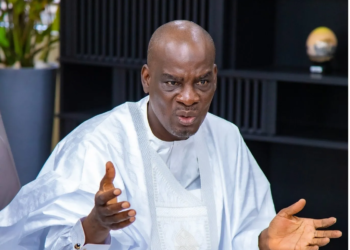
Government has approved a new integrated model for basic education infrastructure, with all future projects expected to follow this design, Education Minister Haruna Iddrisu has announced, as part of efforts to address the persistent problem of schools operating under trees across the country.
Hon. Haruna Iddrisu, Minister of Education disclosed that district assemblies have been directed to ensure new basic education infrastructure reflects the newly approved model, a move he said forms part of President John Dramani Mahama’s broader national reset agenda.
Hon. Iddrisu’s announcement came in direct response to concerns raised by the President of the National Association of Graduate Teachers (NAGRAT), who had referenced the Auditor General’s 2025 report.
The report indicates that 10,730 schools across Ghana are still operating under trees, affecting 13 regions and an estimated 3 million children nationwide.
“As accurately stated, 10,730 schools in Ghana are still under trees, affecting 13 regions of Ghana with 3 million children affected.”
Hon. Haruna Iddrisu, Minister of Education
Directive To District Assemblies
Mr Iddrisu acknowledged the scale of the challenge highlighted in the report, framing government’s response as a direct effort to address the specific concerns raised by the Auditor General regarding inadequate school infrastructure nationwide.

Mr Iddrisu confirmed that he had written to the Minister for Local Government and to every district assembly, directing that henceforth every education infrastructure project at the basic level must reflect the newly approved integrated model. He described this directive as a direct response to the issues flagged in the Auditor General’s report.
He assured that government would make adequate provision within the GETFund formula to reduce the number of schools currently operating under trees, signalling a specific funding commitment tied to the implementation of the new infrastructure model.
Details Of The Integrated Model
Mr Iddrisu explained that under the integrated model, a single school building would incorporate a kindergarten, primary school up to Primary 6, and a junior high school, alongside a changing room, a laboratory, a library and an IT system, all housed within one unified structure.
“With the integrated model, the integrated school will have a kindergarten, primary six, a junior secondary school, a changing room, a laboratory, library and IT system all incorporated in one building.”
Hon. Haruna Iddrisu, Minister of Education
He stated that this design would become the standard model for basic education infrastructure across Ghana going forward, under the administration of President John Dramani Mahama.
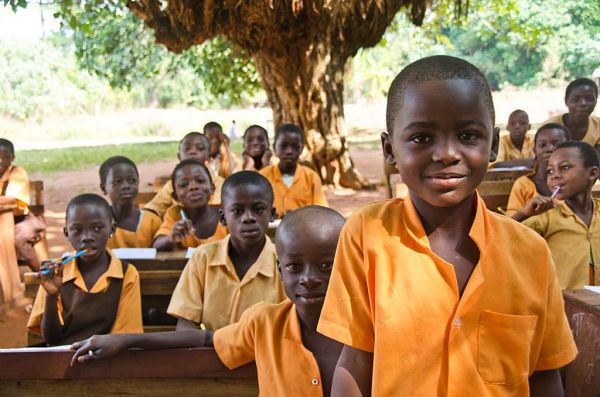
Mr Iddrisu assured stakeholders that government remains committed to investing in the rollout of this integrated infrastructure model, positioning it as a concrete policy response to the long-standing problem of inadequate school facilities that has left millions of Ghanaian children learning in makeshift, outdoor conditions without proper classroom structures.
Addressing Longstanding Infrastructure Gap
The announcement directly targets one of the most persistent challenges facing Ghana’s basic education system. Schools operating under trees have remained a recurring concern in audit reports and public discourse for years, often concentrated in underserved and hard-to-reach communities where infrastructure investment has historically lagged behind demand.
By consolidating multiple levels of basic education, along with essential facilities such as laboratories, libraries and IT systems, into a single integrated building design.
The new model appears intended to both reduce construction costs through standardisation and ensure that newly built schools are equipped with a more comprehensive range of learning facilities from the outset.
Implications For District-Level Planning
With district assemblies now directed to align all new basic education infrastructure with the integrated model, the policy shift is expected to reshape how local government bodies plan and budget for school construction projects going forward.
The directive effectively standardises infrastructure design nationwide, moving away from the piecemeal or inconsistent approaches that may have previously characterised school construction across different districts.

As government moves to implement the integrated model nationwide, attention will likely focus on how quickly the promised GETFund allocations translate into actual construction activity, and how effectively the new standardised design helps reduce the number of the 10,730 schools currently operating under trees.
The scale of the challenge, spanning 13 regions and affecting an estimated 3 million children, suggests that sustained, long-term investment will be required to fully resolve the infrastructure gap highlighted in the Auditor General’s report.
READ MORE: FWSC Set to Meet Teacher Unions to Resolve Strike Impasse