The Ghana Cocoa Board (COCOBOD) is taking the implementation of major reforms in Ghana’s cocoa industry directly to farmers as it intensifies face-to-face stakeholder engagements across the country following the opening of the 2026/2027 cocoa season.
The exercise, which begins in Kumasi and Offinso in the Ashanti Region, forms part of a nationwide sensitisation campaign designed to ensure that cocoa farmers understand the new policy and institutional framework governing the industry under the Ghana Cocoa Board Act, 2026 (Act 1182).
The engagement comes at a critical point for Ghana’s cocoa sector as COCOBOD seeks to strengthen farmer incomes, improve productivity, enhance transparency and rebuild the financial sustainability of the cocoa value chain.
“The engagements are aimed at ensuring that farmers are adequately informed and meaningfully engaged as the new legislation is implemented.”
COCOBOD
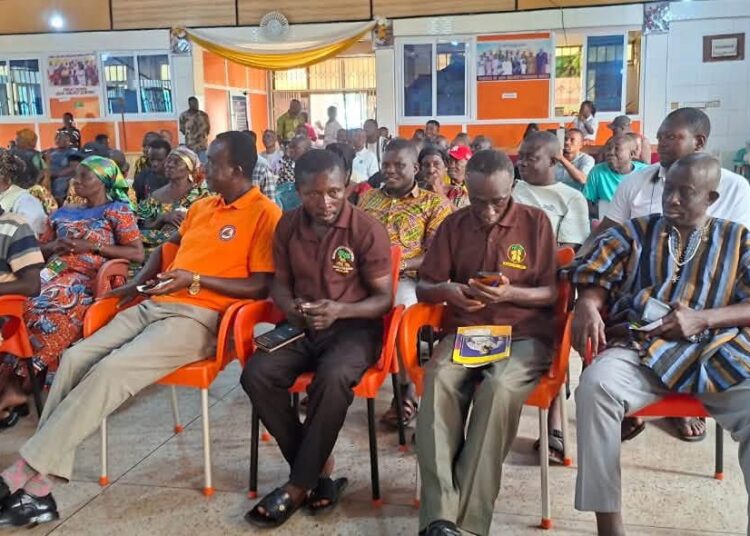
The Public Affairs Department, working in collaboration with the Cocoa Health and Extension Division (CHED), is leading the campaign, which provides farmers and other stakeholders with the opportunity to interact directly with COCOBOD officials and obtain clarification on the changes introduced under the new law.
The engagements also allow farmers to raise concerns about production, farm management, access to support programmes, cocoa marketing and other challenges affecting their livelihoods.
The timing of the campaign is significant because the 2026/27 season is the first cocoa season being implemented under the new legal framework, which introduces important reforms intended to reposition COCOBOD and create a more sustainable foundation for the industry.
One of the most significant provisions is the guarantee that Ghanaian cocoa farmers receive a minimum of 70 per cent of the realised Gross Free-on-Board (FOB) price of cocoa.
‘’For the 2026/27 season, Government has increased the producer price from GH¢41,392 per tonne in the previous season to GH¢42,400 per tonne, equivalent to GH¢2,650 for a 64-kilogram bag. COCOBOD says the new price represents 71.18 per cent of the realised Gross FOB value.’’
COCOBOD
COCOBOD New Law to Promote Stability
The new law also introduces measures intended to improve the long-term financial and institutional sustainability of COCOBOD, while strengthening protection for cocoa farms against illegal small-scale mining.
It further provides a new financing framework to support increased domestic value addition and prohibits COCOBOD from undertaking quasi-fiscal activities. These reforms form part of efforts to move the cocoa sector towards greater financial discipline while ensuring that more value is retained within Ghana’s economy.
The farmer engagements therefore go beyond explaining the provisions of the legislation. They are also being used to communicate the range of interventions available to farmers and to gather feedback from communities at the production end of the cocoa value chain.
COCOBOD continues to implement productivity enhancement programmes, including the provision of free fertiliser, free hybrid cocoa seedlings and the Cocoa Disease and Pest Control Programme.
The interventions are intended to reduce farmers’ production costs, improve farm productivity and strengthen the resilience of cocoa farms. The Board has increasingly placed direct farmer engagement at the centre of its reform strategy.
Earlier stakeholder engagements following Parliament’s passage of the new law brought together farmer groups, Licensed Buying Companies, cocoa processors, staff associations, civil society organisations and the media.
A Focus on Producer Pricing Mechanism
The discussions focused on the producer-pricing mechanism, sustainable financing, traceability, farm protection, farmer welfare and local value addition.
COCOBOD has also previously used farmer rallies and community-level engagements to explain the new legislation and give farmers the opportunity to question officials about its implications.
At a farmers’ rally at Konongo in August, participants from Juaben, Asiwa, Juaso and Konongo directly engaged COCOBOD officials on the new legislation. Farmers called for sustained education and consultation to ensure that producers understood the provisions and their implications for the sector.
The latest campaign builds on that approach by taking the conversation further into the major cocoa growing communities.
For farmers, the engagements are particularly important because the success of the reforms will ultimately depend on how effectively policy decisions translate into improved farm productivity, better incomes and stronger support services at the grassroots.
For COCOBOD, the exercise also provides an opportunity to address misinformation, clarify policy changes and obtain first-hand feedback on challenges affecting the implementation of its programmes.
The Board has previously indicated that stakeholder engagement remains essential to the implementation of the sector reforms, particularly as Ghana works to create a more financially sustainable cocoa industry.
Cocoa Reforms to Support Domestic Participation
The new financing and governance reforms are also expected to support greater domestic participation in cocoa processing and value addition. COCOBOD has said the new framework is intended to provide local processors with more reliable access to cocoa beans and create greater confidence for investment in processing capacity.
This is important for Ghana’s broader agribusiness ambitions because cocoa remains one of the country’s major agricultural commodities and a key source of income for farming communities and businesses operating across the value chain.
By taking the reforms directly to farmers, COCOBOD is seeking to close the information gap between national policy decisions and their implementation at farm level.
The engagement programme is expected to continue across all cocoa-growing regions in the coming days and weeks, bringing together farmers, opinion leaders and other stakeholders as the Board deepens communication on the new law and the measures being introduced to strengthen the industry.
The broader objective is to create a better-informed farming community capable of participating effectively in the transformation of Ghana’s cocoa sector.
As the 2026/27 season progresses, the effectiveness of the reforms will increasingly be measured not only by changes in policy and financing structures, but also by their impact on productivity, farmer incomes, farm sustainability and the competitiveness of Ghanaian cocoa.
COCOBOD’s continued engagement with farmers therefore represents an important component of the sector’s reform agenda, with the Board seeking to ensure that the producers at the heart of the cocoa economy understand the changes and have a direct voice in shaping the future of the industry.
READ ALSO:Ghana’s Debt Servicing Costs Threaten Fiscal Stability