The Eastern Nzema Traditional Authority has expressed deep concern regarding the scheduled return of mining firm Adamus Resources Limited, calling on the central government to maintain rigorous oversight over its 12-month roadmap designed to settle outstanding operational disputes and protect host community welfare.
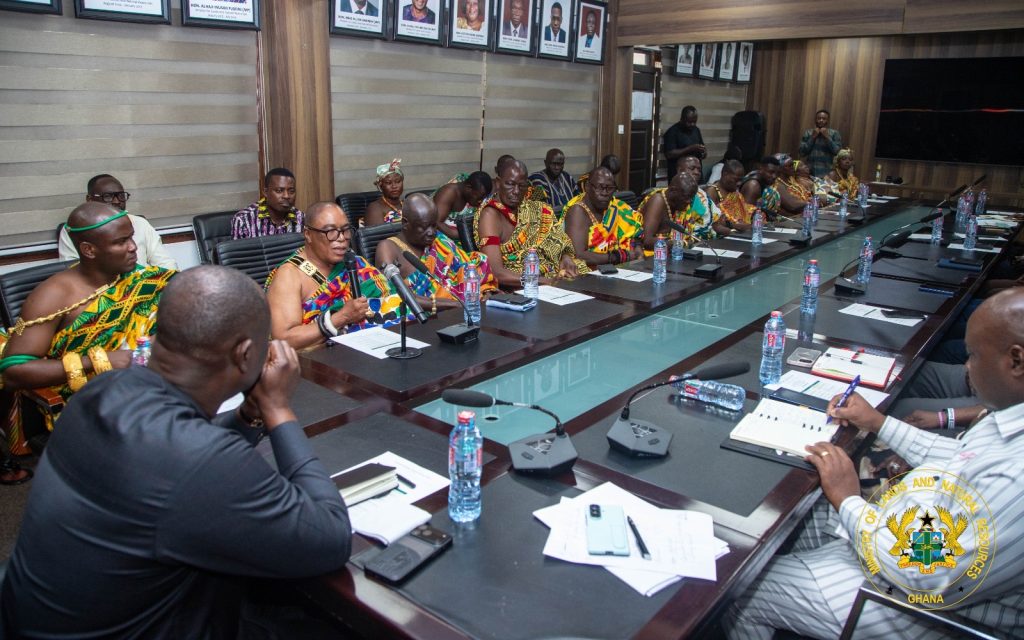
Leading a high-powered delegation of sub-chiefs and Queen Mothers to pay a courtesy visit to the Minister for Lands and Natural Resources, Hon. Emmanuel Armah-Kofi Buah, the Paramount Chief of the Eastern Nzema Traditional Area, Awulae Blay IX, emphasized that the revival of the mining company must prioritize local economic advancement.
The visit aimed to congratulate the Minister on his ministerial appointment, commend his ongoing leadership in promoting the culturally significant annual Nkrumafest, and formally pledge the traditional authority’s commitment to collaborative governance.
Awulae Blay IX noted that while host communities maintain reservations following past operational frictions, the government’s interim roadmap provides a structured framework to rectify historical disputes provided statutory regulators monitor the timeline with strict compliance.
“Awulae Blay IX said although the traditional authorities had concerns about the return of Adamus Resources, they expected the government’s decision to provide a pathway for resolving the challenges surrounding the company to be carefully monitored. He stressed that the 12-month roadmap must achieve its intended purpose and ultimately translate into jobs, sustainable livelihoods and better investment opportunities for the people of Nzema.”
Ministry of Lands and Natural Resources
As an extractive sector analyst, evaluating this initiative highlights the critical need for systemic reform in resource governance across Ghana’s coastal mining belts.
Host communities in Western Ghana have historically borne the environmental and social costs of gold extraction without deriving commensurate socio-economic development, leading to recurring industrial friction and regulatory interventions.
The 12-month roadmap serves as an essential regulatory intervention to enforce corporate responsibility, stabilize host community relations, and reconstruct balance sheets before full operational resumption.
Without transparent oversight and community inclusion, commercial revivals risk exacerbating local disenfranchisement, underscoring why traditional custody must align with statutory natural resource management.
Socio-Economic Alignment and Accountability Frameworks
Expanding on the operational framework, traditional leaders highlighted that the company’s return must not reproduce legacy economic disparities, demanding concrete deliverables for local manpower and supply chains.
Awulae Blay IX asserted that the interim framework “must achieve its intended purpose and ultimately translate into jobs, sustainable livelihoods and better investment opportunities for the people of Nzema,” emphasizing that host communities require binding commitments rather than speculative declarations.

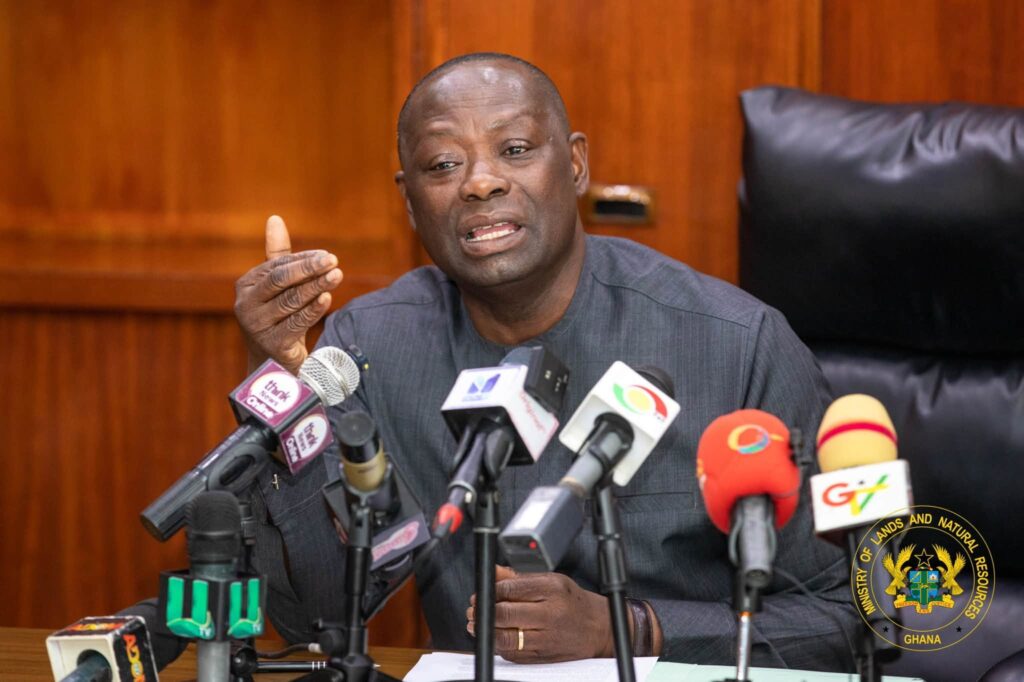
Responding to the delegation’s operational requirements, Hon. Emmanuel Armah-Kofi Buah assured the traditional authorities that regulatory enforcement during the roadmap period will directly address legacy operational shortfalls.
The Minister explained that Adamus Resources would be strictly required to clear its outstanding liabilities while actively exploring avenues for fresh capital injection, including bringing in strategic equity partners to stabilize operations.
Furthermore, government promised continuous stakeholder engagement, ensuring traditional authorities remain active participants in monitoring corporate compliance.
Energy Infrastructure Recognition and Cultural Ownership
Beyond mining operations, the Eastern Nzema Traditional Authority called for broader institutional acknowledgment regarding the enclave’s pivotal contributions to national energy security.
Pointing to major industrial installations hosted within their traditional boundaries, the delegation advocated for policy adjustments that align public asset branding with local geographical identity, asserting that regional development must mirror the area’s massive resource output.

To solidify regional identity and community pride, Awulae Blay IX formally proposed renaming the national gas processing infrastructure from Ghana Gas to “Atuabo Gas.”
The Paramount Chief explained that “renaming would strengthen the sense of ownership of the facility among the people of Atuabo and surrounding communities,” bridging national infrastructural assets with grassroots traditional stewardship.
Institutional Commitments to Regional Development
Reaffirming state backing for the district, Minister Armah-Kofi Buah assured the chiefs that government strategies aim to position Adamus Resources to operate on a financially and environmentally sustainable trajectory.
He reiterated that structural reforms within the extractive asset would go hand-in-hand with state-led infrastructural expansion across the Western Region.
The Minister pledged that the ministry will work alongside statutory mining agencies to guarantee that corporate restructuring directly benefits local workers and contractors.
Concluding the dialogue, Hon. Armah-Kofi Buah assured the delegation that government remains steadfast in addressing Nzema’s broader socio-economic priorities, pledging targeted investments in road networks and critical social infrastructure to foster lasting regional growth.
READ ALSO: CSA: Ghana Led Operation Blackout, Not FBI