
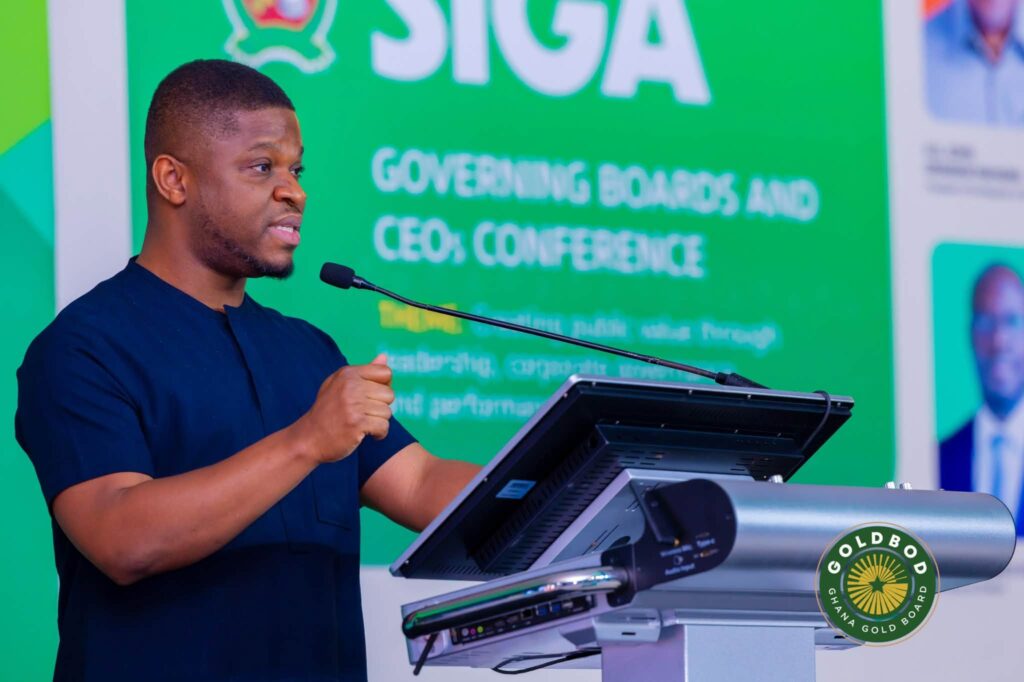
The Chief Executive Officer of the Ghana Gold Board (GoldBod), Sammy Gyamfi, Esq., speaking at the Accra edition of the Loveworld Trade and Investment Forum at the University of Professional Studies, Accra, has challenged African youth to lead the continent’s economic transformation.
Highlighting the critical need to transition away from structural dependencies on foreign assistance, he stressed that young innovators must spearhead local wealth creation to secure sustained industrial resilience.
He emphasized that the time for tangible action across domestic markets is immediately at hand, urging a collective focus on production, entrepreneurship, and value creation over reliance on imports.
“He said GoldBod has given Ghana greater control over its gold, replacing smuggling and informal exports with a formal, compliant system. He encouraged young people to explore the formal gold trade, which does not require large capital, and noted that GoldBod’s offices are open to guide them.”
Ghana Gold Board (GoldBod)

Expanding on this mandate, he explained that Gold Board has successfully institutionalized comprehensive governance structures across the domestic supply chain to give Ghana greater control over its gold resources, effectively replacing illicit smuggling and informal exports with a formal, compliant system.
This legal restructuring provides accessible entry pathways for ambitious citizens, ensuring that mineral equity actively yields shared prosperity across local communities.
He encouraged young people to explore the formal gold trade, which does not require large capital, and noted that GoldBod’s offices are open to guide them.
Frameworks for Formalization and Economic Sovereignty
Historically, West Africa’s artisanal and small-scale mining (ASM) sectors have been plagued by fragmented market frameworks, porous supply routes, and significant capital flight.
Unofficial channels routinely siphoned precious minerals out of national borders, stripping governments of essential tax revenue and depriving local entrepreneurs of fair pricing mechanisms.
By establishing GoldBod as an overarching regulatory and commercial authority, Ghana has effectively curbed illicit financial flows and instituted standardized pricing models.

This regulatory paradigm ensures that gold produced within domestic borders contributes directly to national reserves and currency stabilization, turning a traditionally volatile commodity into a predictable pillar of macroeconomic health.
Furthermore, formalizing the gold value chain creates a transparent ecosystem where small-scale operators receive verified market valuations.
Under this structured setup, the administrative bottlenecks that once restricted market participation to foreign cartels or well-capitalized conglomerates are dismantled.
By offering comprehensive compliance support and real-time market data, GoldBod bridges the historic divide between small-scale operators and institutional international markets, transforming precious metals trading into an inclusive engine of broader domestic development.
Unlocking Youth Entrepreneurship Without Heavy Capital Constraints
A core pillar of this policy direction is the deliberate lowering of barrier entries for young entrepreneurs entering the extractive management ecosystem.
Traditionally, high capital investment requirements, expensive machinery, and opaque licensing procedures deterred young professionals from venturing into resource trading.
GoldBod’s modernized trading framework shifts the emphasis from heavy capital ownership to structured intermediary trading, aggregations, logistics, and compliance support services.
Youth participants can now function as certified aggregators, assaying agents, and licensed trade facilitators without bearing the prohibitive financial burdens of large-scale mineral extraction operations.
By establishing accessible district desks and direct advisory hubs across the country, the board offers step-by-step guidance on licensing, regulatory adherence, and mineral tracking.
This structural shift allows young graduates and business owners to channel their technical skills into supply chain logistics, trade finance, digital traceability, and gold brokerage.
Consequently, youth participation is transformed from an abstract theoretical goal into an immediate, viable career pathway that drives genuine domestic wealth creation.
Industrializing Resources to Drive Value-Addition and Industrial Growth
Beyond trading logistics, GoldBod’s policy vision fundamentally shifts Ghana’s extractive posture from raw raw-material exporter to localized value-addition powerhouse.
For decades, foreign refineries reaped the primary economic benefits of processing African minerals, leaving host nations vulnerable to raw commodity price volatility.
Under the current strategic direction, domestic refining capacity, assaying technology, and jewel manufacturing are prioritized, keeping a substantial portion of the resource value chain within the national economy.

This approach serves as a protective buffer against global macroeconomic shocks while stimulating auxiliary service industries.
Ultimately, integrating value addition into youth entrepreneurship guarantees long-term industrialization across the extractives sector.
As young professionals enter gold trading and processing, auxiliary industries such as specialized legal services, mineral insurance, eco-friendly refining technologies, and export logistics naturally expand around them.
This comprehensive ecosystem approach ensures that Ghana’s gold reserves build lasting domestic infrastructure, enhance national balance sheets, and cement the country’s status as a self-reliant global leader in gold trading.
READ ALSO: Black Stars Coach Search Deadline Extended