Ghana’s ambition to sustain economic growth and accelerate development could face a major setback if the country fails to address persistent weaknesses in domestic revenue mobilisation, the Institute of Statistical, Social and Economic Research (ISSER) has warned.
The institute says Ghana’s revenue generation remains below the sub-Saharan African average, creating a financing constraint that could limit the government’s ability to fund infrastructure, create jobs and support economic diversification.
The warning raises fresh concerns about the sustainability of Ghana’s economic recovery, particularly as policymakers seek to build on the gains recorded in 2025 while meeting growing public expenditure demands.
At the launch of ISSER’s State of the Ghanaian Economy Report 2025, the institute highlighted the need for Ghana to strengthen its revenue collection systems and rethink its spending priorities to secure the resources required for its next phase of economic transformation.
The concern is that stronger economic growth alone may not translate into sufficient government revenue to finance development if the country fails to improve its capacity to collect taxes.
Ghana’s Tax Revenue Falls Short of Regional Benchmark
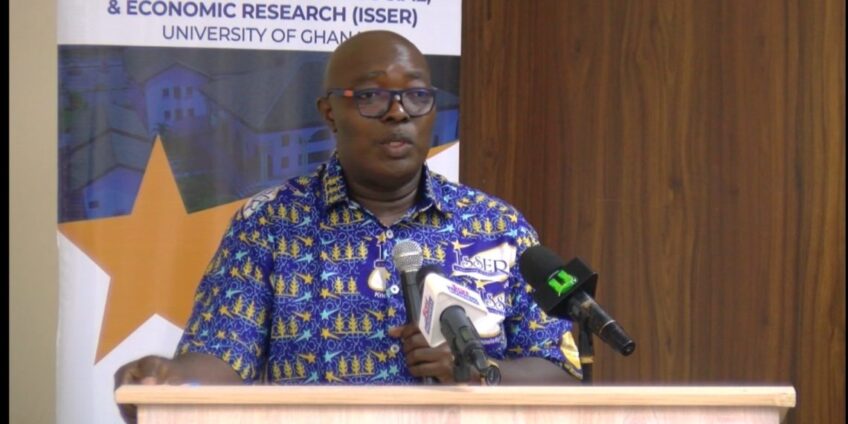
Presenting the report, ISSER Director Professor Robert Darko Osei disclosed that Ghana’s tax revenue stood at about 30% of gross domestic product (GDP) in 2025, a level he said was significantly lower than the sub-Saharan African average.
The shortfall presents a major challenge for a country seeking to expand public investment while maintaining fiscal discipline after years of economic difficulties.
“Our revenue effort is a bit low. In fact, tax revenue is under 30% in 2025, was about 30% of GDP, and that was significantly lower than that which pertains in sub-Saharan Africa,” Professor Osei said at the launch.
The observation highlights a fundamental weakness in Ghana’s fiscal position. Although the economy has shown signs of recovery, the government still needs sufficient and reliable revenue to finance public services, infrastructure projects and employment-generating initiatives.
When revenue mobilisation falls short of expenditure requirements, authorities face difficult choices. They may have to reduce spending, postpone development projects or rely on additional borrowing, potentially complicating efforts to maintain long-term fiscal stability.
ISSER’s assessment suggests that Ghana must confront this challenge if the country is to turn economic recovery into tangible improvements in living standards.
ISSER Pushes for Wider Tax Net Instead of Higher Burdens
Rather than placing additional pressure on individuals and businesses already paying taxes, Professor Osei believes Ghana should focus on bringing more economic activities and eligible taxpayers into the tax system.
This approach could help the government increase revenue without disproportionately increasing the burden on compliant taxpayers. “What it then points to is the need for bringing more into the tax net as it were, so that the revenue effort can be improved,” he said.
Broadening the tax base would require stronger compliance, more effective enforcement and improved identification of taxable economic activities. It would also involve addressing weaknesses that allow eligible individuals and businesses to remain outside the formal tax system.
For Ghana, the challenge is to ensure that revenue mobilisation improves alongside economic expansion. A growing economy can create opportunities to collect more taxes, but those opportunities may be lost if the tax system fails to capture a sufficiently broad share of economic activity.
The strategy also matters for businesses operating within the formal economy. Expanding compliance could help create a fairer system in which the responsibility for financing public services is shared more broadly rather than concentrated among existing taxpayers.
Economic Rebasing Could Complicate Revenue Targets
ISSER has also raised concerns about Ghana’s planned economic rebasing, warning that the exercise could reduce the country’s tax-to-GDP ratio if revenue collection does not grow alongside the economy.
Economic rebasing updates the base year and statistical structure used to calculate national accounts, potentially providing a more accurate picture of the size and composition of economic activity.
However, an increase in measured GDP does not automatically generate additional tax revenue. If the recorded size of the economy rises while tax collections remain relatively unchanged, the tax-to-GDP ratio could decline.
Such a development could make Ghana’s revenue performance appear weaker relative to the size of its economy and underscore the importance of improving tax collection as economic activity expands.
The implication is that Ghana cannot rely on economic growth or statistical revisions alone to strengthen its fiscal position. Revenue authorities must ensure that the expanding economy translates into actual collections that support government programmes.
Spending Cuts Drove Fiscal Improvement in 2025
Another significant finding from ISSER’s assessment is that Ghana’s improved fiscal position in 2025 was driven largely by expenditure reductions rather than a substantial increase in domestic revenue or grants.
According to Professor Osei, revenue and grants remained broadly unchanged relative to GDP, suggesting that spending restraint accounted for much of the improvement.
While controlling expenditure can help restore fiscal stability, relying heavily on spending cuts may become difficult to sustain when infrastructure requirements, social interventions and employment priorities continue to grow.
The government therefore faces a delicate balancing act. It must preserve fiscal discipline while ensuring that essential development programmes receive adequate funding.
ISSER’s call to reconsider expenditure priorities suggests that spending efficiency must accompany stronger revenue mobilisation. Improving how public funds are allocated could help direct limited resources towards projects with greater economic and social returns.
The institute also noted that Ghana’s average tariff rates are higher than those of neighbouring countries, reinforcing the need to broaden domestic taxation rather than depend excessively on existing revenue sources.
Ghana’s Growth Ambitions Face a Critical Test
Ghana’s ability to sustain its recovery will depend partly on whether the government can build a more resilient domestic revenue base without undermining private sector activity.
The stakes extend beyond meeting annual budget targets. Reliable revenue is essential for financing roads, supporting public services, expanding economic opportunities and reducing dependence on borrowing.
If domestic revenue fails to keep pace with economic expansion and spending requirements, the government could struggle to convert improved macroeconomic conditions into sustained development gains.
ISSER’s warning therefore places revenue mobilisation at the centre of Ghana’s growth agenda. Expanding the tax base, improving compliance and prioritising expenditure will be critical to creating the fiscal room needed to support the country’s development ambitions.
The challenge ahead is to move beyond restoring economic stability and establish a revenue system capable of financing long-term growth. Without that shift, Ghana could find that its economic progress is not matched by the public resources needed to sustain it.