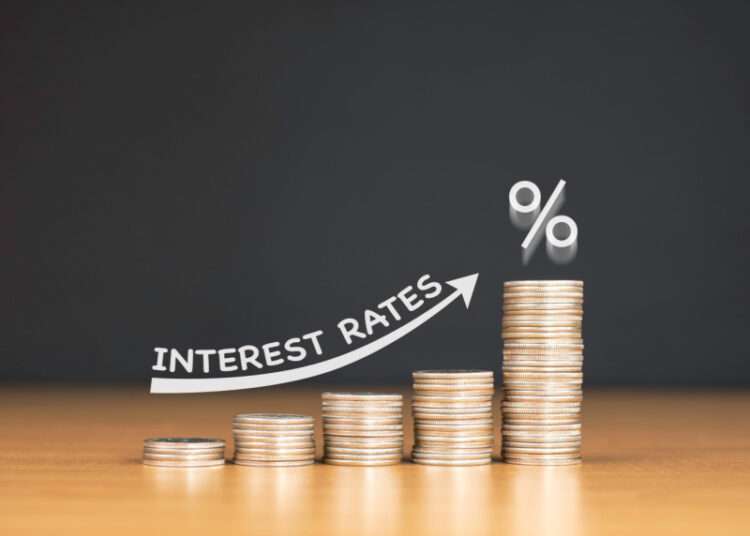
Ghana’s interest rate environment has undergone a significant shift over the past year, with borrowing costs falling sharply across several segments of the financial market as inflationary pressures ease and monetary policy becomes more accommodative.
Data from the Bank of Ghana (BoG) show that interest rates on government Treasury bills and bank lending declined considerably in August 2026 compared with the same period in 2025. However, the decline has not been uniform across the market, as yields on medium- and long-term government bonds remained broadly unchanged.
The developments reflect the changing dynamics of Ghana’s monetary policy, where lower inflation and improving macroeconomic conditions have created room for reduced interest rates, while limited trading activity continues to constrain movements in longer-dated government securities.
The central bank’s latest assessment highlights the extent to which monetary easing has influenced short-term borrowing costs, even as the longer end of the bond market remains relatively stable.
BoG’s Policy Rate Drops From 25% to 14%
One of the most significant developments has been the reduction in the Monetary Policy Rate from 25.0% in August 2025 to 14.0% in August 2026.
The 11-percentage-point decline reflects the cumulative monetary easing undertaken by the Bank of Ghana following a sustained moderation in inflation and improvements in the country’s macroeconomic fundamentals.
The reduction represents a major shift from the tighter monetary conditions that previously characterised the economy, when elevated inflation required restrictive policy measures to contain price pressures.
As inflationary pressures moderated, the central bank gained greater flexibility to lower its policy rate, with the adjustment gradually influencing other interest rates across the financial system.
According to the Bank of Ghana, interest rate developments in August 2026 continued to reflect the more expansionary monetary policy environment established during the second half of 2025.
The policy shift is particularly important because the Monetary Policy Rate serves as a key reference point for interest rate decisions across the financial sector.
However, the extent to which lower policy rates translate into cheaper credit depends on how banks and other market participants respond to changing economic conditions.
Interbank Rate Declines as Monetary Easing Spreads
The impact of the central bank’s policy adjustments has also become visible in the interbank market, where financial institutions lend to one another.
The Interbank Weighted Average Rate (IWAR) declined to 10.2% in August 2026 from 23.3% in August 2025, representing a substantial reduction in the cost of short-term funds.
This downward movement reinforces the easing of monetary conditions and suggests that the decline in the policy rate has been accompanied by lower interest rates in the interbank market.
A reduction in interbank rates can influence the broader financial system by lowering the cost at which banks obtain short-term liquidity.
The development is therefore an important indicator of how monetary policy changes are transmitted beyond the central bank’s benchmark rate.
Nevertheless, cheaper interbank funding does not automatically guarantee that households and businesses will obtain loans at equally lower rates. Banks must also consider credit risks, operating expenses, borrower repayment capacity and other funding costs when setting lending rates.
Bank Lending Rates Fall to 15.9%
Businesses and individuals seeking credit have also seen a notable reduction in average bank lending rates.
The Bank of Ghana reported that the average lending rate declined to 15.9% in August 2026 from 24.2% a year earlier.
The reduction points to a pass-through effect from the decline in the policy rate to lending conditions within the banking sector.
Lower lending rates can potentially ease financing pressures on businesses that depend on bank credit to fund operations, purchase equipment, expand production and pursue new investment opportunities.
Households may also benefit from reduced borrowing costs, although the actual interest rate offered to each borrower will depend on individual credit assessments and the terms of the loan.
For Ghanaian businesses that have faced expensive financing in previous years, the decline could provide some relief and improve the viability of investments that were previously considered too costly.
However, the real economic benefits will depend on whether banks continue to adjust their lending rates and whether credit becomes more accessible to businesses, particularly small and medium-sized enterprises.
Treasury Bill Rates Record Sharp Declines
The Treasury bill market recorded some of the most striking movements in the interest rate environment.
According to the Bank of Ghana, the 91-day Treasury bill rate declined to 5.4% in August 2026 from 10.3% in August 2025.
The 182-day bill rate also dropped to 7.3% from 12.3%, while the 364-day rate fell to 12.2% from 13.1% over the same period.
The sharp decline in shorter-dated Treasury bill rates reflects changing investor expectations and developments in the domestic money market.
The central bank attributed the movement to sustained investor demand at the short end of the yield curve, improved inflation expectations and ongoing government efforts to reduce domestic financing costs.
Lower Treasury bill yields can help the government reduce the cost of borrowing through short-term domestic instruments, potentially easing pressure on public finances.
However, the same development creates a different environment for investors who rely on Treasury bills for relatively predictable returns.
As yields decline, investors may need to reassess their investment strategies and compare available returns across government securities, bank deposits and other financial instruments.
Long-Term Government Bond Yields Refuse to Budge
Despite the sharp decline in short-term interest rates, medium- and long-term government securities have not experienced a comparable adjustment.
The Bank of Ghana reported that rates on two-year, three-year, five-year, six-year, seven-year, 10-year, 15-year and 20-year government bonds remained broadly unchanged.
The central bank attributed the stability to limited activity in that segment of the market.
This divergence highlights an important feature of Ghana’s current interest rate environment. While short-term rates have responded strongly to monetary easing and investor demand, longer-term yields have remained relatively stable.
Long-term government bond yields are influenced by several factors, including expectations about future inflation, fiscal conditions, government borrowing requirements and investors’ assessment of the risks associated with holding securities over extended periods.
Consequently, a reduction in the policy rate does not necessarily produce an immediate or proportional decline in long-term borrowing costs.
The limited activity reported in the longer-dated segment also suggests that market conditions may not yet be generating sufficient trading momentum to produce significant yield adjustments.
Positive Real Interest Rates Offer Another Signal
Despite falling nominal interest rates, the Bank of Ghana noted that real interest rates remained broadly positive during the period under review.
Real interest rates account for the effect of inflation on nominal returns. They therefore provide a better indication of the purchasing power investors may retain from interest earnings.
According to the central bank, real rates remained positive because inflation declined at a faster pace than nominal interest rates.
This development is significant because it suggests that the reduction in nominal yields has not necessarily translated into negative inflation-adjusted returns.
Nevertheless, the benefits differ across investment products, and actual returns depend on the prevailing interest rate, inflation expectations, taxes and other investment-related costs.
Ghana’s latest interest rate developments therefore present a mixed picture. Monetary easing has reduced borrowing costs across several key segments of the market, while lower Treasury bill yields have changed the return environment for investors.
Yet the stability of long-term bond yields shows that the transmission of monetary policy remains uneven.
Whether the decline in short-term rates eventually extends more decisively into the longer-dated bond market will depend on future inflation trends, investor demand, fiscal developments and trading activity.
READ ALSO: Ghana’s $13.8bn Trade Surplus Raises Fresh Economic Concerns