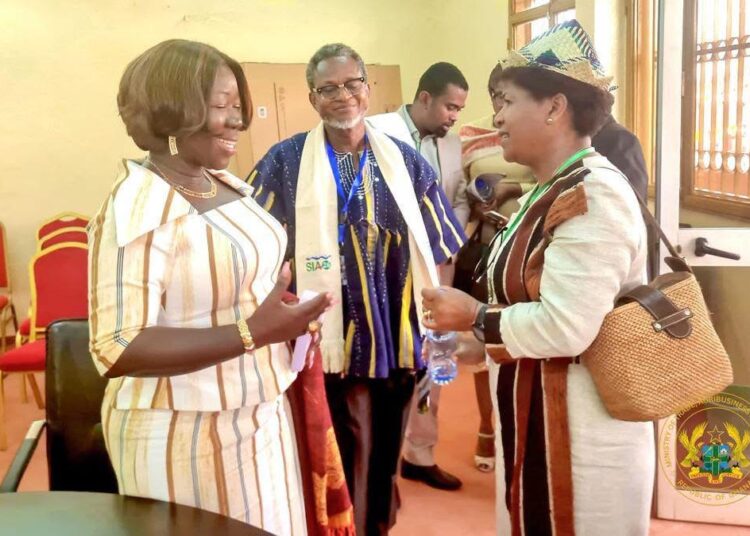
Ghana and Madagascar are exploring opportunities to strengthen bilateral cooperation in the handicrafts industry, with discussions focusing on cultural exchange, artisan development and expanded access to international markets ahead of the 4th International Handicrafts Fair scheduled for June 2027 in Madagascar.
The engagement forms part of efforts by the two countries to position their traditional craft industries as viable economic sectors capable of supporting entrepreneurship, generating employment and increasing the commercial value of locally produced goods.
The discussions were held between Ghana’s Minister for Trade, Agribusiness and Industry, Hon. Elizabeth Ofosu-Adjare, and the Director-General of Madagascar’s National Artisans Centre, Madam Ralaly Fabienne, on the sidelines of the 18th International Arts and Crafts Fair of Ouagadougou (SIAO 2026) in Burkina Faso.
The meeting provided an opportunity for both countries to explore areas of mutual interest in the development of their handicraft industries, particularly through international exhibitions, business partnerships and the exchange of expertise.
“We are determined to transmit authentic skills while creating sustainable economic opportunities for artisans and communities.”
Minister for Trade, Hon. Elizabeth Ofosu-Adjare
International Fair Opens New Market Opportunities
The planned participation of Ghana in the 4th International Handicrafts Fair in June 2027 presents an opportunity to connect Ghanaian artisans with international buyers, distributors, investors and other players in the creative economy.
International handicraft exhibitions serve as commercial platforms where producers can display their products, establish business relationships, study consumer preferences and identify potential export destinations.
For Ghana, participation in the Madagascar fair could provide an additional avenue to promote its diverse traditional and contemporary craft products beyond established regional markets.
The country’s handicrafts industry includes kente textiles, Adinkra fabrics, Bolgatanga baskets, beads, leather products, pottery, wood carvings and other culturally distinctive products.
Data from the Ghana Export Promotion Authority’s 2024 Non-Traditional Export Statistics indicate that the Industrial Arts and Crafts subsector recorded a 23 per cent increase in export earnings in 2024, contributing approximately three per cent to total non-traditional exports, compared with 2.43 per cent in 2023.
The performance was supported by strong growth in selected product categories, including kente, handicrafts and bamboo and cane furniture.
Kente products recorded a 523 per cent increase, while handicraft items and bamboo and cane furniture registered growth of 440 per cent and 274 per cent respectively.
Ghana’s Industrial Arts and Crafts subsector increased its contribution to non-traditional exports from 2.43 per cent in 2023 to approximately 3 per cent in 2024.
The opportunity to participate in Madagascar’s 2027 exhibition could therefore complement Ghana’s efforts to sustain export growth by exposing local producers to new markets and commercial networks.
However, converting exhibition participation into lasting economic benefits will require follow up arrangements, including buyer engagement, distribution partnerships, product standardisation and access to export financing.
Cultural Exchange and Artisan Development
Beyond trade promotion, the engagement highlights the importance of cultural exchange in strengthening cooperation between African countries.
Ghana and Madagascar possess distinct handicraft traditions shaped by their histories, indigenous knowledge, natural resources and cultural identities.
Ghana’s craft industry is recognised for its textiles, weaving, basketry, bead making, pottery and wood carving, while Madagascar’s artisans work extensively with natural materials, including wood, stones, bamboo and plant fibres.
According to Madagascar’s National Centre for Artisans, its handicraft industry encompasses activities such as basket weaving, wood sculpture, jewellery production and textile design.
The institution also identifies artisan training, product promotion and the development of domestic and international customer relationships as important areas of its work.
Such similarities provide opportunities for both countries to exchange production techniques, improve product designs and strengthen the capacity of artisans to respond to changing market demands.
Minister for Trade, Hon. Elizabeth Ofosu-Adjare
“The Malagasy handicraft industry uses local resources such as wood, stones, bamboo and plant fibres to create products that reflect the country’s cultural identity.”
The proposed cooperation could also encourage interactions between artisan associations, creative institutions, design schools and other organisations involved in developing traditional industries.
Also, skills exchange and technical collaboration can support improvements in product finishing, quality control, packaging, branding and production methods.
These areas are particularly important for small-scale producers seeking to transition from informal production activities into commercially structured enterprises.
Strengthening Africa’s Creative Economy
The Ghana-Madagascar engagement comes at a time when African countries are increasingly exploring ways to connect cultural industries with trade, industrialisation and regional economic development.
The 18th edition of SIAO 2026, where the meeting took place, is itself being organised around the theme of African handicrafts and industrialisation.
The exhibition, scheduled for October 30 to November 8, 2026, in Ouagadougou, brings together artisans, buyers, institutions and other stakeholders to examine how traditional production can be developed into more competitive commercial activities.
Its focus reflects a wider recognition that Africa’s handicraft industries require stronger production systems, investment, technical support and access to international markets.
“African handicrafts and industrialisation,’’ she stated.
For Ghana and Madagascar, cooperation in this area could contribute to building stronger connections between cultural preservation and economic development.
The African Continental Free Trade Area (AfCFTA) also provides a broader framework for expanding trade in African-made products by improving access to the continent’s single market, subject to applicable rules of origin, standards and trade procedures.
The June 2027 exhibition therefore represents an opportunity for Ghana to strengthen its engagement with Madagascar while introducing its artisans and creative enterprises to a wider international audience.
READ ALSO:Ato Forson Moves to Lock Ghana’s Economic Recovery into Law