
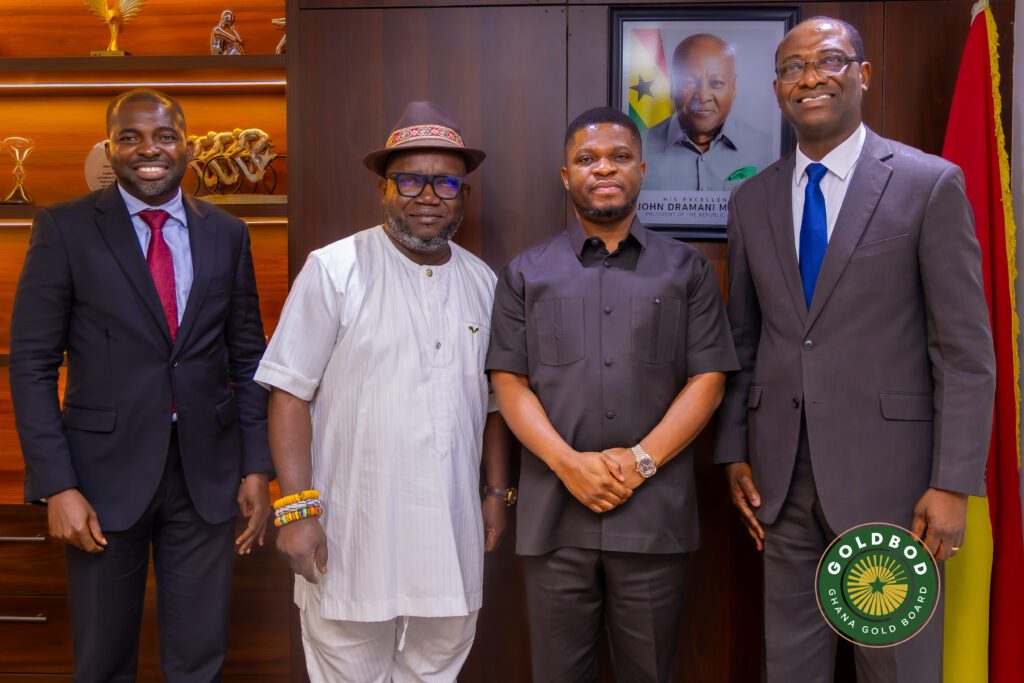
The Chief Executive Officer of the Ghana Gold Board (GoldBod), Sammy Gyamfi, Esq. has hosted Indian High Commissioner to Ghana, H.E. Shri Surinder Bhagath to explore bilateral cooperation across gold trading, refining, value addition, and strategic investments.
This high-level engagement reflects how GoldBod is proactively driving new operational frameworks to secure maximum domestic economic retentions from mineral exports.
“The engagements have covered areas including gold purchasing and pricing, licensing, anti-smuggling measures, mineral traceability, responsible sourcing, local refining and value addition. Ghana’s experience has also been discussed as a possible reference for countries seeking to strengthen governance and maximise economic benefits from their mineral resources.”
Ghana Gold Board (GoldBod)
The visit provided a pivotal platform to advance broader economic relations between Accra and New Delhi, focusing on concrete investment opportunities within Ghana’s rapidly evolving gold ecosystem.

With GoldBod established under the Ghana Gold Board Act, 2025 (Act 1140), its centralized oversight and modern regulatory mandate have systematically drawn global curiosity.
International financial authorities and sovereign partners are evaluating Ghana’s institutional blueprint for formalizing artisanal small-scale mining while capturing downstream industrial value.
Global Diplomatic Attention Surges Around Ghana’s Extractive Reforms
Ghana’s operational experience is increasingly referenced as a gold-standard regulatory model across developing mineral-rich nations seeking to end illicit resource flight.
Bilateral inquiries from peer African economies such as Guinea, Malawi, Rwanda, Namibia, and Zambia as well as Western markets like the United States, underscore GoldBod’s emergence as a center of policy excellence.
Foreign representatives are prioritizing structured technical exchanges to study how GoldBod enforces responsible mineral traceability, deters cross-border smuggling, and implements transparent licensing mechanisms.

Through structured discussions surrounding centralized purchasing protocols and dynamic assay pricing, GoldBod has demonstrated that sovereign mineral governance can coexist with market efficiency.
By building institutional capacity around ethical sourcing, Ghana provides a viable blueprint for resource-rich nations intent on converting underground deposits into tangible fiscal revenue and foreign exchange stability.
Industrial Capacity and Technical Synergy with India
India’s structured interest represents a major strategic milestone for GoldBod’s industrial expansion goals.
As one of the world’s premier consumers and fabricators of gold products, India possesses extensive industrial capacity, bullion refining infrastructure, and technical expertise.
Collaborating directly with Indian refiners and trade bodies enables Ghana to bridge existing infrastructure gaps within its local value chain.
Rather than remaining solely a raw unrefined bullion exporter, Ghana’s partnership with India focuses heavily on domestic processing, assaying accuracy, and local capacity development.
Transferring technical know-how into Ghana’s domestic refining landscape ensures that raw gold is converted into high-purity commercial bars and jewelry locally, yielding significantly higher profit margins before export shipment.
Comprehensive Research: Analyzing the Imperative for Gold Sector Reforms
Historically, sub-Saharan Africa’s gold extraction landscape has suffered from extreme value leaks, pervasive informal smuggling routes, and unrefined raw exports that deprive host nations of full macroeconomic benefits.
Small-scale artisanal mining, while supporting millions of livelihoods, frequently operated outside formal banking channels, exposing miners to predatory pricing and encouraging illicit cross-border mineral flows.
Furthermore, relying entirely on raw dore exports left domestic economies exposed to external commodity price volatility while missing out on valuable refining, assaying, and manufacturing revenues.

The enactment of the Ghana Gold Board Act, 2025 (Act 1140), directly addresses these structural vulnerabilities by centralizing regulatory authority and legal trade channels under GoldBod.
Establishing standard purchasing frameworks, strict anti-smuggling controls, and mandatory traceability certifications ensures that artisanal production flows seamlessly into formal fiscal channels.
Crucially, by making local refining and downstream value addition a statutory requirement rather than an afterthought, GoldBod guarantees higher foreign exchange retention, creates skilled local employment, and ensures mineral extraction directly propels sustainable national development.
READ ALSO: Partey, Kudus Return as Björkegren Names Ghana Squad