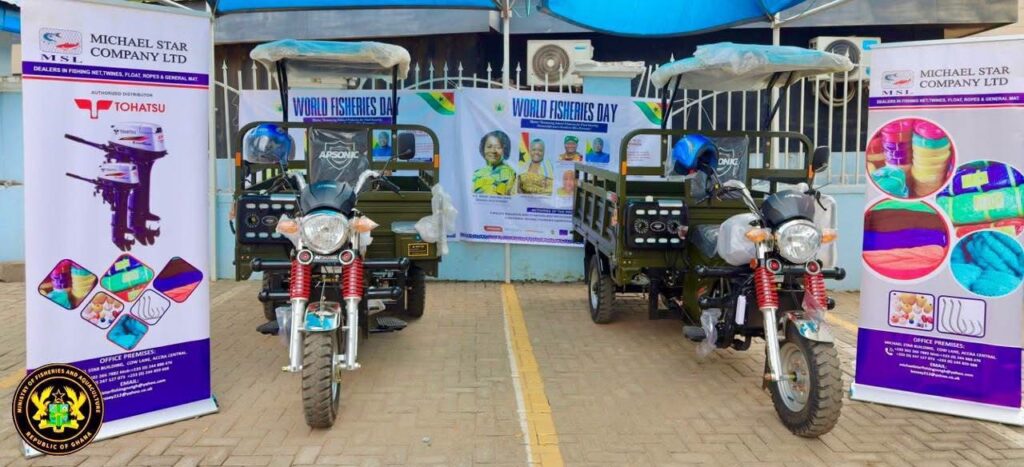
Michael Star Company Ltd has donated two tricycles and cash support to the Ministry of Fisheries and Aquaculture to facilitate preparations towards the 2026 celebration of World Fisheries Day, reinforcing private-sector participation in initiatives aimed at advancing Ghana’s fisheries and aquaculture industry.
The donation, presented ahead of the national celebration scheduled for November 19 to 21, 2026, is expected to support the Ministry’s logistical and organisational arrangements for the three-day event, which will bring together stakeholders across the fisheries value chain.
Mr Eric Ofori Doku, International Relations Officer of Michael Star Company Ltd, presented the items to the Ministry’s Chief Director, Dr Afisah Zakariah, who received them on behalf of the Minister for Fisheries and Aquaculture, Hon. Emelia Arthur.
“The donation comprises two tricycles and cash support towards the successful organisation of World Fisheries Day 2026, scheduled for November 19–21.”
Michael Star Company Ltd.
Private Sector Strengthens Fisheries Partnership
The contribution by Michael Star Company Ltd highlights the importance of collaboration between government institutions and private enterprises in supporting sector-wide development programmes.
The provision of two tricycles is particularly relevant to operational logistics, potentially supporting the movement of materials and other essential items during preparations and activities associated with the celebration.
Although the Ministry has not disclosed the financial value of the donation or the specific allocation of the cash support, the contribution provides additional resources towards the organisation of the event.
The National Fisheries and Aquaculture Policy identifies the sector as an important contributor to employment, wealth creation, food and nutrition security, and the supply of raw materials to fish-processing industries.
Fisheries Sector Faces Production Challenges
The donation also comes against the background of increasing national attention on the need to strengthen domestic fish production and ensure the sustainable utilisation of aquatic resources.
Fish remains a major source of animal protein for Ghanaians, making the performance of the sector particularly important to household nutrition, food security and the broader agricultural economy.
According to the National Development Planning Commission’s 2024 Annual Progress Report, fish contributed approximately 60 per cent of Ghana’s animal protein intake, while annual per capita consumption stood at about 20 kilogrammes.
However, the country continues to face challenges in meeting domestic demand through local production.
“Ghana spent approximately GH¢1.26 billion on frozen fish imports in 2024, highlighting the continuing gap between domestic supply and consumption.”
Ministry for Fisheries and Aquaculture
The report further indicated that Ghana imported approximately 78,550 metric tonnes of fish in 2024, compared with about 84,828 metric tonnes in 2023.
Although the reduction suggests progress in domestic supply, the figures underline the need for sustained investment in fisheries management and aquaculture development. Production figures also reveal differences in the performance of the various subsectors.
Marine fish production increased from approximately 425,361 metric tonnes in 2023 to 442,361 metric tonnes in 2024. However, inland fisheries production declined from 147,583 metric tonnes to approximately 131,552 metric tonnes over the same period.
Aquaculture production recorded a modest increase, rising from approximately 116,108 metric tonnes in 2023 to 121,809 metric tonnes in 2024, although it remained below the national target of 145,500 metric tonnes.
“Marine fisheries produced approximately 442,361 metric tonnes in 2024, while aquaculture contributed 121,809 metric tonnes, according to the NDPC’s 2024 Annual Progress Report.”
Ministry for Fisheries and Aquaculture
World Fisheries Day Offers Industry Platform
The upcoming World Fisheries Day celebration provides an opportunity to bring these challenges and opportunities into broader national discussions.
Observed internationally on November 21, World Fisheries Day draws attention to the importance of fisheries communities, sustainable fishing practices, aquatic ecosystems and the livelihoods supported by the industry.
Ghana’s three-day celebration, scheduled for November 19 to 21, is expected to provide a platform for stakeholders to reflect on the sector’s performance, exchange knowledge and strengthen collaboration towards its development.
Discussions around responsible fishing, effective fisheries regulation, aquaculture investment, post-harvest management and value addition remain particularly relevant to Ghana’s ambitions of building a more productive and resilient fisheries industry.
The National Fisheries and Aquaculture Development Plan 2024–2028 also provides a policy framework for expanding aquaculture production, improving fish health management and promoting sustainable practices across the sector.
Achieving these objectives will require coordinated efforts involving government, private-sector operators, fishing communities, researchers, development partners and financial institutions.
For companies operating within the fisheries value chain, participation in industry development initiatives offers an opportunity to contribute to an enabling environment for sustainable business growth while supporting national development priorities.
The Ministry of Fisheries and Aquaculture has expressed appreciation to Michael Star Company Ltd for its contribution, acknowledging the company’s support towards the successful organisation of the 2026 celebration.
“The Ministry has commended Michael Star Company Ltd for its generosity and commitment towards supporting the successful celebration of World Fisheries Day 2026.”
Ministry for Fisheries and Aquaculture
The involvement of businesses and other stakeholders will remain important in ensuring that World Fisheries Day goes beyond a commemorative occasion to encourage practical commitments towards sustainable fisheries management, increased domestic fish production and improved livelihoods across Ghana’s fisheries and aquaculture value chain.
READ ALSO:Services Sector Powers Ghana’s Economy to 6.8% Growth