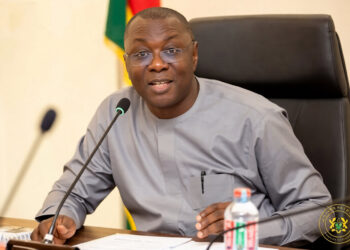
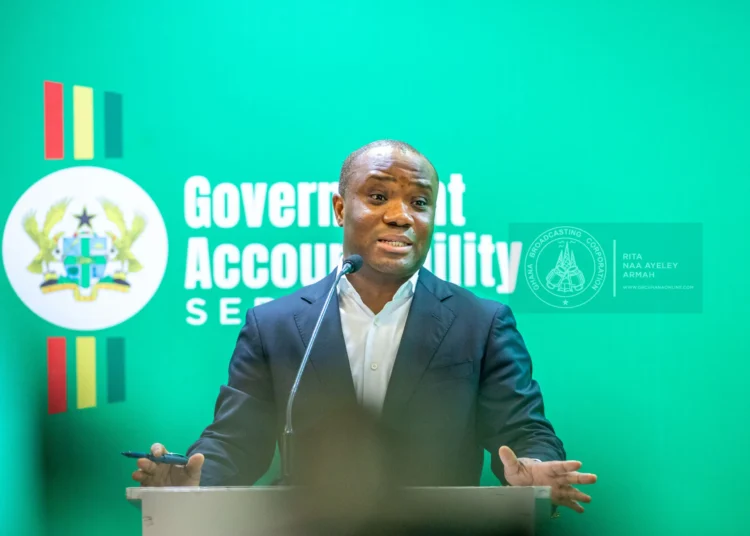
Presidential Spokesperson and Minister for Government Communications, Hon. Felix Kwakye Ofosu, has rejected claims that the John Dramani Mahama administration borrowed approximately $15 billion within its first 20 months in office, arguing that the opposition’s calculation relied on inconsistent exchange-rate conversions.
Speaking during the debate on the 2027 Budget in Parliament on Wednesday, November 18, 2026, Kwakye Ofosu accused the opposition of using different exchange rates to compare borrowing under the previous and current administrations, insisting that the resulting figures did not provide an accurate account of government borrowing.
“So it is not true that we have borrowed up to the tune of 15 billion dollars. That must be placed on record.”
Minister of State in charge of Government Communications, Felix Kwakye Ofosu
The Minister explained that the opposition had converted borrowing under the previous administration into Ghana cedis and divided the amount by an exchange rate of GH¢16 to arrive at GH¢49 billion.
He argued that the same approach was not applied consistently when calculating borrowing under the current administration. According to him, the opposition used an exchange rate of GH¢11.60 for the current government’s borrowing, arriving at a figure of GH¢64 billion.

Kwakye Ofosu maintained that the use of different exchange-rate denominators distorted the comparison and created the impression that the current administration had accumulated more borrowing.
He used the mathematical relationship between numerators and denominators to explain his objection, arguing that dividing amounts by different exchange rates could produce figures that were not directly comparable.
“What they are attempting is a clever trick.” He further accused the opposition of taking advantage of the depreciation of the cedi recorded during its period in office to construct what he described as a misleading comparison of borrowing levels.
Government defends its borrowing record
Kwakye Ofosu maintained that the $15 billion figure did not accurately represent the government’s borrowing within the period under discussion.
He attributed the disputed calculation to what he described as an inconsistent conversion method, arguing that the opposition had used the exchange rate of GH¢16 for its own borrowing figures and GH¢11.60 for the current administration’s figures.
The Minister did not, in his remarkst, provide a separate consolidated breakdown of the government’s total borrowing, the instruments used to raise funds or the precise amount accumulated over the stated 20-month period.
His response therefore focused primarily on challenging the opposition’s exchange-rate methodology rather than presenting a full alternative debt schedule. He also attributed the calculation approach to Dr Bawumia, stating that it had previously been introduced into Ghana’s economic debate.

Interest rates and economic conditions enter the debate
Beyond the borrowing dispute, the Minister cited interest rates as another indicator of the government’s economic performance.
He recalled that some businesses borrowed from banks at interest rates of up to 30 per cent under the previous administration. By contrast, he stated that businesses could now access loans at rates of between 7 and 9 per cent.
Kwakye Ofosu argued that the reduction in borrowing costs represented a change in the conditions facing businesses and challenged the opposition’s broader assessment of the economy.
“Today there are businesses that borrow at 7 percent, 9 percent.” He added that banks were sending messages to customers encouraging them to access loans, which he presented as evidence of improved lending conditions.
The Minister also referred to the primary balance as an economic indicator that, in his assessment, had improved compared with the situation inherited by the current administration.
Debt dispute forms part of wider budget debate
Kwakye Ofosu’s intervention came during parliamentary consideration of the 2027 Budget, which was presented by Finance Minister Dr Cassiel Ato Forson.
His remarks addressed opposition criticism of the government’s economic management, with particular attention to public borrowing, interest rates and the use of exchange rates in comparing the two administrations.

The dispute over the $15 billion figure centres on the conversion method described by the Minister. His presentation did not include the underlying debt data or a full calculation that would independently establish the total borrowing figure.
The exchange-rate argument and the government’s rejection of the opposition’s allegation therefore remain claims made by Kwakye Ofosu during the parliamentary debate.