
Mussa Dankwa, Pollster and Executive Director of Global InfoAnalytics, has disclosed that young voters aged 16 to 34 have given four major government policies majority approval, with satisfaction levels exceeding those recorded among voters generally in the September 2026 tracking poll.
The assessment covers the 24-Hour Economy, National Apprenticeship Programme, No-Academic-Fee policy, and Free Senior High School (Free SHS). “What does the data really suggest?”
The findings indicate that although young respondents express majority satisfaction with all four initiatives, their assessments vary, with Free SHS recording the highest satisfaction and the 24-Hour Economy the lowest.
24-Hour Economy Records Lowest Youth Satisfaction
The 24-Hour Economy policy recorded a 51% satisfaction rating among young voters, compared with 47% among voters overall. Dissatisfaction stood at 32% among young respondents, against 34% across the general voting population.
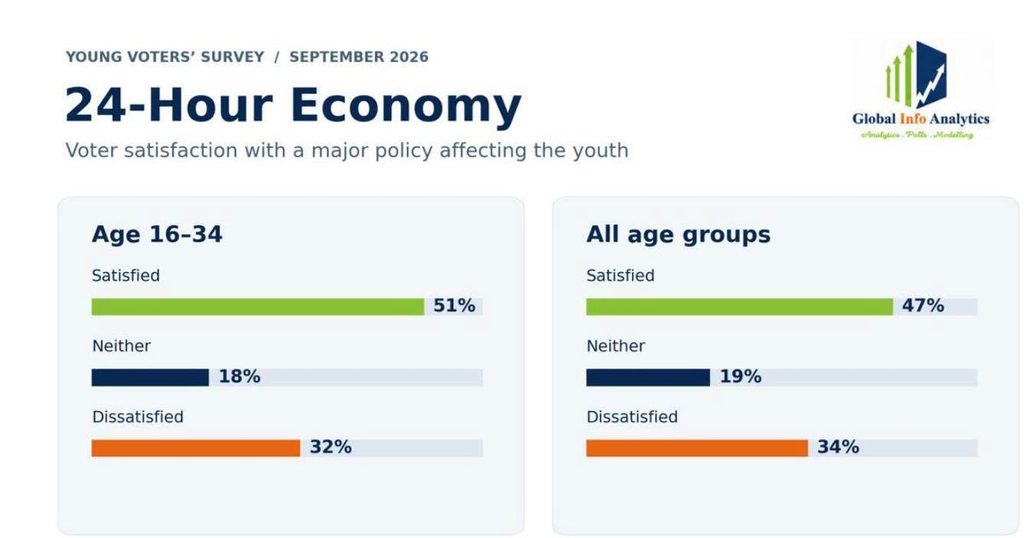
Mr Dankwa observed that while a majority of voters generally gave the controversial policy a “fail mark”, young voters had given it a “pass mark”. Despite receiving majority satisfaction among the 16 to 34 age group, the 24-Hour Economy recorded the lowest satisfaction level among the four youth-focused policies assessed.
The findings suggest that young respondents are comparatively more satisfied with the policy than the wider electorate, although the 51% rating indicates that its reception among younger voters remains divided.
Free SHS Records Highest Youth Approval
Free Senior High School, introduced under the previous New Patriotic Party administration, recorded the highest satisfaction rating among young respondents.
The poll found that 63% of young voters were satisfied with the policy, slightly above the 61% recorded among voters overall. Dissatisfaction among young respondents stood at 22%, compared with 24% across the general population.
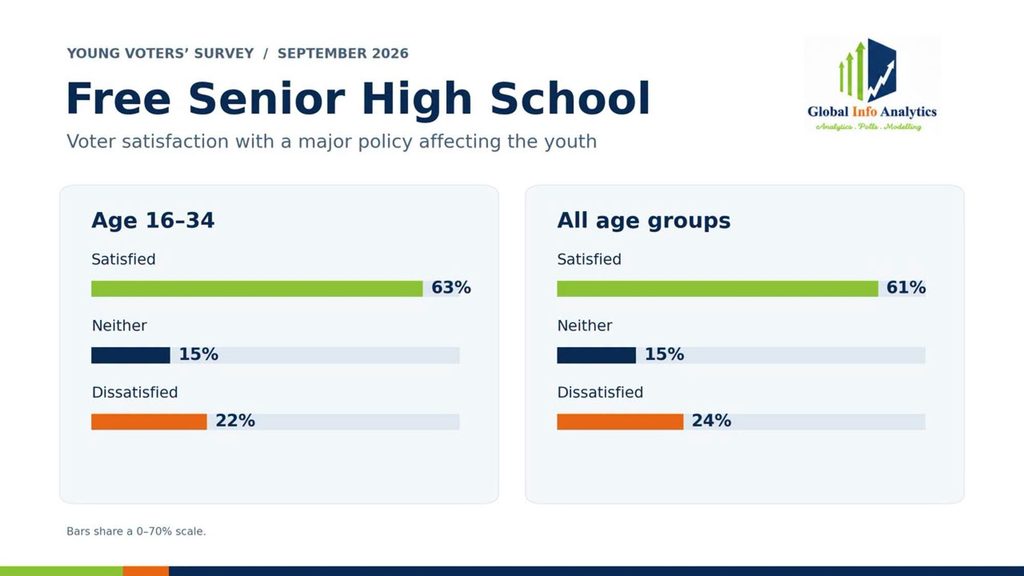
The results show that Free SHS continues to attract majority satisfaction among both younger respondents and voters generally, with young people recording a marginally higher approval level. The assessment places the education policy ahead of the three other initiatives in the youth satisfaction comparison.
Apprenticeship Programme Attracts Majority Satisfaction
The National Apprenticeship Programme also received majority satisfaction among respondents, with young voters expressing slightly stronger approval than the general electorate.
According to the September 2026 findings, 53% of voters overall were satisfied with the programme, while 28% expressed dissatisfaction. Among young voters, dissatisfaction was lower at 25%, while the proportion expressing satisfaction was slightly higher than the overall 53%.
Although Mr Dankwa did not provide the exact satisfaction percentage for young respondents in the figures presented, the comparison indicates a more favourable assessment of the programme among the younger age group.
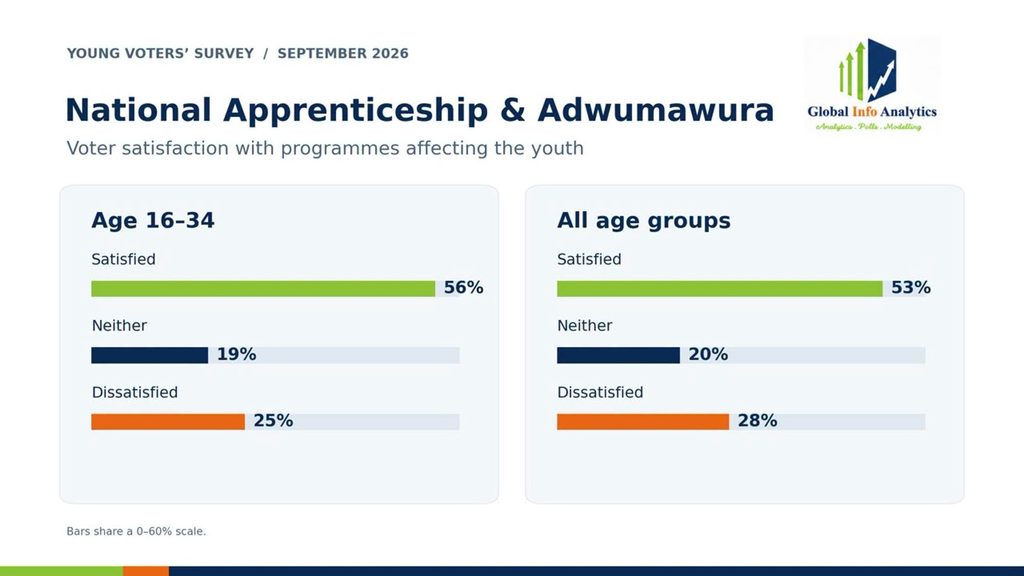
The results offer an indication of how the apprenticeship initiative is being received by its key target demographic, particularly young people seeking technical and vocational skills.
No-Academic-Fee Policy Receives Strong Youth Support
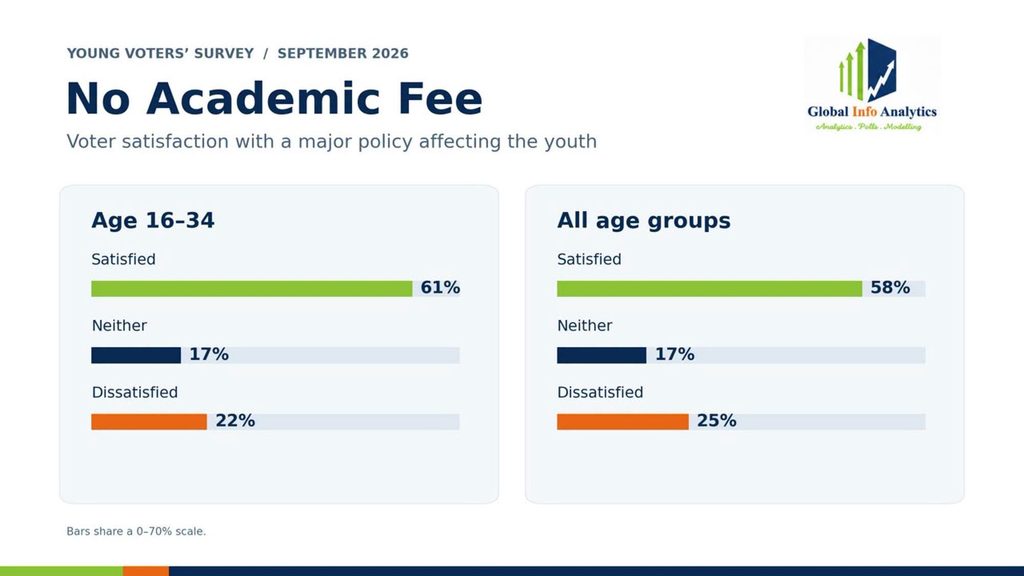
The No-Academic-Fee policy also recorded higher satisfaction among young voters than the general electorate. The poll found that 61% of young respondents were satisfied with the policy, compared with 58% of voters overall. Dissatisfaction stood at 22% among young voters, against 25% across the wider population.
The three-percentage-point difference in satisfaction indicates a more favourable assessment among younger respondents. The results also place the policy behind Free SHS but ahead of the 24-Hour Economy in the youth satisfaction figures provided.
April 2027 Poll to Track Changes
The September 2026 assessment provides a snapshot of public satisfaction with four policies targeting education, employment, skills development and economic activity.
Across all four initiatives, young voters recorded higher satisfaction than voters overall. However, the differences in their ratings show that support is not uniform, with Free SHS attracting the highest satisfaction and the 24-Hour Economy receiving the lowest.
Mr Dankwa disclosed that Global InfoAnalytics would revisit the policies in its April 2027 tracking poll. “The policies will be assessed again in the April 2027 tracking poll.”

The next assessment is expected to provide an opportunity to track changes in public satisfaction. However, the figures presented do not include the poll’s sample size, margin of error or detailed methodology, limiting independent assessment of the statistical significance of the differences.
For now, the September findings show that young voters give all four policies majority approval, while recording higher satisfaction levels than the general electorate across each initiative.
READ ALSO: UGEL Hostel Charges Among Lowest Compared to Private Facilities – UG Professor