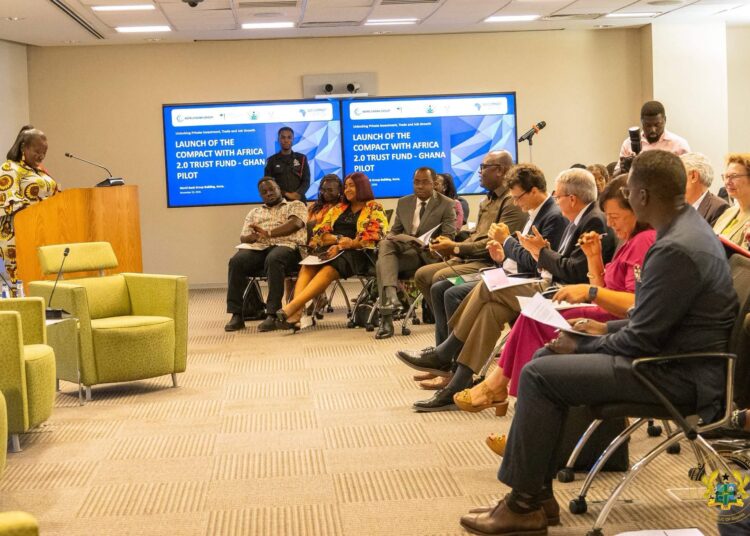
Ghana is targeting approximately 36,000 direct jobs in the textiles and garment manufacturing industry under the newly launched Compact with Africa (CwA) 2.0 Pilot, as the government intensifies efforts to attract investment, strengthen local manufacturing and expand the country’s export capacity.
The initiative is designed to improve Ghana’s investment environment, address structural barriers to trade and accelerate industrialisation through targeted policy and infrastructure reforms.
Speaking at the launch, the Minister for Trade, Agribusiness and Industry, Hon. Elizabeth Ofosu-Adjare, said the programme aligned with the government’s broader ambition to reposition Ghana as a competitive manufacturing and export destination rather than an economy heavily dependent on exporting unprocessed commodities.
“The establishment of garment factories is projected to create approximately 36,000 direct jobs, particularly for young people and women.”
Minister for Trade, Hon. Elizabeth Ofosu-Adjare
She emphasised that expanding domestic production and value addition would be essential to creating sustainable employment, strengthening industrial capacity and increasing Ghana’s participation in international markets.
Investment Reforms to Drive Industrial Growth
Ghana’s participation in the CwA 2.0 Pilot places the country among the first four nations selected for the initiative, providing an opportunity to strengthen investment policies and improve the conditions necessary for private-sector expansion.

The programme forms part of the second phase of the G20-backed Compact with Africa, which seeks to mobilise private investment through improved business environments, stronger institutional partnerships and reforms that address barriers to economic growth.
According to the World Bank Group, the broader Compact with Africa framework focuses on connecting African businesses with international investors while supporting governments to implement reforms that encourage private capital mobilisation and employment creation.
For Ghana, the pilot will concentrate on four priority areas: investment policy implementation, trade policy, development of the TransVolta corridor, and textiles and garments.
These interventions are expected to address persistent challenges confronting businesses and prospective investors, particularly administrative delays, transportation expenses, regulatory complexities and difficulties associated with meeting international product standards.
The Minister identified lengthy approval procedures and high logistics costs as significant obstacles to investment and trade competitiveness.
“Lengthy approval processes, high transportation costs and difficulties faced by businesses in meeting standards and accessing markets remain among the challenges the programme seeks to address.”
Minister for Trade, Hon. Elizabeth Ofosu-Adjare
Export Performance Strengthens Ghana’s Ambition
The launch comes against the background of improved performance in Ghana’s non-traditional export sector, which recorded earnings of US$5.006 billion in 2025, compared with US$3.83 billion in 2024.
According to the Ghana Export Promotion Authority’s 2025 Non-Traditional Exports Statistics Report, the performance represented a 30.7 per cent increase, marking the first time earnings from the sector exceeded US$5 billion.
A significant development was the contribution of processed and semi-processed products, which generated approximately US$3. 09 billion, representing 83.47 per cent of total non-traditional export earnings.
The performance demonstrates the growing contribution of value-added products to Ghana’s export economy and reinforces the importance of expanding domestic processing and manufacturing capacity.
Cocoa derivatives, including cocoa paste, cocoa butter and cocoa powder, were among the major contributors to export growth, benefiting from demand in international manufacturing industries.
However, the government is seeking to build on these gains by expanding the range of manufactured products Ghana can competitively supply to international markets.
The Minister indicated that the country was targeting at least US$10 billion in non-traditional export earnings by 2030, making industrial investment, production efficiency and market access important priorities.
“The national target is to increase non-traditional export earnings to at least US$10 billion by 2030.”
Minister for Trade, Hon. Elizabeth Ofosu-Adjare
TransVolta Corridor and Garment Manufacturing

Beyond investment and trade reforms, the development of the TransVolta corridor represents another significant component of the pilot.
Efficient transportation infrastructure is essential to industrial development because it influences the cost and reliability of moving raw materials, intermediate products and finished goods between production centres and markets.
For manufacturing companies, transportation expenses can affect production costs, delivery schedules and the ability to fulfil international orders competitively.
Strengthening the TransVolta corridor is therefore expected to support trade connectivity and improve the movement of goods, complementing the programme’s wider objective of reducing logistical constraints on businesses.
The textiles and garments component, meanwhile, is expected to translate investment opportunities into employment and expanded manufacturing activity.
The projected 36,000 direct jobs could create significant opportunities for young people and women, particularly as garment manufacturing offers employment across different stages of production, including cutting, sewing, finishing, quality control and factory operations.
However, translating the employment target into measurable outcomes will depend on the establishment and operational readiness of the proposed factories, sustained investment, access to production inputs and the availability of workers with relevant technical skills.
Manufacturers will also need to meet international quality requirements, maintain competitive production costs and establish reliable relationships with buyers to secure sustainable export orders.
The Ministry has consequently reaffirmed its commitment to working with the World Bank Group, the International Finance Corporation (IFC) and other development partners to ensure the pilot delivers practical results.
The collaboration is expected to support the implementation of reforms, strengthen institutional capacity and create conditions that encourage private-sector participation.
Ultimately, the success of Ghana’s CwA 2.0 Pilot will be measured not only by investment commitments but also by the number of businesses established, jobs created, improvements in trade efficiency and growth in manufactured exports.
READ ALSO:Analyst Urges Ghana To Borrow For Projects, Not Consumption