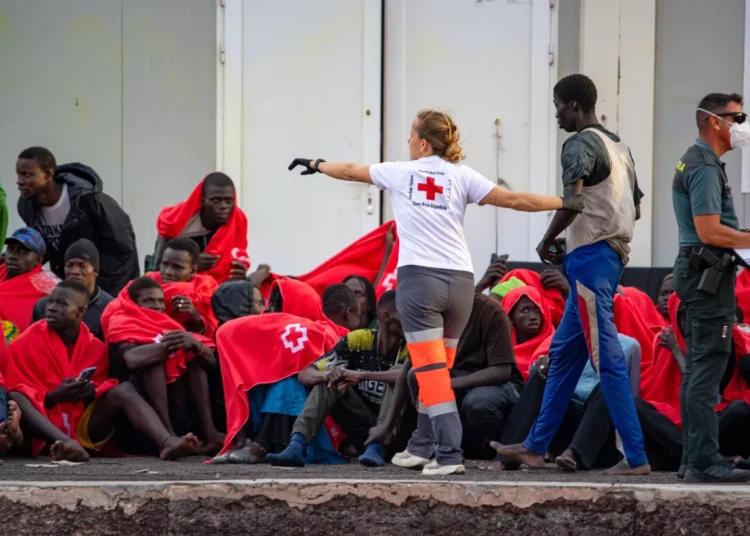
Spanish authorities have reported a record 1,990 migrant arrivals in the Canary Islands in a single day, as boats carrying people from West Africa reached the archipelago amid favourable sailing conditions.
The arrivals on Tuesday, involving 15 boats, marked the highest number of migrants to reach the islands in one day. Spain’s maritime rescue service said search and rescue vessels accompanied the boats as they arrived, one after another, at El Hierro, the westernmost island in the archipelago.
The surge comes just days before Spain holds a national election, with migration expected to be a major issue for voters and political parties.
Canary Islands regional leader Fernando Clavijo described the arrivals as unprecedented, saying the island had faced a particularly difficult day. “Sadly, this is a historic day,” Clavijo said in an interview with a Spanish radio station.

He said that approximately 100 minors were among those who arrived, including a four-day-old baby born during the journey. Most of the boats, he added, had departed from Senegal and Gambia.
Clavijo attributed the high number of departures partly to favourable weather and sea conditions, which had made the crossing possible for more people seeking to reach Europe. “The sailing conditions were favorable and there was a full moon, so these people looking for a better future ended up on our shores,” he said.
El Hierro Struggles To Accommodate New Arrivals
The scale of the arrivals has placed additional pressure on El Hierro, a small island with a population of approximately 12,000 people.
Clavijo stated that the island lacked the capacity to accommodate such a large number of people, many of whom arrived exhausted and in poor physical condition after the dangerous journey across the Atlantic.
He expressed satisfaction with the arrangements to transfer adult migrants to mainland Spain but called on other Spanish regions to help accommodate unaccompanied minors who require care and protection from the authorities.
The regional leader also rejected rhetoric portraying migrants as a threat, warning against attempts to demonise people fleeing their countries in search of better opportunities. He described such language as “a xenophobic discourse of bad people.”
Clavijo further criticised a recent agreement by Austria, Denmark, Germany, Greece and the Netherlands to send migrants to Rwanda, describing the arrangement as “ridiculous.” “Europe is on the wrong path,” he said.

His comments reflect wider disagreements over how European countries should manage migration, including proposals to transfer asylum seekers and migrants to countries outside the continent.
Canary Islands Remain Key Route To Europe
The Canary Islands have for years served as a major entry point for migrants attempting to reach Europe from West Africa.
Although the archipelago lies approximately 65 miles (105 kilometres) from the nearest African coast, many migrants undertake longer and more dangerous routes to avoid security forces. Some journeys last several days or weeks, while boats that fail to reach their intended destinations can drift into the open Atlantic.
The crossing has claimed thousands of lives, highlighting the risks faced by people attempting to reach the islands in search of work, safety and improved living conditions.
More than 26,000 people have reached the Canary Islands this year, with approximately half of the total arriving in November.
Tuesday’s arrivals surpassed the previous single-day record, set only two weeks earlier when 1,400 people reached Gran Canaria on November 7.
Departures from West Africa are often seasonal, with November typically recording an increase as migrants attempt the crossing before rougher winter conditions set in. Recently calm seas have contributed to the rise in departures.
Despite European Union efforts to reduce irregular migration through cooperation with West African countries, many people continue to undertake the journey, believing that leaving offers their best chance of finding employment and building a better future.
In June, Pope Leo XIV also addressed the issue during a visit to the Canary Islands, warning people smugglers against exploiting migrants’ desperation and saying they would face God’s wrath.
The latest arrivals have renewed attention on the humanitarian pressures facing the Canary Islands and the wider European debate over migration management.
With the national election approaching, the record influx is likely to add to discussions about border controls, migrant reception arrangements and the responsibilities of Spain and other European countries towards people arriving through the dangerous Atlantic route.
READ ALSO: CDD-Ghana: Corruption Steals Classrooms, Jobs and Opportunities From Ghanaian Youth