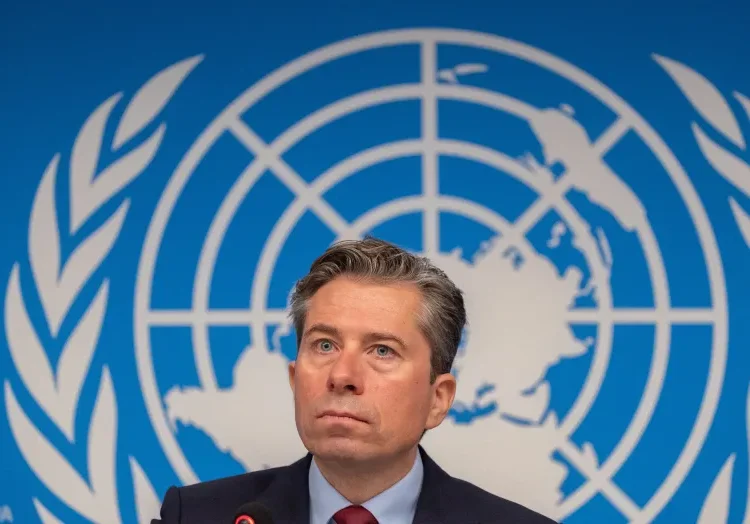
UN Under-Secretary-General for Humanitarian Affairs and Emergency Relief Coordinator, Tom Fletcher, has warned that millions of people in Yemen are facing hunger and severe shortages of essential supplies as escalated violence, restrictions on aid routes and inadequate humanitarian funding push the war-torn country further into crisis.
The UN Aid Chief arrived in Yemen today to press for urgent assistance to civilians affected by the conflict, with particular attention to communities in Taiz City, where access to food and medicine remains a critical concern.
In a statement outlining the purpose of his mission, Tom Fletcher warned that the humanitarian situation is deteriorating and that civilians were increasingly unable to obtain the supplies required for survival.
“Hospitals and first responders are under attack. Fighting, insecurity and heavy restrictions along key supply routes are preventing families from accessing the food and medicine they need to survive.”
Tom Fletcher
Renewed Violence Displaces Thousands

Yemen has endured years of conflict involving the internationally recognised government, based in Aden and backed by Saudi Arabia, and Houthi forces, which have controlled the capital, Sana’a, for years and receive support from Iran.
The prolonged conflict has devastated infrastructure, disrupted public services and left large sections of the population dependent on humanitarian assistance.
According to Tom Fletcher, more than 364,000 people have been forced to flee their homes since August, with tens of thousands displaced in the week preceding his arrival.
The latest movements have placed additional demands on humanitarian organisations attempting to provide shelter, food, medical supplies and other essential assistance.
The Humanitarian Chief identified Taiz City as an urgent priority for aid access, calling for safe and sustained assistance to civilians in need.
The city has faced prolonged conflict and restrictions that have complicated the movement of people and goods. Continued barriers along key supply routes threaten to prevent families from obtaining food, medicine and other necessities, even where humanitarian supplies are available elsewhere.
Aid Response Faces Severe Funding Shortfalls

Alongside the conflict, a severe shortage of humanitarian funding is threatening the ability of aid agencies to respond to growing needs across Yemen.
Tom Fletcher warned that underfunding had pushed the humanitarian operation towards breaking point, placing additional strain on teams working in dangerous conditions to support civilians.
The funding crisis has affected the wider international humanitarian system, which is already struggling to meet growing needs in multiple emergencies.
According to the UN Aid Chief, the global response is “overstretched, underfunded and under attack.”
Yemen remains one of the situations where the international response is furthest behind its objectives.
UN is seeking to reach 87 million people worldwide with lifesaving assistance this year, but the country’s worsening conditions and limited funding have made that ambition increasingly difficult to achieve.
The shortfall threatens the continuity of essential programmes, including food assistance, healthcare, protection services and support for displaced families. Humanitarian organisations operating in Yemen must also contend with insecurity, logistical difficulties and restrictions that increase the cost and complexity of delivering aid.
He also called on international donors to increase their support, warning that the response could not be sustained without renewed financial commitment, adding, “we will not allow the people of Yemen to slip off the world’s radar.”
UN Demands Release of Detained Aid Workers

Also, Tom Fletcher used his visit to demand the immediate and unconditional release of UN personnel and other humanitarian workers detained by Houthi forces.
The detention of aid workers has cast uncertainty over the security of humanitarian operations and the ability of international organisations to work without intimidation.
In his statement, Fletcher directly addressed the Houthis, urging them to release detained colleagues and respect the protection afforded to humanitarian personnel.
“Our detained UN colleagues and other humanitarians. Our work and our people must be protected,” he stated.
The issue has become increasingly urgent following the death of a Yemeni UN human rights employee, Mohammad el Shami, who passed away while in Houthi detention after being held for more than two years.
The UN Human Rights Office condemned the development in October, with High Commissioner Volker Türk expressing concern that el Shami’s family had only learned of his death weeks after it occurred.
As of mid-October, 71 UN personnel remained in Houthi detention, according to the information provided by the UN. The Secretary-General’s office had also reported in June that another UN colleague had died while being held.
The detention of humanitarian and UN personnel has raised serious safety concerns in Yemen and made it harder for aid agencies to continue their work and support civilians.
READ ALSO: CDD-Ghana: Corruption Steals Classrooms, Jobs and Opportunities From Ghanaian Youth