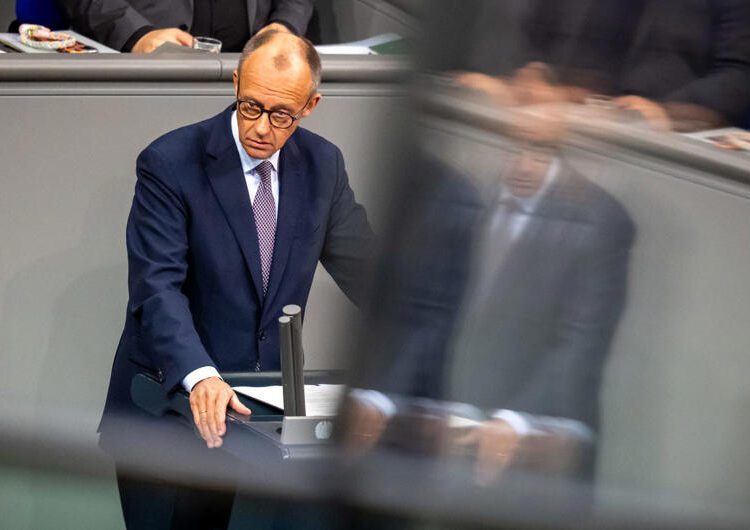
Germany’s parliament has approved a €556 billion federal budget for 2027, backing increased spending on defence, infrastructure and social security as the government prepares to borrow €210.4 billion to finance its plans.
The Bundestag passed the budget on Friday with 317 lawmakers voting in favour and 260 against. The governing coalition of the Christian Democratic Union (CDU), its Bavarian sister party, the Christian Social Union (CSU), and the Social Democratic Party (SPD) supported the legislation.
Planned expenditure under the core federal budget represents an increase of €31.4 billion, or approximately six per cent, compared with the previous year.
However, projected tax revenues of €391.3 billion are below the federal government’s original forecasts, increasing the amount of borrowing required to finance public expenditure.
The planned €210.4 billion in new borrowing would represent the second-highest level in the history of the Federal Republic of Germany. Borrowing was higher only in 2021, during the coronavirus pandemic, when the government took on €215.4 billion in new debt.
The borrowing is divided among three financing arrangements: €123 billion for the core federal budget, €57.8 billion for the special fund for infrastructure and climate neutrality, and €29.6 billion for the special fund supporting the German armed forces, known as the Bundeswehr.
These special funds are not accumulated financial reserves. Rather, they provide financing mechanisms that allow the government to undertake additional debt-funded expenditure outside the core federal budget.
Defence Spending And Ukraine Support Increase
Defence expenditure accounts for a substantial share of the planned increase in federal spending, reflecting the government’s intention to strengthen Germany’s military capabilities.
The regular defence budget is expected to rise from approximately €82.7 billion in 2026 to €109.7 billion in 2027. An additional €29.6 billion will come from the Bundeswehr special fund, established in 2022 by the government led by former Chancellor Olaf Scholz.
The €100 billion fund was created under the previous coalition of the SPD, Greens and Free Democrats to finance additional military investment. It is expected to be fully exhausted by the end of 2027.
Germany has also earmarked €11.6 billion for support for Ukraine, adding to the government’s defence-related financial commitments.
Military expenditure is projected to continue increasing over the coming years. According to the Federal Ministry of Finance’s current financial plans, the regular defence budget alone could reach €183.7 billion by 2030.
The planned increases underline the growing importance of defence in Germany’s spending priorities, although the government must also accommodate substantial commitments in other areas.
Social Spending Places Pressure On Public Finances
Despite the rise in defence expenditure, the Federal Ministry of Labour and Social Affairs remains the largest spending department, with an allocation of €203.3 billion.
The amount represents approximately 36.6 per cent of the entire core federal budget, with a substantial proportion directed towards the statutory pension insurance scheme.
However, the additional federal subsidy to the pension system is scheduled to be reduced by €3 billion. The reduction could place further pressure on the scheme, with employees and employers facing the prospect of higher contribution rates.
The Federal Employment Agency is also experiencing financial difficulties. According to the budget figures, it will require a federal loan of €8.2 billion.
Meanwhile, the cost of servicing Germany’s existing debt is becoming a growing burden on public finances. The government initially earmarked €41.9 billion for interest payments in 2027, an increase of €11.6 billion compared with 2026.
The rising cost of debt servicing reduces the resources available for other priorities, including education, infrastructure, social security and potential tax relief.
Investment under the core federal budget is nevertheless expected to increase to approximately €61.8 billion, with further debt-financed investment channelled through the special fund for infrastructure and climate neutrality.
Klingbeil Warns Public Of Possible Sacrifices
Speaking during the final budget debate, Federal Finance Minister Lars Klingbeil indicated that the government’s forthcoming financial and economic reforms could require sacrifices from the public. “We will not be able to avoid asking people to make sacrifices,” Klingbeil, who also serves as Co-chair of the SPD, said.
He stressed that any resulting financial burdens would need to be distributed fairly. However, the government has yet to specify precisely what measures the public could face as it attempts to address rising expenditure and financial constraints.
The pressure is already extending beyond the 2027 budget. Current estimates indicate that Germany could face a funding shortfall of approximately €25 billion in 2028.
The projection already takes into account the planned postponement until 2033 of repayments on emergency loans taken out during the coronavirus pandemic and debt incurred through the Bundeswehr special fund.
If the reduction in electricity tax is extended beyond 2027, the funding gap could widen to approximately €30 billion.
The projected shortfall raises questions about how the government will finance its commitments while managing debt, social expenditure and demands for further public investment.
Pension Reform Adds To Government’s Challenges
Alongside the adoption of the 2027 budget, the government is preparing a comprehensive overhaul of the pension system.
Federal Labour Minister Alexander Schweitzer has presented a 287-page draft bill for consultation, setting out proposals intended to place statutory pension insurance on a more sustainable financial footing over the long term.
The proposed reforms come amid rising social expenditure and an ageing population, both of which are increasing pressure on the pension system.
The government must therefore balance competing demands, including higher defence spending, infrastructure investment and social protection, while addressing the long-term sustainability of public finances.
Although the 2027 budget has secured parliamentary approval, the projected borrowing, rising interest payments and expected funding gap for 2028 indicate that Germany’s fiscal challenges will extend beyond the coming financial year.
The government’s ability to implement its spending priorities while securing the resources needed for future obligations will remain a central test of its economic and fiscal policy.
READ ALSO: Pakistan, Saudi Arabia, Türkiye Deepen Defence Pact Amid Houthi Attacks