
Spain’s Pablo Hernández de Cos has been selected as the next President of the European Central Bank (ECB), after EU leaders reached a consensus on the institution’s future leadership.
De Cos will take over when current Chief Christine Lagarde steps down early on February 7, 2027.
French President Emmanuel Macron confirmed the decision following discussions among European leaders at a summit in Brussels, describing the proposed appointments as a balanced leadership team committed to the stability and prosperity of the euro area.
“The Euro Summit welcomed Christine Lagarde’s decisive leadership during her term in office.
“A consensus emerged on the nominations to the European Central Bank. I welcome a balanced trio of individuals serving the stability and prosperity of the euro area, with Pablo Hernández de Cos as President and Laurence Boone and Markus Brunnermeier on the Executive Board.”
Emmanuel Macron
Hernández de Cos, a former Governor of the Bank of Spain and current General Manager of the Bank for International Settlements (BIS), will become the first Spaniard to lead the ECB.
He emerged ahead of rival candidate Klaas Knot of the Netherlands after Dutch officials decided to support his nomination, effectively withdrawing their own candidate from the contest.
The other two appointments agreed by EU diplomats are France’s Laurence Boone and Germany’s Markus Brunnermeier, who are expected to join the ECB’s six-member Executive Board.
The selections follow months of negotiations over the distribution of senior positions at the central bank.
De Cos Brings Experience From Previous Economic Crises
Hernández de Cos, 55, brings extensive experience in monetary policy and financial crisis management to the ECB presidency.
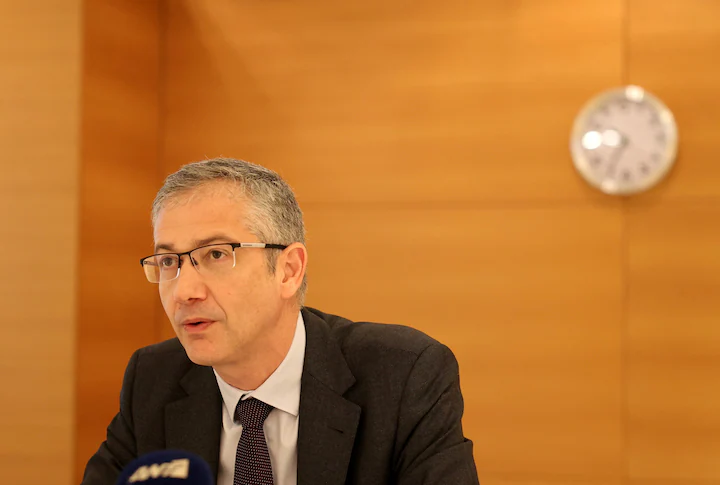
A trained monetary economist, he previously held several positions within the ECB and the Bank of Spain before becoming governor of Spain’s central bank. In that role, he served on the ECB’s Governing Council, which is responsible for determining monetary policy across the euro area.
His career has included involvement in several major economic challenges, including Spain’s banking sector bailout, the COVID-19 pandemic and the inflation surge that followed the pandemic.
As Governor, he participated in the ECB’s response to the rise in inflation, which prompted the institution to undertake its fastest interest rate-hiking cycle on record.
Colleagues and observers have described him as pragmatic and moderate, with a reputation for combining economic theory with practical experience in monetary policymaking.
Although policymakers from southern Europe are sometimes associated with support for looser monetary conditions, Hernández de Cos has not been easily categorised along conventional monetary policy lines.
His appointment therefore brings the ECB presidency to a southern European policymaker with experience navigating both financial instability and periods of significant inflationary pressure.
ECB Faces Renewed Inflation And Financial Market Pressures
The leadership transition comes as the ECB confronts renewed inflationary pressures linked to the war involving Iran, alongside concerns about financial instability in the euro area.
The conflict has contributed to rising energy costs, complicating the central bank’s efforts to maintain price stability. At the same time, political uncertainty in France has raised concerns about potential financial market pressures spreading to other eurozone economies.
Inflation has reached 4 per cent, twice the ECB’s target, according to the figures provided in the source material. Policymakers have increasingly signalled that another interest rate increase in December may be necessary to contain price pressures.
However, the longer-term direction of monetary policy remains uncertain.
Financial markets expect a further rate increase, followed by a possible easing of inflationary pressures as oil prices retreat and statistical base effects begin to influence year-on-year comparisons from the spring.
The new leadership will therefore inherit a challenging economic environment in which decisions on interest rates will have implications for households, businesses, government borrowing and financial markets across the euro area.
ECB President’s Institutional Limits
Despite the importance of the presidency, Hernández de Cos will not have the authority to determine interest rates independently.
Monetary policy decisions are taken collectively by the ECB’s 27-member Governing Council, which includes the Executive Board and national central bank governors from eurozone countries.
The President plays a central role in leading the institution and shaping discussions, but major policy decisions require the support of the wider Governing Council.
This means Hernández de Cos will have to build consensus among policymakers with different economic conditions and monetary policy preferences.
His experience at the Bank of Spain, the ECB and the BIS is expected to be relevant as the institution navigates the competing demands of controlling inflation and safeguarding financial stability.
Macron’s endorsement of the appointments also signals the emergence of a new leadership team representing Spain, France and Germany at the centre of the ECB’s executive structure.
READ ALSO: CDD-Ghana: Corruption Steals Classrooms, Jobs and Opportunities From Ghanaian Youth