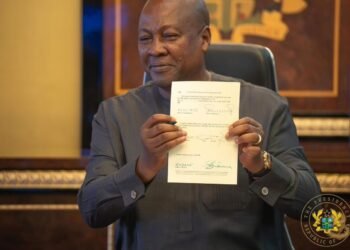
President John Dramani Mahama has indicated that the expenditures being made by the government are having a multiplier effect by providing opportunities at several levels.
The President, in addressing the National Peace Council, emphasized that the government is spending heavily on infrastructure through the Big Push agenda.
“We are implementing the Big Push and investing a lot of money, especially in the road sector, and in paying contractors with laid-off workers who are suddenly hiring again.
“So, they are hiring civil engineers, technicians, machine operators, steel benders, masons, carpenters, electricians, plumbers, and so it’s going to create a multiplier effect on the economy.”
John Dramani Mahama, President of Ghana
The President added that payments made to contractors by the government provide work to the drivers employed. The tipper tracks they use require maintenance, giving work to the auto mechanics.
Other activities of the contractors include buying cement, iron rods, fuel, and other products from suppliers, all contributing to the expansion of the economy. He added that food vendors, who are mainly women, will establish themselves around the various sites. The link goes on to affect hairdressers, boutiques, and many more. “So, it has a multiplier effect on the economy, and we believe that that will give us stimulus for creating more jobs not only in the construction sector but in many other sectors,” President Mahama reiterated.

Stabilizing the Economy Via the Youth
The President recounted the lack of opportunity for the youth in the country and the overwhelming mandate given to him by the good people of Ghana. He declared that it is the government’s responsibility to provide opportunities and an environment to grow the youth. This viable and conducive environment will ripple growth through businesses and the private sector to support the government’s efforts.
According to the President, the government has focused on stabilizing the economy, and “thank God we are seeing some light at the end of the tunnel” in the first eleven months of 2025. He mentioned that the government has worked effectively to bring the country thus far.


The youth remain a priority in the growth and development of Ghana, and the government will keep working hard to serve them well, the president assures.
The various initiatives in the real sector, such as the 24-Hour Economy and all the initiatives under the agriculture sector, such as the Feed Ghana initiative, are meant to create jobs for the youth. These initiatives, the President added, are programed to permeate several critical sub-sectors of the economy and diversify the economy.
Ghana’s total reliance on the traditional commodity raw material export to sustain the economy is an outdated approach. President Mahama, therefore, intends to create new opportunities to diversify the country’s growth and boost its wealth. These numerous new opportunities arising in the real sectors, the agriculture and the industry sectors, are youth-focused.
The youth are the foundation of the country, and the resources of the country are meant to establish them, ensuring the sustenance of the country’s heritage, values, and self-reliance.
Recounting the Achievements of the Government
The President acknowledged the challenges of the first eleven months of his young government and proudly declared that the Ghanaian “economy is appearing stable.” He recounted that the country has gained traction from the international community and agencies, providing a favorable outlook. Ghana has been upgraded in terms of our credit rating by various credit rating agencies, not just one, the President said.

According to H.E. John Mahama, inflation has also declined to single digits, currently at 6.3 percent. These are things all Ghanaians are testament to, he alluded. He added that the cost of living has abated because the prices of food in the market have declined.
He, however, urged the economic agents to keep their eyes on the ball and continue to adhere to appropriate actions that contribute to building the Ghana we want.
READ ALSO: Ghana’s 2026 Tariff Hike Renews Push for Nuclear Power