

In a double-barreled move to fortify Ghana’s industrial backbone, the Ministry of Trade, Agribusiness and Industry (MoTAI) has intensified its collaboration with the Ghana Commodity Exchange (GCX) and the Ghana Standards Authority (GSA).
According to MoTAI, these strategic engagements signal the Mahama administration’s commitment to a “farm-to-factory” reset, ensuring that local manufacturers have access to high-quality raw materials while securing a ready market for “Made-in-Ghana” apparel.
By synchronizing the operations of the commodity exchange with the rigorous testing protocols of the standards authority, MoTAI is creating a seamless value chain to reduce the nation’s reliance on expensive imports, and position Ghanaian businesses to dominate the African Continental Free Trade Area (AfCFTA).
“The engagement was a priority for the Ministry to better understand the operations of GCX… and strengthen collaboration in support of trade, industrialization and export policy objectives”
Ministry of Trade, Agribusiness and Industry
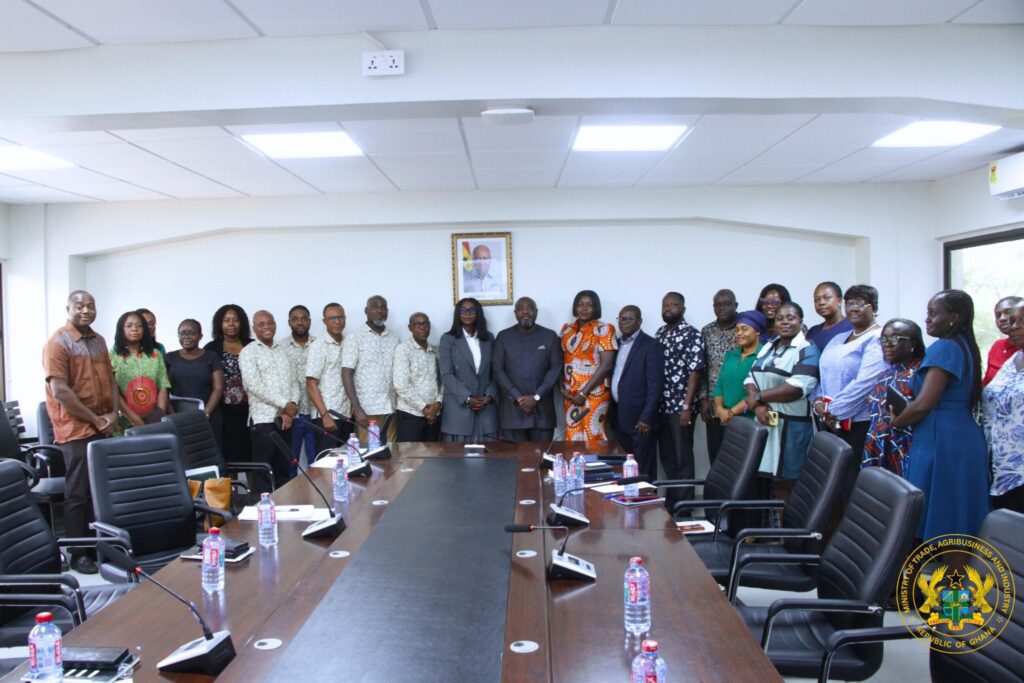
The meeting with the Ghana Commodity Exchange highlighted a record-breaking 2025 for the platform. Led by CEO Madam Evelyn Abaka, the delegation revealed that the Exchange facilitated over GHS 1.8 billion in trades, moving more than 78,000 metric tonnes of commodities.
This liquidity is transforming the lives of over 50,000 farmers who now benefit from transparent price discovery and reduced post-harvest losses across nine strategic warehouses.
However, for the GCX to become a true engine of industrialization, the leadership is calling for policy mandates. Specifically, they urged the Ministry to require that high-value crops – such as soya, sesame, shea, and cashew – be traded exclusively through the Exchange.
This would ensure that local industries have first right of refusal on high-quality, standardized raw materials before they are exported.
Enforcing Global Quality Standards
MoTAI noted that a critical component of this partnership is the enforcement of quality. The GCX reported strict adherence to the national aflatoxin limit of 15ppb (parts per billion).
In 2026, quality is no longer just a health requirement; it is a trade requirement. By ensuring that maize, rice, and soya meet these international standards, the Exchange is effectively “pre-clearing” Ghanaian goods for export to the most demanding global markets.

“The Exchange reported that it has supported over 50,000 farmers through capacity building and post-harvest loss reduction initiatives while enforcing quality standards”
Ministry of Trade, Agribusiness and Industry
Director of Trade Development, Mr. Kobena Ebo Quayson, assured the Exchange that the Ministry is committed to strengthening the Grains Committee. This specialized body will resolve policy bottlenecks, ensuring that the GCX has the regulatory teeth to manage the nation’s grain reserves and industrial inputs efficiently.
Standardizing Uniforms
While the GCX secures the raw materials, a separate MoTAI delegation led by Madam Abena Manso-Howard Gyamfi met with the Ghana Standards Authority (GSA) to address the “tail end,” of the value chain: manufacturing.
The Ministry is pushing a bold initiative to mandate the local procurement of uniforms and apparel for security agencies and state institutions. To make this work, the GSA is fast-tracking the development of specific standards for locally produced fabrics.
Prof. George Agyei, Director-General of the GSA, pledged to treat the testing of these fabrics with utmost urgency to ensure that locally made military fatigues and institutional uniforms meet the rigorous durability and safety requirements of the state – removing any excuse for outsourcing these contracts to foreign firms.

The synergy between these three entities represents a structural shift in how Ghana handles trade. By leveraging the GCX for supply, the GSA for quality assurance, and the Ministry for market-creating policies, the government is building an ecosystem that protects local SMEs.
This approach aligns perfectly with the 24-Hour Economy vision, where factories can operate around the clock, fueled by a steady, standardized supply of local materials.
READ ALSO: Energy Commission Staff Denounce False Claims of Leadership Rift