
In a high-stakes move to accelerate Ghana’s industrialization agenda, the Association of Ghana Industries (AGI) has formalized a strategic partnership with the UK-Ghana Chamber of Commerce (UKGCC) to deepen bilateral trade and investment.
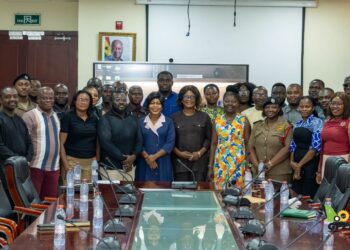
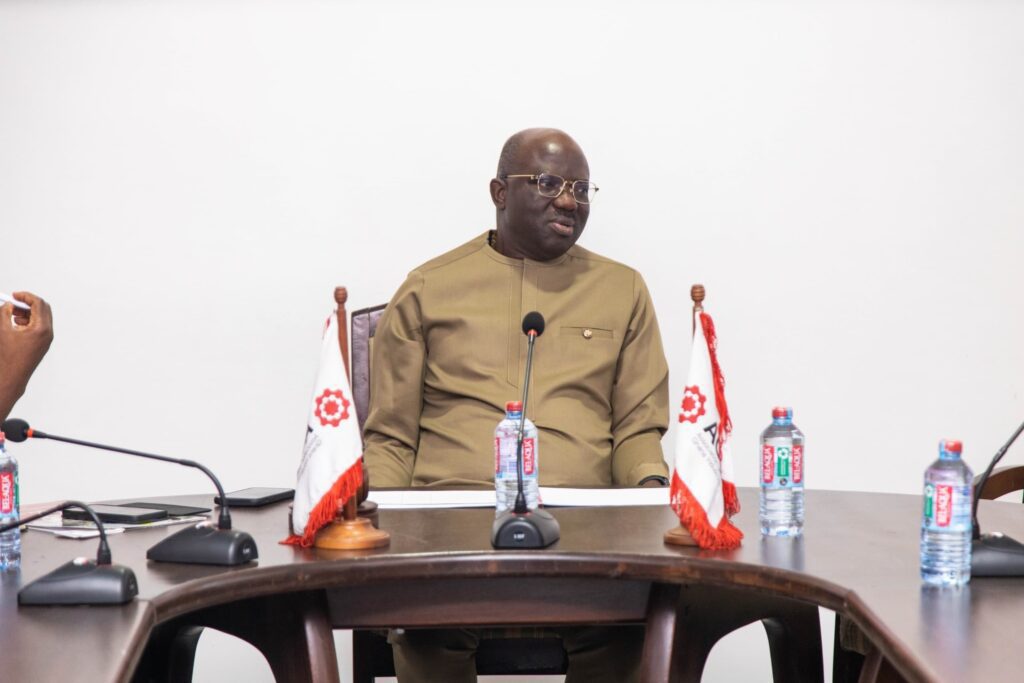
The engagement, held at the AGI Head Office in Accra, brought together AGI President Pharm. Kofi Nsiah-Poku and UKGCC Executive Director Madam Adjoba Kyiamah to address the structural barriers hindering local manufacturers from scaling into international markets.
“With total trade between the two nations reaching £1.5 billion as of late 2025, the collaboration is timed to leverage the UK-Ghana Trade Partnership Agreement to drive a new era of export-led growth. Discussions focused on creating a seamless trade bridge that prioritizes value addition over raw material exports, aligning with the government’s 2026 ‘Great Industrial Reset’ policy”
Association of Ghana Industries
Despite the steady increase in trade volumes, many local industries continue to struggle with duplicative testing and complex certification regimes that increase the cost of doing business.
According to the Association, one of the primary objectives of the AGI-UKGCC alliance is to harmonize regulatory standards and simplify market-entry requirements for Ghanaian goods entering the United Kingdom.

By developing joint programs for capacity building, both institutions seek to equip AGI members with the technical expertise and compliance knowledge needed to navigate the UK’s stringent quality controls, particularly in the pharmaceutical and food processing sectors.
“The engagement formed part of AGI’s continuous efforts to strengthen strategic partnerships that support Ghana’s industrialisation agenda and improve market access for local businesses. Discussions centred on enhancing trade facilitation, promoting investment flows, and business matchmaking”
Association of Ghana Industries
By creating these structured pathways, the AGI is effectively de-risking the export process for small and medium enterprises (SMEs) that have traditionally viewed international trade as a prohibitive venture.
High-Growth Sectors
The partnership identified a specific cluster of industries poised for rapid expansion under the current economic climate. Manufacturing, pharmaceuticals, agribusiness, energy, and ICT were tagged as the “catalytic sectors,” that will receive targeted support for networking and investment matchmaking.
“Emphasis was placed on creating platforms for member networking, policy advocacy, and knowledge exchange,” AGI announced, underscoring the intention to create dedicated platforms where Ghanaian manufacturers can directly interface with UK investors and distributors, bypassing the traditional middlemen who often erode the profit margins of local producers.
The Association added that the pharmaceutical sector, in particular, stands to benefit from this knowledge exchange as Ghana seeks to become a regional manufacturing hub. The collaboration will likely see increased technology transfer from the UK to support local medicine production, further reducing the national expenditure on imported drugs.
This bilateral engagement comes at a time when the AGI is increasingly vocal about the need to curb raw material dependency. The President of AGI, Pharm. Kofi Nsiah-Poku, reiterated that for Ghana to achieve sustainable industrial growth, its private sector must transition into producing high-value finished goods.
The collaboration with the UKGCC is viewed as a vehicle to support the government’s Feed the Industry and 24-Hour Economy programs by ensuring that expanded production cycles have ready, high-value off-take markets in Europe.
The AGI’s proactive stance signals a shift away from passive advocacy toward active deal-making. By partnering with a global network like the British Chambers of Commerce through the UKGCC, the AGI is positioning its members to survive and thrive in an increasingly protectionist global economic order.
The AGI also revealed that beyond trade facilitation, the partnership aims to tackle the “financing choke point” that has long stifled industrial expansion in Ghana.
Through the UKGCC’s linkages with UK-based financial institutions and development finance bodies, “the AGI hopes to unlock affordable long-term debt and equity for its members.” Access to this capital is crucial for upgrading machinery and adopting the advanced technologies mentioned during the briefing as necessary for global competitiveness.
As the AGI and UKGCC move toward implementing these joint programs, the focus remains on delivering “practical value,” to the factory floor. For the Ghanaian industrialist, the road to London just became a lot clearer, paved by a strategic alliance that values execution over rhetoric.
READ ALSO: ECG Announces Planned Power Outages Across Four Regions