
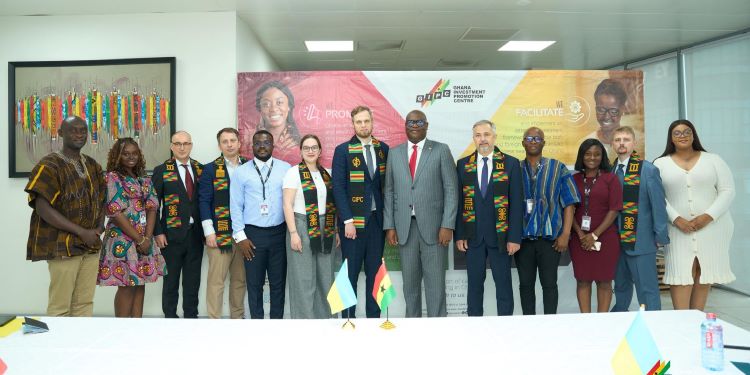
The Ghana Investment Promotion Centre (GIPC) has entered into high-level discussions with the Ukrainian government to establish a multi-million-dollar food distribution and processing hub in Accra – a strategic move that underscores Ghana’s growing influence as the commercial heartbeat of West Africa.
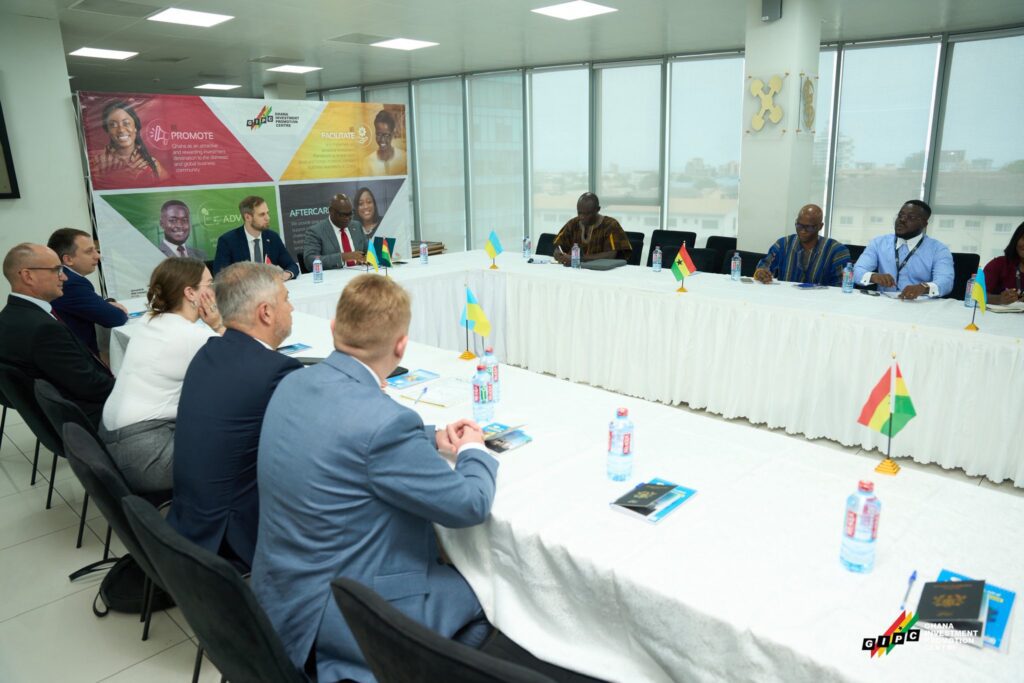
The announcement came following a pivotal meeting between the CEO of GIPC, Mr. Simon Madjie, and Ukraine’s Deputy Minister for Economy, Environment, and Agriculture, Mr. Denis Bashlyk, where Ukraine – traditionally known as the “breadbasket of Europe,” – sought to anchor its African expansion within the stable and investor-friendly climate of Ghana.
The proposed hub is designed to be more than a simple storage facility. According to the development roadmap, the center will serve as a sophisticated nexus for processing, packaging, and secondary distribution.
“Mr Bashlyk outlined plans to establish processing facilities and supply high-quality seeds to Ghanaian farmers to improve productivity, support technology transfer, and enhance food security… as well as potential investment in wheat flour processing and other value addition projects”
Ghana Investment Promotion Centre
According to the GIPC, the hub is expected to streamline the flow of essential agricultural commodities from the Black Sea region into the wider West African market, by leveraging Ghana’s strategic geographic position and its status as the host of the African Continental Free Trade Area (AfCFTA) Secretariat.

For GIPC, the initiative represents a significant win in its mission to attract foreign direct investment that offers tangible benefits to the local economy. Mr. Madjie emphasized that Ghana’s “investor-friendly environment,” was a primary factor in Ukraine’s decision, making this a calculated economic play and not a mere diplomatic gesture.
The establishment of such a hub is expected to create thousands of direct and indirect jobs, ranging from high-tech food processing roles to logistics and supply chain management positions.
Furthermore, the GIPC noted it has committed to a “concierge,” style of investment support to ensure the project moves from paper to reality with minimal friction. This includes dedicated assistance with regulatory facilitation, identifying suitable land for the processing facilities, and navigating the operational setup phase.
Lowering the barriers to entry for Ukrainian investors positions Ghana as the most reliable partner for international agricultural giants looking for a foothold in Africa.
Technology Transfer and Seed Sovereignty
While the distribution aspect of the hub is significant, the most transformative element for the Ghanaian farmer lies in the proposed technology and input transfer. Mr. Denis Bashlyk outlined a vision that goes beyond exporting grain to Ghana, as Ukraine intends to establish local processing facilities and, crucially, supply high-quality, high-yield seeds to Ghanaian farmers.
This move, presented in an earlier meeting with the Minister of Food and Agriculture, Hon. Eric Opoku, addresses one of the most persistent bottlenecks in Ghanaian agriculture: the lack of access to advanced inputs that can withstand climate variability and improve overall productivity.
The partnership includes a significant humanitarian and developmental component – the distribution of five million seed packets specifically targeted at vulnerable farmers to provide a much-needed “productivity shock” to the local sector, enhancing food security at the household level while integrating smallholder farmers into a more formal, high-value supply chain.
The discussions also delved into the specifics of industrial value addition, with a particular focus on wheat flour processing.
Currently, much of the region’s wheat-based products are imported as finished goods, leading to higher costs and missed industrial opportunities, but by investing in local milling and processing infrastructure, the Ukraine-Ghana partnership will capture more of the value chain within Ghanaian borders.
This focus on value addition aligns perfectly with the government’s broader industrialization agenda. Strengthening storage, processing, and logistics infrastructure will not only improve trade efficiency with Ukraine but will also build the muscle of Ghana’s domestic agricultural sector.
GIPC noted that when Ghana can finally process and package high-quality food products locally, it ceases to be a mere consumer in the global market and becomes a competitive exporter.
The meeting between Mr. Madjie and Mr. Bashlyk touched on the critical need for modernized storage and cold-chain solutions, underscoring the fact that a project of this magnitude requires a capable logistics backbone.
To function as a true regional gateway, the Ghanaian hub must be able to handle vast quantities of perishable and non-perishable goods with world-class efficiency and the infrastructure deficit is being viewed by both parties not as a hurdle, but as an additional investment opportunity.

The ripple effects of improved logistics infrastructure will be felt across all sectors of the Ghanaian economy. Improved roads, modernized port facilities, and state-of-the-art warehouses are the physical foundations upon which the “Blue Economy” and the “Agro-Industrial” sectors will grow.
As Ukraine brings its expertise in large-scale agricultural logistics to the table, Ghana must create the right environment to help the project succeed.
READ ALSO: US-Iran Ceasefire Talks Set To Begin