

New data from a national poll conducted in March 2026 by the Global InfoAnalytics has revealed a growing gap between voter sentiment and internal party preferences within the National Democratic Congress, with Dr Cassiel Ato Forson emerging as the most popular figure among general voters.
The findings, presented by Mussa Dankwa, show that while Ato Forson enjoys strong backing from the broader electorate, party chairman Johnson Asiedu Nketia maintains an edge among party delegates.
In a direct head to head comparison between the two, Ato Forson leads Asiedu Nketia by 14 percentage points among general voters. However, the trend reverses within the party structure, where Asiedu Nketia holds a 5 point advantage among delegates.
The contrasting outcomes highlight a complex political dynamic that could shape the party’s future leadership contest ahead of the 2028 elections.
Ato Forson’s Rising Momentum Among Delegates
Despite trailing slightly among delegates, Ato Forson has recorded significant gains within that group. According to the poll, his support among delegates increased from 12 percent to 19 percent, representing a 7 point rise over the survey period.
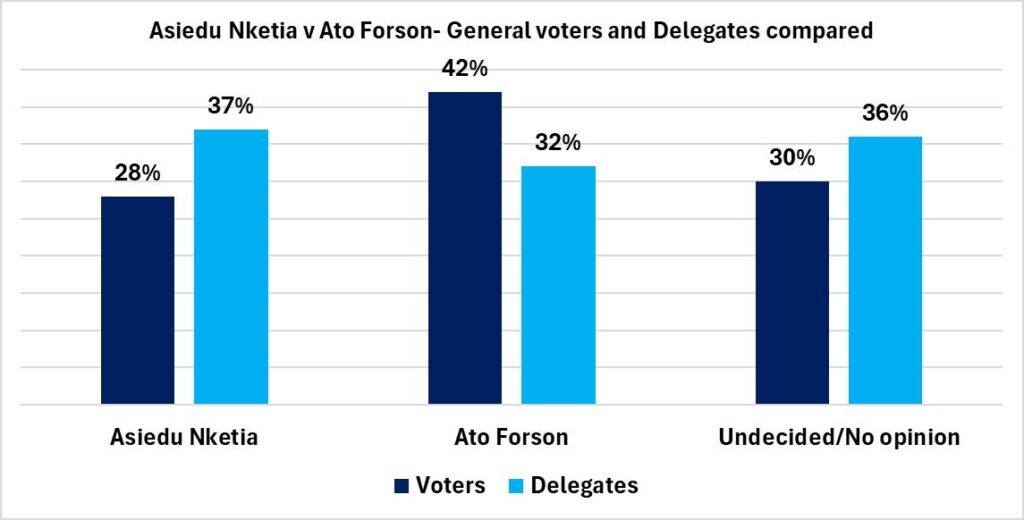
This growth accounts for nearly half of the total gains recorded among all candidates, suggesting a steady upward trajectory for the finance minister within the party’s internal base.
Mr Dankwa described this as a key development, noting that Ato Forson is now the second most popular candidate among delegates while maintaining his lead among general voters.
“We will continue to observe this phenomenon to see if it becomes a trend,” he said, indicating that future polls will determine whether the shift in support continues. The data also raises questions about whether Asiedu Nketia can maintain his lead among delegates or prevent further erosion of his support base.
General Voter Appeal as Strategic Advantage
The poll underscores Ato Forson’s strength among general voters, a factor that could prove decisive in a national election context. His ability to attract support beyond the party’s core membership positions him as a candidate with broader electoral appeal.
Political analysts note that this dual advantage, strong public support combined with rising delegate backing, could enhance his prospects should he decide to formally contest the party’s presidential primaries.
The convergence between delegate and voter support, though still evolving, is seen as a potential advantage that could distinguish his candidacy from others.
Haruna Iddrisu’s Mixed Support Profile
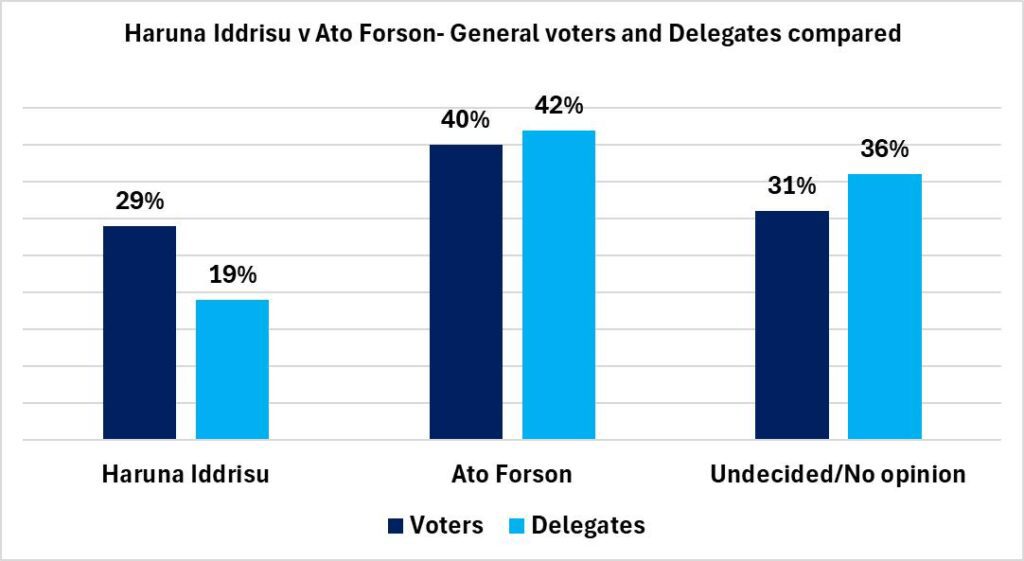
The data also provides insight into the standing of Haruna Iddrisu, whose support appears to differ significantly between voters and delegates. In a head to head contest with Ato Forson, Haruna Iddrisu secures 29 percent support among general voters but only 19 percent among delegates, a gap of 10 percentage points.
This suggests that while he remains relatively popular with the public, his influence within the party’s internal decision making structure may be more limited.
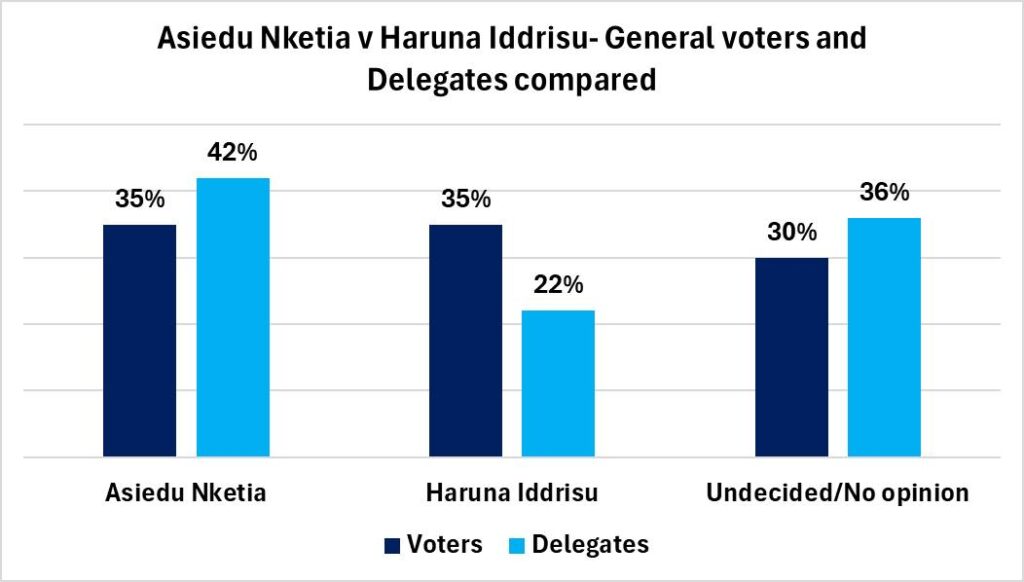
In contrast, Ato Forson’s support shows a more balanced pattern, with 40 percent backing among voters and 42 percent among delegates in direct comparisons. Mr Dankwa noted that this alignment between public and internal support could become a critical factor in determining future leadership outcomes.
Asiedu Nketia’s Strong Delegate Base
Despite the growing momentum behind Ato Forson, Asiedu Nketia continues to command strong support among party delegates. Previous polling data showed him maintaining a substantial lead over Haruna Iddrisu within the delegate base, with a margin of up to 20 points.
This dominance suggests that Asiedu Nketia remains a formidable figure within the party’s internal structure, even as his standing among general voters appears less pronounced.
The divergence between delegate and voter preferences reflects differing priorities and perspectives between the two groups, with delegates often focusing on internal party considerations while voters emphasize broader national issues.
Implications for NDC Leadership Race
The emerging data highlights the importance of understanding both internal and external political dynamics in shaping the future of the National Democratic Congress.
The differences in support between delegates and general voters suggest that potential candidates will need to balance party loyalty with broader public appeal.
For Dr Ato Forson, the challenge will be to consolidate his gains among delegates while maintaining his strong standing with the electorate. For Asiedu Nketia, the focus may be on expanding his appeal beyond the party base.
Haruna Iddrisu, meanwhile, faces the task of translating his public support into stronger backing within the party structure. With another round of polling expected in May 2026, there is a high expectation to see how these trends evolve. The current data provides an early indication of shifting dynamics, but the race remains fluid.
Mr Dankwa emphasized the value of comparing data from different sample groups, noting that it provides a more comprehensive understanding of political preferences. “The beauty of data from two different sample frames is to see the differences in choices,” he explained.
As the political landscape continues to develop, the interplay between voter sentiment and delegate influence is likely to play a decisive role in determining the party’s future leadership.
READ ALSO: Ghana Streamlines Licensing Procedures For Apparel Manufacturers