
A new poll among delegates of the National Democratic Congress has revealed an emerging contest for the party’s 2028 presidential candidacy, with Hon. Johnson Asiedu Nketia taking an early lead but facing increasing competition from Dr Cassiel Ato Forson.
The survey, conducted by Global InfoAnalytics, marks the first major snapshot of internal party sentiment following President John Dramani Mahama’s current tenure. It suggests that while Asiedu Nketia remains the frontrunner, his lead is narrowing as other potential contenders gain traction.
According to the findings, Asiedu Nketia commands 29 percent support among delegates, followed by Ato Forson at 19 percent. Haruna Iddrisu comes in third with 11 percent, while Julius Debrah and Professor Jane Naana Opoku-Agyemang each register 8 percent. A significant 24 percent of respondents remain undecided, highlighting the fluid nature of the race.
Shrinking Lead Raises Strategic Questions
While Asiedu Nketia maintains a clear lead, the poll indicates a shift in momentum. In an earlier baseline survey conducted a week prior, he led Ato Forson by 16 points. That margin has now narrowed to 10 points, suggesting that undecided delegates are increasingly leaning toward the finance minister.
A similar trend is observed in comparisons with other candidates. Asiedu Nketia’s lead over Haruna Iddrisu has reduced from 20 points to 18 points, while his advantage over Julius Debrah has dropped from 23 points to 21 points.
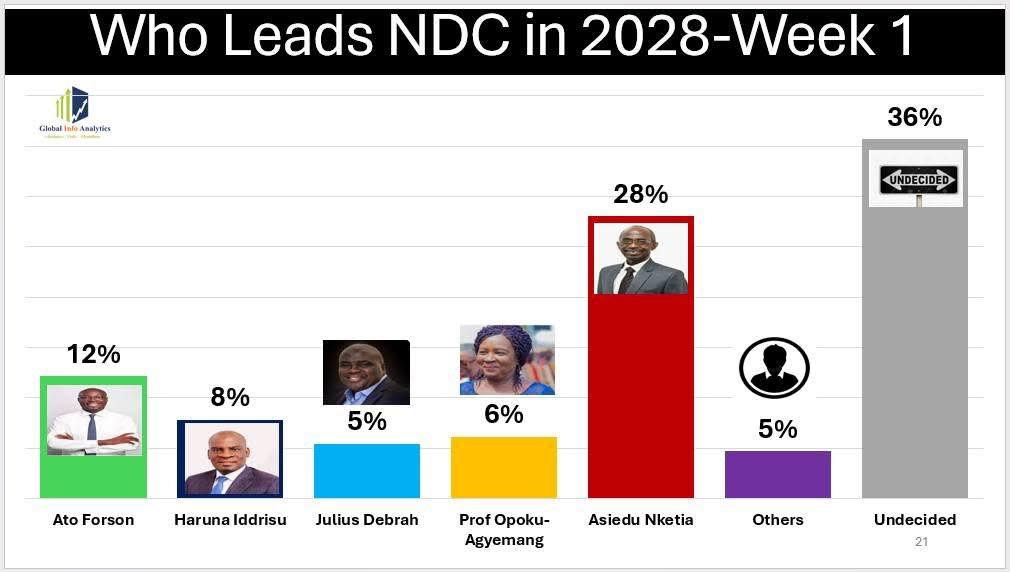
The data suggests that although the party chairman remains ahead, other contenders are gradually consolidating support. Political analysts say this trend reflects a dynamic internal contest where early leads may not necessarily translate into final outcomes.
The narrowing gaps point to an evolving race that could intensify as the party approaches its next presidential primary.
Head to Head Contests Reveal Close Margins
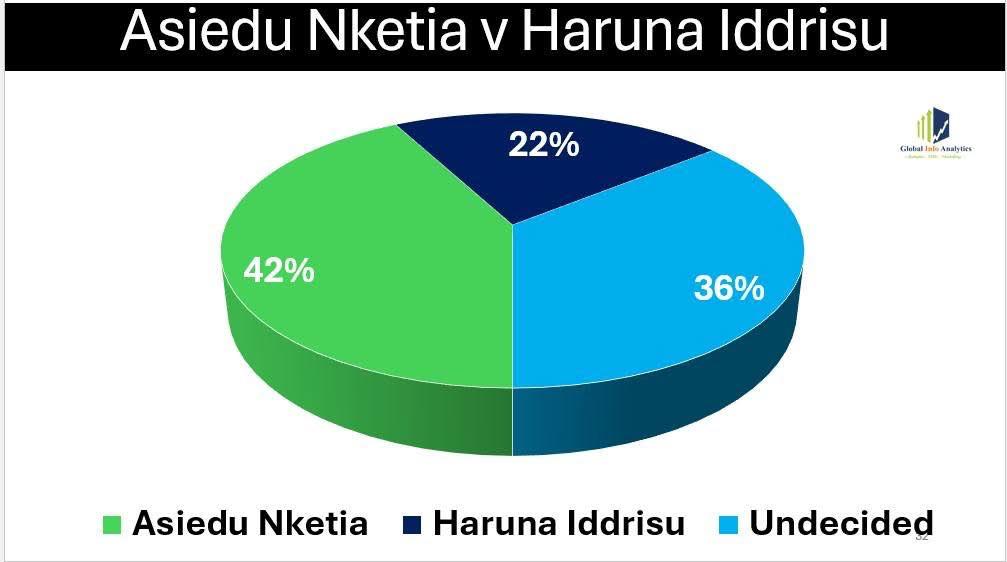
Further insights from the poll show how candidates perform in direct comparisons. In a head to head scenario between Asiedu Nketia and Haruna Iddrisu, the party chairman leads with 42 percent against 22 percent, with 36 percent undecided.
A similar pattern is observed in a matchup with Julius Debrah, where Asiedu Nketia secures 43 percent compared to Debrah’s 18 percent, while 39 percent remain undecided.
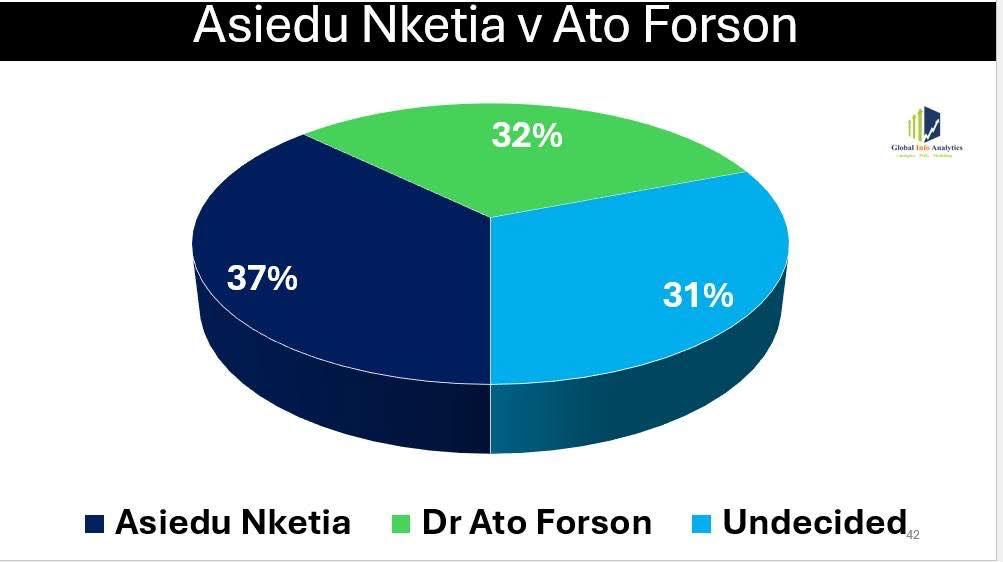
However, the most competitive pairing is between Asiedu Nketia and Ato Forson. In this scenario, the chairman leads with 37 percent, closely followed by Forson at 32 percent, with 31 percent undecided. This narrower margin underscores Forson’s growing appeal within the party and positions him as the most formidable challenger.
Despite the absence of any formal declaration from Ato Forson regarding a presidential bid, the poll suggests that he is already a central figure in the conversation about the party’s future leadership.
Delegates Prioritize Performance and Vision
Beyond candidate preferences, the poll provides insight into the qualities delegates consider most important in selecting a presidential candidate. A strong majority of respondents, 74 percent, identified performance as the top criterion, followed by 53 percent who emphasized the need for a visionary leader.
Other factors included being a good servant of government at 35 percent and a good servant of the party at 20 percent. Personality was cited by 20 percent of respondents, while only 8 percent mentioned the importance of a youthful candidate.
Gender was a factor for just 1 percent, indicating that delegates are more focused on leadership attributes than demographic considerations.

These findings suggest that candidates seeking to strengthen their positions will need to demonstrate clear records of achievement and articulate compelling visions for the party and the country.
Grassroots Concerns Over Jobs Dominate Sentiment
The poll also highlights underlying concerns among party delegates, particularly regarding employment opportunities. A significant 78 percent of respondents expressed concern about the lack of jobs, reflecting broader national anxieties about economic conditions.
Despite these concerns, there remains a strong sense of optimism within the party. About 88 percent of delegates indicated that they are hopeful the situation will improve in the near future. Only 3 percent expressed pessimism, while 9 percent were uncertain.
Analysts note that these sentiments could influence the direction of the leadership race, as candidates may be expected to address job creation and economic growth as central campaign themes.
The poll was conducted between March 31 and April 9, covering nearly 10,400 delegates across all 16 regions of Ghana. The survey used random probability sampling and computer assisted data collection methods to ensure a broad and representative sample.
This wide coverage provides a comprehensive snapshot of internal party dynamics at an early stage in the succession process. However, observers caution that opinions may shift significantly as the political landscape evolves and candidates formally declare their intentions.
An Open Race with Evolving Dynamics
The findings underscore the competitive nature of the emerging NDC race to succeed President Mahama. While Asiedu Nketia currently leads, the narrowing margins and high number of undecided delegates suggest that the contest remains open.
Ato Forson’s rising support positions him as a key contender, even in the absence of an official campaign. Meanwhile, other figures such as Haruna Iddrisu, Julius Debrah, and Jane Naana Opoku-Agyemang continue to maintain notable levels of support.
As the party prepares for the next electoral cycle, the focus is likely to shift toward policy direction, leadership style, and the ability to address pressing national concerns. For now, the race remains fluid, with multiple pathways still possible.
READ ALSO: Pope Leo Touches Down in Algeria for Historic Papal Visit