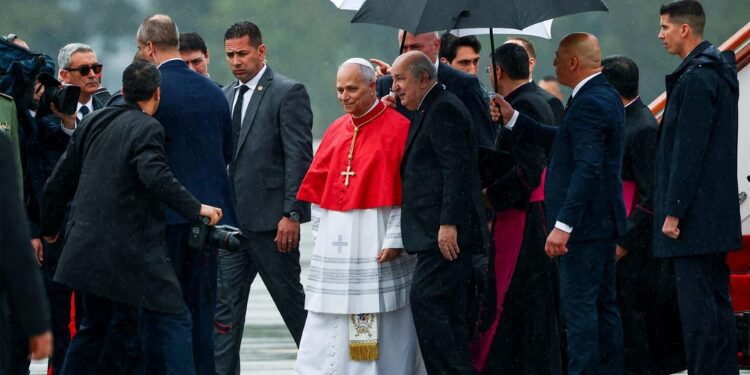
Pope Leo XIV has touched down in Algeria for a historic papal visit, becoming the first pontiff to undertake an apostolic journey to the North African nation and opening his four-country tour of Africa with a landmark diplomatic and pastoral milestone.
According to Pope Leo XIV, the Africa trip had originally been envisioned as the first international journey of his papacy.
He described the visit as “very special for several reasons” and expressed hope that it would serve as “a blessing for me personally,” as well as for “the Church and the world.”
Pope Leo XIV also highlighted the symbolic and spiritual significance of Algeria, noting his deep connection to the legacy of St. Augustine. “I am very happy to visit the land of St. Augustine again,” he said, adding that Augustine provides a very important bridge in interreligious dialogue and remains much loved in his homeland.
The Holy Father emphasized that the journey reflects a broader mission of building bridges to build peace and reconciliation, describing the visit as an opportunity to reinforce a shared global message of unity.
The Pope’s arrival in Algiers was marked by a formal state welcome, with President Abdelmadjid Tebboune receiving the pontiff as an honour guard stood in formation and a young girl presented him with flowers. The visit carries particular weight in light of Algeria’s religious landscape, where around 99% of the population is Sunni Muslim and the Catholic community numbers fewer than 9,000 people out of more than 45 million residents.
The visit also holds personal significance for Pope Leo, who has often referred to himself as a “son of Augustine.” During his election on May 8, 2025, he invoked the legacy of St. Augustine, the former bishop of Hippo Regius near present-day Annaba, who died there in A.D. 430. The pontiff had previously travelled to Algeria in 2003 and again in 2014 while serving as leader of the Augustinian order.
Algeria also holds deep significance in modern Church history, being the site of the martyrdom of 19 Catholics during the Algerian Civil War, later beatified in 2018. Their story continues to symbolise the Church’s resilience and commitment to faith in the region despite periods of violence and hardship.
Bishop Michel Guillaud of Constantine-Hippone in an interview with a media outlet, noted that the purpose of the visit is centred on “meeting the Algerian people and supporting his Church,” while also drawing strength from the enduring spiritual connection associated with Augustine’s legacy.
Pope Leo Defies Trump Criticism, Vows to Continue Peace Advocacy

Earlier aboard, the Holy Father defied Trump criticism and vowed to continue peace advocacy, stating he has no fear of the administration of Donald Trump despite a sharp and public rebuke over his stance on the escalating conflict involving Iran.
The first US-born pope in history emphasised that his broader appeal for peace and condemnation of the “delusion of omnipotence” fuelling the Iran wars and other conflicts around the world was not intended as a direct attack against Trump or any other individual.
The Holy Father, made the remarks while speaking to reporters aboard his flight to Algeria, marking the beginning of his African tour and his second major international trip since assuming the papacy last year. The visit is expected to focus on peacebuilding, humanitarian outreach, and strengthening ties with Catholic communities across the continent.
In earlier statements, the Holy Father strongly criticised Trump’s rhetoric toward Iran, particularly a warning that “a whole civilisation will die tonight,” which he described as “truly unacceptable.” He has repeatedly called for an off-ramp to end the conflict, reinforcing his position that diplomacy and restraint remain the only viable path forward.
This response came after US President, Donald Trump issued a strong criticism on Sunday night, questioning the Pope’s performance and describing him as politically liberal, while also urging him to distance himself from what Trump characterised as radical left-wing influences.

“He’s a very liberal person, and he’s a man who doesn’t believe in stopping crime, he’s a man who doesn’t believe we should be toying with a country that wants a nuclear weapon so they can blow up the world.”
Donald Trump
Regardless, the Holy Father remains firmly committed to prioritising peace and reconciliation in a world marked by conflict and tension. He continues to advocate for dialogue, mutual understanding, and humanitarian concern. His message consistently centres on reducing suffering, promoting stability, and encouraging global leaders and communities to choose cooperation over division.
READ ALSO : Investor Jitters Rise as Analyst Forecasts Tepid Market Activity in Q2