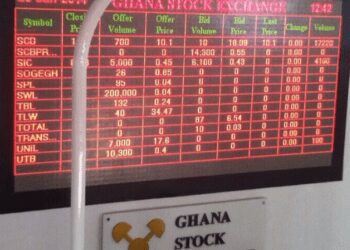
The Ghana Stock Exchange (GSE) delivered an exceptional performance in the first quarter of the year, sparking optimism among investors and market watchers.
However, emerging signals suggest that this bullish momentum may not carry through into the second quarter, with analysts warning of a likely slowdown in trading activity and returns.
In an exclusive engagement, Vaultz News spoke with Kwabena Nyarko, Financial Market Expert and CEO of Pipliquidator Fx, who provided deep insights into the market’s trajectory and what investors should expect in the months ahead.
A Strong First Quarter Sets the Tone
The GSE closed the first quarter on a high note, with the benchmark GSE Composite Index reaching 13,095.56 points, representing a remarkable year-to-date return of 49.32 percent. The GSE Financial Stocks Index also recorded a significant gain, closing at 8,195.07 points with a year-to-date return of 76.35 percent.
Market capitalization reflected similar strength, climbing past the GHS 300 billion mark before consolidating at GHS 246.5 billion by the end of the quarter.
Mr. Nyarko described the performance as “one of the most impressive starts to a financial year in recent memory,” attributing the rally to improved investor confidence, macroeconomic stability, and renewed interest in financial stocks.
“What we witnessed in the first quarter was a convergence of positive macroeconomic signals and strong corporate performance, particularly within the banking sector. Investors responded to these signals with renewed confidence, which translated into significant gains across the board.”
Kwabena Nyarko
He added that the financial sector played a crucial role in driving the rally, noting that “banks and financial institutions have become the backbone of the market’s recent resurgence.”
Why the Second Quarter May Lose Steam
Despite the impressive Q1 performance, Mr. Nyarko cautioned that the second quarter may not replicate the same level of growth. According to him, the market is entering a phase of consolidation, where gains are likely to stabilize rather than accelerate.
“Markets do not move in a straight line. After such a sharp rally, it is natural to see a period of correction or muted activity. The second quarter is likely to reflect that adjustment phase. I expect tepid activity across the market in the second quarter.”
Kwabena Nyarko
He emphasized that investor expectations must be recalibrated, as the extraordinary returns seen in Q1 are unlikely to be sustained in the near term.
In his view, “the current environment calls for cautious optimism rather than aggressive positioning,” adding in a measured tone that “investors should prepare for a more subdued pace of returns.”

Key Factors Driving the Muted Outlook
Mr. Nyarko highlighted several factors that could contribute to the anticipated slowdown in market activity. Chief among them is profit-taking, as investors who benefited from the Q1 rally may begin to offload their positions.
“When you have a market that delivers close to 50 percent returns in just one quarter, it is only logical that some investors will lock in profits. That alone can reduce upward momentum.”
He also pointed to external economic uncertainties, including global financial conditions and commodity price fluctuations, as potential headwinds.
“Global market dynamics cannot be ignored,” he remarked, adding that “developments in international markets like what is going on in the middle east often have a ripple effect on emerging markets like Ghana.”
Another critical factor, he said, is liquidity constraints. While investor interest remains strong, limited liquidity could dampen trading volumes and slow price movements.
“Liquidity is the lifeblood of any market. If it tightens, even a fundamentally strong market can experience slower growth,” he cautioned.
Sectoral Outlook: Financial Stocks Remain Key
While the overall market outlook for Q2 appears subdued, Mr. Nyarko remains optimistic about certain sectors, particularly financial stocks.
He explained that “the banking sector still holds significant upside potential, even in a moderating market,” citing improved balance sheets and regulatory stability as key drivers.
“Financial stocks will continue to attract investor attention, but the pace of growth may not be as explosive as what we saw in Q1. Instead, we are likely to see more measured and sustainable gains.”
Kwabena Nyarko
At the same time, he advised investors to diversify their portfolios, noting that “overconcentration in a single sector can expose investors to unnecessary risks, especially in a slowing market.”
Investor Strategy in a Cooling Market
As the market transitions into what is expected to be a quieter quarter, Mr. Nyarko urged investors to adopt a more strategic and disciplined approach.
“This is not the time for speculative trading. Investors need to focus on fundamentals, conduct thorough analysis, and take a long-term view of the market.”
Kwabena Nyarko
He stressed the importance of patience, adding that “successful investing is not about chasing short-term gains but about building sustainable wealth over time.”
In a candid remark, he noted that “those who remain disciplined during periods of market slowdown often emerge stronger when the next growth cycle begins.”
Outlook for the Market
While the second quarter may bring a slowdown in market activity, Mr. Nyarko remains confident in the long-term prospects of the Ghanaian stock market.
“The fundamentals of the Ghanaian economy are gradually improving, and the stock market will continue to reflect that progress over time. A temporary slowdown should not be mistaken for a reversal of the broader growth trend.”
Kwabena Nyarko
He concluded with a reassuring message to investors.
“Every market cycle has its highs and lows. What matters is how investors position themselves during these phases. The second quarter may be quieter, but it also presents opportunities for those who know where to look.”
Kwabena Nyarko
As investor jitters rise amid expectations of a tepid second quarter, the message from market experts is that caution, strategy, and a long-term perspective will be key to the evolving market.
READ ALSO: Moody’s Upgrades Ghana Outlook on Stronger Fiscal Position