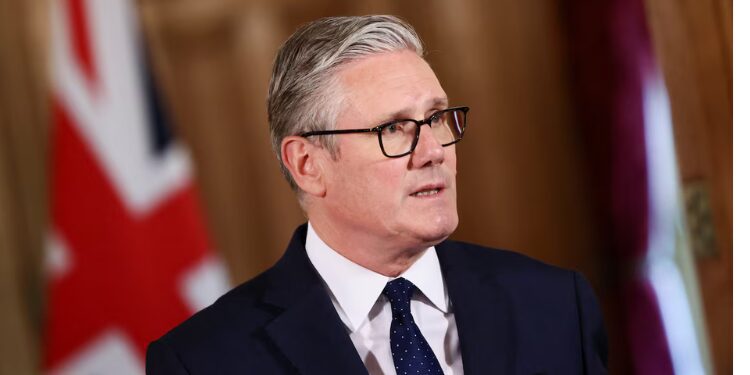
UK Prime Minister, Keir Starmer has accepted responsibility for Labour’s poor performance in local elections across England after the party suffered significant losses in several key areas, intensifying political pressure on his leadership.
Speaking to reporters following the early results, Starmer admitted the scale of the setback, saying, “They are very tough, and there’s no sugarcoating it.”
He further indicated that, Labour had “lost brilliant Labour representatives across the country, that hurts, and it should hurt, and I take responsibility”.
Despite the losses, the Prime Minister insisted the results would not alter his political direction, adding, “Days like this don’t weaken my resolve to deliver the change that I promised.”
The elections, which cover 136 local councils across England alongside devolved parliamentary contests in Scotland and Wales, are widely viewed as the most important test of public opinion ahead of the next general election expected in 2029.
Early counting showed Labour losing support in several traditional strongholds, particularly in former industrial regions across central and northern England, as well as parts of London.
The losses quickly intensified speculation about Starmer’s political future, with some Labour lawmakers warning that poor performances in Scotland and Wales, combined with heavy council losses in England, could renew calls for the Prime Minister to step aside or set out a timetable for his departure.
However, Senior Labour figures moved swiftly to defend Starmer and discourage any immediate leadership challenge.
John Healey acknowledged the scale of the setbacks but insisted the government still had time to recover politically. “I think he can still deliver, he can still turn it round,” Healey added.
He also warned against internal divisions, saying voters did not want “the potential chaos of a leadership election.”
Labour suffered one of its most symbolic defeats in Tameside, where the party lost control of the council for the first time in nearly 50 years after Reform UK captured all 14 seats Labour had been defending.
Political analyst John Curtice described the outcome as worse than many within Labour had anticipated.“The picture has been pretty much as bad as anyone expected for Labour, or worse,” he said.
In the midst of the uncertainties, Keir Starmer stated “I’m not going to walk away and plunge the country into chaos.” after the first results in England showed losses for Labour.
He pointed to Labour’s landslide victory in the July 2024 general election stating, “I led our party to that victory, that is a five-year mandate to change the country.”
Starmer concluded that in the coming days, he will”set out the further steps” that Labour will take to convince the electorate.
Reform UK Surge Signals Growing Fracture in Britain’s Political Landscape
Nigel Farage and his Reform UK party emerged as the biggest winners from the early local election results, gaining more than 300 council seats across England and reinforcing signs of a major political realignment in Britain.
The results highlighted the continued breakdown of the country’s traditional two-party system, with both Labour and the Conservatives losing support to smaller and insurgent parties from across the political spectrum.
Analysts said the elections reflected one of the most significant shifts in British politics in decades, as increasing numbers of voters turned away from the once-dominant Labour and Conservative parties.
Farage described the results as a “historic change in British politics.”
Reform UK’s gains have also strengthened speculation that the party could emerge as a significant opposition force in Scotland and Wales, potentially challenging the influence of the pro-independence Scottish National Party and Plaid Cymru.
At the same time, other smaller parties also recorded encouraging early performances. The Green Party reported strong results in several areas, while the Liberal Democrats said they expected further gains as counting continued throughout the day.
Green Party MP Sian Berry welcomed the initial results, saying the party was “looking at really good early results.”
Meanwhile, the Conservatives also faced setbacks in several areas, although party figures attempted to downplay the scale of the losses. James Cleverly described it as a “tough” day for the Conservatives but insisted there were “some areas where we’ve beaten expectations”.
Reform Deputy Leader Richard Tice indicated that the results reflected widespread frustration with Britain’s political establishment and described the outcome as a “complete rejection” of Labour and the Conservatives.