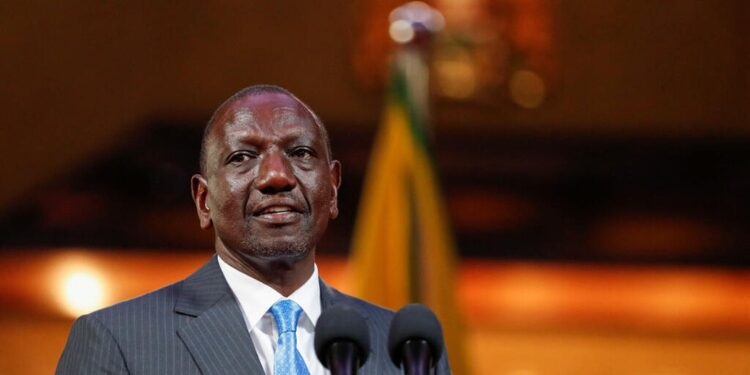
Kenyan President William Ruto has issued a strong appeal for Africa to assume greater responsibility for shaping its economic future, insisting that the continent must break away from reliance on foreign aid and increasingly harness its own resources to drive development and long-term transformation.
Addressing heads of state, government officials, business leaders and development partners, including French President Emmanuel Macron at the Africa Forward Summit in Nairobi, Ruto indicated that, the gathering represented an opportunity to redefine Africa’s relationship with longstanding partners and reposition the continent as a strategic actor rather than a passive recipient of external assistance.
“We gather, ladies and gentlemen, at a profound, consequential moment in global affairs. The foundations of international order are being reshaped by deepening geopolitical divisions, persistent conflicts, economic volatility, climate pressures and widening inequalities.”
William Ruto
Ruto noted that the answer to growing global fragmentation was not isolation, but stronger multilateral cooperation based on sovereign equality, mutual respect and shared responsibility.
“It is not how we do it. It is in that spirit that we convene this summit, grounded in our shared conviction that enduring partnerships must not be built on dependency but on sovereign equality, not on aid or charity but on mutually beneficial investments and not on extraction or exploitation but on win-win engagements.”
William Ruto
He stressed that Africa is approaching global negotiations from a position of strength, pointing to the continent’s vast natural resources, expanding consumer markets and rapidly growing youth population.
By 2050, he noted, one in every four people in the world will be African, a demographic shift that will shape labour markets, urbanisation, energy demand and global economic growth.
Ruto urged international partners, including France, to build relationships with Africa around industrialisation, innovation and value creation rather than traditional donor-recipient arrangements.
“Because Africa is not part of the global problem, Africa is in fact the solution to the global challenges that exist today, including those of Africa.”
William Ruto
Moreover, the Kenyan President indicated that Africa must reduce dependence on costly external borrowing and instead harness domestic capital to fund infrastructure, industrialisation and climate resilience.
He criticised the international financial system for imposing disproportionately high borrowing costs on African countries and for perpetuating risk perceptions that do not reflect the continent’s economic realities.
“This imbalance is neither sustainable nor just. It is one of the principal constraints on Africa’s ability to finance infrastructure, industrialization, climate adaptation and economic transformation at the scale that is required.”
William Ruto
At the centre of his message was a direct appeal for the continent to trust in its own financial strength. He said Africa holds more than $4 trillion in domestic savings, including pension funds, insurance assets and central bank reserves, yet continues to face significant financing gaps in critical sectors. “Africa must increasingly finance Africa. Let me repeat that. Africa must increasingly finance Africa, ” Ruto stated.
According to Ruto, the challenge facing the continent is not a shortage of liquidity, but fragmented financial systems and persistent perceptions of risk that discourage investment in productive sectors.
He pointed to Kenya’s National Infrastructure Fund as an example of what can be achieved when domestic resources are mobilised effectively, revealing that the fund has raised approximately $1 billion in just four months. He also said Kenya has mobilised nearly $4 billion locally over the past three and a half years to support its affordable housing programme.
Ruto said stronger African institutions such as the African Development Bank, Afreximbank and the Africa Finance Corporation will play a central role in building a more resilient and coordinated financial architecture.
He also argued that Africa’s vast renewable energy potential should be used to drive industrialisation rather than simply exporting raw materials for processing elsewhere. “Africa must become a competitively industrial hub powered by clean energy, modern infrastructure, innovation and strategic investment partnerships,” he added.
Ruto Pushes for Security Council Reform and African-Led Peace Efforts

President William Ruto also called for reforms in global governance and stronger African-led responses to growing insecurity on the continent, warning that persistent conflict, extremism and weak institutions continue to undermine Africa’s development and stability.
According to the Kenyan President, parts of Africa are facing overlapping crises driven by violent extremism, terrorism, organised crime, unconstitutional changes of government and the worsening effects of climate change.
He noted that the scale of the challenge is already reflected in global figures, with Africa accounting for nearly 40 per cent of active armed conflicts worldwide and close to half of all internal displacements. “These figures underscore both the scale and the urgency of the challenges confronting our continent,” he said.
Ruto further stressed that peace in Africa cannot be achieved through military responses alone, stating, “We must therefore reaffirm our collective support for African-led peace and security mechanisms.”
He further indicated that, Africa must strengthen its own strategic autonomy in managing peace and security, while also calling for reforms in global institutions, particularly the United Nations Security Council.
Ruto strongly criticised Africa’s continued exclusion from permanent representation, despite the continent’s population size and global significance.
“It is both indefensible and unconscionable that a continent of nearly 1.5 billion people continues to remain excluded from permanent representation on the Security Council.
William Ruto
He warned that such exclusion weakens the legitimacy of global governance systems, stating, “No global governance architecture can credibly claim to be democratic, while a substantial part of humanity remains absent from the table where the world’s most consequential decisions are made.”
READ ALSO: President Mahama Arrives in Nairobi for Africa Forward Summit