
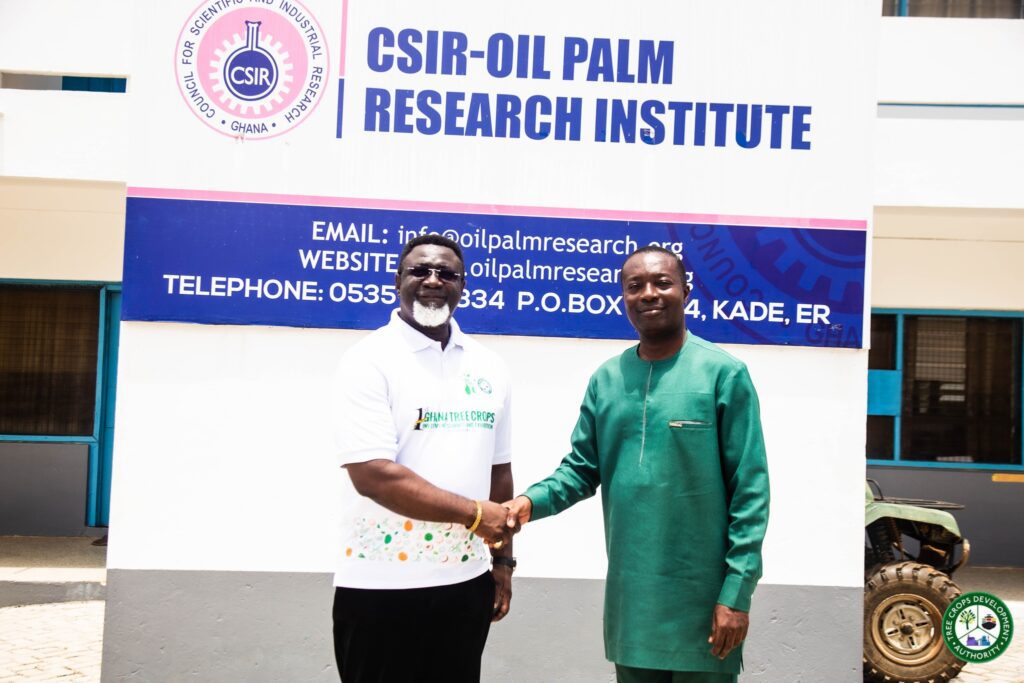
The leadership of the Tree Crops Development Authority (TCDA), led by Chief Executive Officer Dr. Andy Osei Okrah, has conducted a high-level assessment of the Council for Scientific and Industrial Research – Oil Palm Research Institute (CSIR-OPRI) to verify its capacity to anchor the National Policy on Integrated Oil Palm Development (2026-2032).
According to the TCDA, this strategic verification exercise marks the transition of the government’s 100,000-hectare expansion agenda from a budgetary blueprint into an implementation phase.
Checking the institute’s operational readiness ensured that the proposed $500 million financing facility is supported by a robust supply of certified and high-yielding planting materials. The move effectively linked research-driven agriculture to the broader national goals of industrialization, export expansion, and sustainable job creation.
“The national policy, announced as part of the 2026 Budget, seeks to transform Ghana’s oil palm industry through the establishment of 100,000 hectares of new oil palm plantations nationwide. The initiative is backed by a proposed $500 million financing facility and is projected to create between 250,000 and 500,000 direct and indirect jobs across the oil palm value chain”
Tree Crops Development Authority
The National Policy on Integrated Oil Palm Development is a massive fiscal and agricultural commitment to the tree crop sector. The initiative is not merely about land expansion; it is a structured attempt to transform Ghana’s oil palm industry into a globally competitive powerhouse.
The ambitious scale of this six-year project is expected to trigger a significant socio-economic shift, with projections suggesting the creation of between 250,000 and 500,000 direct and indirect jobs across the entire oil palm value chain.
The implementation framework for this national policy relies on a critical synergy between regulation and scientific research. Under this arrangement, the Tree Crops Development Authority serves as the regulatory anchor, tasked with enforcing quality standards, sustainability protocols, and sector-wide compliance.
Conversely, CSIR-OPRI acts as the technical engine, responsible for the scientific integrity of the inputs that will drive the expansion. This convergence is intended to prevent the proliferation of substandard planting materials, which have hindered the sector’s productivity in the past.
During the visit, Dr. Okrah and his delegation were briefed on the “nursery management and quality assurance systems” currently being deployed to meet the rigorous demands of the national project. The delegation’s tour of the CSIR-OPRI facilities in Kusi provided a firsthand look at the scale of preparation required for such a massive intervention.
Dr. Isaac Danso, Director and Principal Research Scientist at the institute, demonstrated the various stages of seed germination and seedling development, emphasizing traceability and genetic purity – factors that are essential for attracting the international investors to engage with the $500 million financing facility.
The TCDA vetted these operational facilities to de-risk the government’s investment, ensuring that the project’s primary inputs deliver the projected yields.

Technical Readiness and Seedling Volume
One of the most significant outcomes of the engagement was the confirmation of CSIR-OPRI’s production capacity. Management at the institute assured the TCDA leadership that it has already secured over five million quality oil palm seedlings to meet the anticipated surge in demand.
This volume is critical for the initial phases of the 100,000-hectare target. For the TCDA, this operational readiness was a vital sign that the government’s policy is backed by physical inventory rather than just legislative intent.
Dr. Andy Osei Okrah commended the institute’s management for their foresight in expanding production capacity ahead of the policy’s full rollout, noting that the ability to supply high-yielding materials at this scale is what will differentiate this expansion from previous, less-coordinated agricultural programs.
He further added that the technical expertise demonstrated by the CSIR-OPRI scientists – particularly in the areas of quality assurance and nursery management – is a strong indication that the national oil palm plantation initiative is on course for a successful implementation.
Reaffirming the executive vision, Dr. Okrah highlighted that H.E. John Dramani Mahama’s focus on this sector is a “transformative intervention designed to build a resilient and globally competitive oil palm industry.”
Beyond the immediate agricultural output, the National Policy on Integrated Oil Palm Development is a driver for industrialization, as the expansion of plantations is intended to feed a growing network of processing mills, thereby creating a robust “oil palm value chain” that supports local manufacturing.

This strategy aligns with the broader national agenda of moving away from the export of raw materials toward high-value, processed agricultural products. The $500 million financing facility is to support this transition by providing the necessary capital for both plantation development and the industrial infrastructure required to process the resulting yields.
The TCDA CEO emphasized that the partnership between the regulator and the research institute is the anchor for this resilience, grounding the project in “research, regulation, quality assurance, and sustainability,” to competitively position Ghana on the global stage.
With five million seedlings ready for deployment and a $500 million facility on the horizon, the focus has shifted from policy debate to execution.
READ ALSO: Steve Cohen Announces End Of Reelection Bid