The government has unveiled an ambitious plan to transform Ghana’s oil palm industry into a major pillar of economic growth, job creation, and export diversification, announcing sweeping reforms and investments aimed at revitalising a sector long described as rich in potential but stunted by fragmented development.
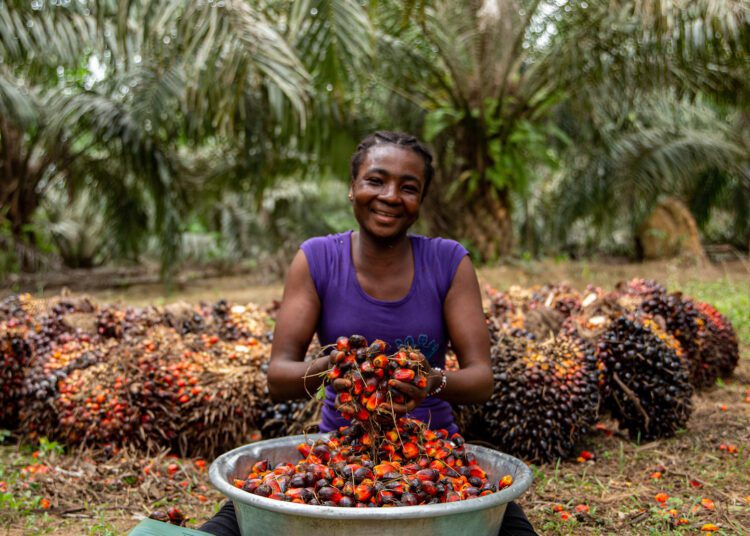
Presenting the 2026 Budget Statement to Parliament, the Minister for Finance and Acting Minister for Defence, Dr. Cassiel Ato Forson, outlined a bold National Policy on Integrated Oil Palm Development (2026–2032) that seeks to position oil palm—Ghana’s “Red Gold”—as a cornerstone of agricultural industrialisation.
Dr. Forson stated that the policy represents a decisive shift in the country’s approach to oil palm, combining large-scale plantation development with smallholder inclusion, sustainable financing, regulatory strengthening, and export-oriented value chain expansion.
“The policy represents a new dawn for Ghana’s agro-industrial future, drawing lessons from global leaders such as Malaysia and Indonesia while adapting them to our local context.”
Dr Cassiel Ato Forson, Ghana’s Minister for Finance
Cultivation of 100,000 Hectares of New Oil Palm Plantations
A key target of the policy is the cultivation of 100,000 hectares of new oil palm plantations across suitable regions of the country. Dr. Forson described this as the scale required to unlock Ghana’s comparative advantage and reduce its dependence on imported crude palm oil.
Despite being one of the earliest African countries to cultivate the crop, Ghana imports almost 200,000 metric tonnes of crude palm oil annually, draining more than US$200 million in foreign exchange. “This policy seeks to change that reality,” he said, emphasising that the plan aims to achieve self-sufficiency while laying the foundation for export competitiveness.

The expansion programme is expected to generate more than 250,000 direct and indirect jobs across the value chain, including roles in nursery development, plantation establishment, harvesting, processing, refining, logistics, and agro-industrial services.
Citing the success of Côte d’Ivoire—which produces more than 650,000 tonnes of crude palm oil annually compared to Ghana’s 260,000 tonnes—Dr. Forson highlighted the urgency of coordinated national action. He noted that Ghana’s climate and land endowment provide ample opportunity for rapid scale-up if supported by the right policies.
One of the most persistent constraints to plantation development, according to the minister, has been access to large, contiguous tracts of land suitable for cultivation.
To resolve this, the government will acquire and develop land banks through the Ministry of Lands and Natural Resources, ensuring secure tenure, transparent ownership structures, fair compensation, environmental compliance, and proper registration under the Lands Act, 2020 (Act 1036). Dr. Forson stressed that this approach will provide the clarity and predictability investors and farmers need to expand production.
US$500 million Oil Palm Development Finance Window.
A major financing intervention sits at the heart of the policy: a dedicated US$500 million Oil Palm Development Finance Window. Developed in partnership with the World Bank, other development finance institutions, and the Development Bank of Ghana (DBG), the facility is intended to break what the minister described as the “financing trap” associated with long-gestation crops.

“Conventional short-term commercial loans are ill-suited for a crop that takes nearly seven years to reach full maturity,” he said. The new facility will provide long-term loans, a five-year moratorium on both principal and interest, concessional rates, and financing for up to 70 percent of project costs.
Funding under this window will be tied to strict sustainability and governance standards, channelled only into environmentally responsible, labour-friendly, and community-supportive investments.
Dr. Forson noted that the model is designed to crowd in both domestic and international investors, moving Ghana closer to a competitive agro-industrial economy capable of earning substantial foreign exchange.
The inclusion of smallholder farmers is a central pillar of the strategy. Through a new Outgrower Partnership Scheme, smallholders will be directly linked to nucleus estates and processing facilities. They will receive improved seedlings, mechanisation services, subsidised fertiliser, and guaranteed off-take agreements at fair and transparent prices.
Institutions such as the Tree Crops Development Authority (TCDA), the Oil Palm Research Institute (OPRI), and Ghana EXIM Bank will support cooperatives with financing, research, technical assistance, and market facilitation. A Smallholder Support Fund will prioritise women and youth, giving them access to affordable credit and skills training to strengthen inclusion.

Dr. Forson said this model mirrors global best practice, particularly in Southeast Asia, where coordinated integration of large estates and smallholders transformed oil palm into an engine of shared prosperity. “By combining the scale of large estates with the dynamism of small farmers, Ghana will create a value chain that is both competitive and equitable,” he added.
Strengthening Institutions
Institutional strengthening forms another major layer of the policy. The TCDA will lead regulatory oversight, including licensing, production planning, and data management.
Dr Forson also noted that OPRI will spearhead research on high-yield, climate-resilient varieties, while the Oil Palm Development Association of Ghana (OPDAG) will lead industry coordination and public-private engagement.
To improve compliance and prevent revenue leakages, the government will introduce a tax stamp regime for refined edible oils, similar to the system used in the beverage industry. Dr. Forson explained that this will reduce smuggling and under-declaration while protecting local producers from unfair competition.
The Finance Minister described the oil palm policy as a comprehensive blueprint for agricultural transformation, export diversification, job creation, and rural development.
“It is a bold commitment to re-industrialise agriculture, deepen rural transformation, and make Ghana a regional leader in sustainable palm oil production by 2032. Ghana has the land and the people. What we are now adding is the vision that ensures every palm planted today becomes a symbol of prosperity tomorrow.”
Dr Cassiel Ato Forson, Ghana’s Minister for Finance
The unveiling of the National Policy on Integrated Oil Palm Development marks a decisive turning point in Ghana’s agricultural and industrial trajectory.

With its blend of large-scale plantation expansion, strong smallholder inclusion, sustainable financing, and enhanced regulatory oversight, the policy lays out a clear and practical pathway for transforming oil palm into a major engine of jobs, exports, and rural prosperity.
It reflects a renewed national commitment to unlock Ghana’s long-untapped potential in “Red Gold,” positioning the sector as a cornerstone of economic diversification. As Dr. Cassiel Ato Forson emphasised, Ghana now pairs its natural advantage with a strategic vision capable of turning every planted palm into a symbol of long-term, shared prosperity.
READ ALSO: Ghana Attracts $3.5bn Oil Investments to Revive Production