
Speaking before an elite gathering of international state officials, corporate financiers, and manufacturing executives at the Ghana-Belarus Business Forum in Minsk, the President of the Republic of Ghana, His Excellency John Dramani Mahama, has presented a comprehensive strategy that establishes agribusiness as the primary anchor of future bilateral relations.
Addressing a distinguished executive gallery of senior diplomatic corps and industrial leaders, the President declared that for global capital searching for the next high-yield frontier in Africa, Ghana’s modernized agricultural space offers the most compelling investment proposition available today.
“Agriculture represents perhaps the greatest immediate opportunity for collaboration between our two countries. Belarus has earned a global reputation for excellence in the production of agricultural machinery and equipment, fertilizer production, and agro-industrial systems.
“Ghana is currently undertaking one of the most ambitious agricultural modernization programs in its history. Through our Feed Ghana program, we are investing in mechanization, irrigation, improved seeds, livestock development, and agri-processes. We are establishing farmers’ service centers across the country to provide machinery, technical support, and modern farming services to Ghana’s farmers”
President John Dramani Mahama
President Mahama described the assembly as a shift from decades of passive, purely cordial diplomatic relations to an active, results-driven economic partnership. Directly linking Eastern European industrial capacity to West African agrarian potential, he positioned the partnership as an opportunity to capitalize on the fastest-growing food and consumer markets.
The landmark “Feed Ghana” program, at the center of the government’s industrialization agenda, is a complete overhaul of the state’s agricultural infrastructure to reverse sub-Saharan agricultural models constrained by low-yield manual cultivation, inadequate storage networks, and a heavy reliance on raw commodity exports.
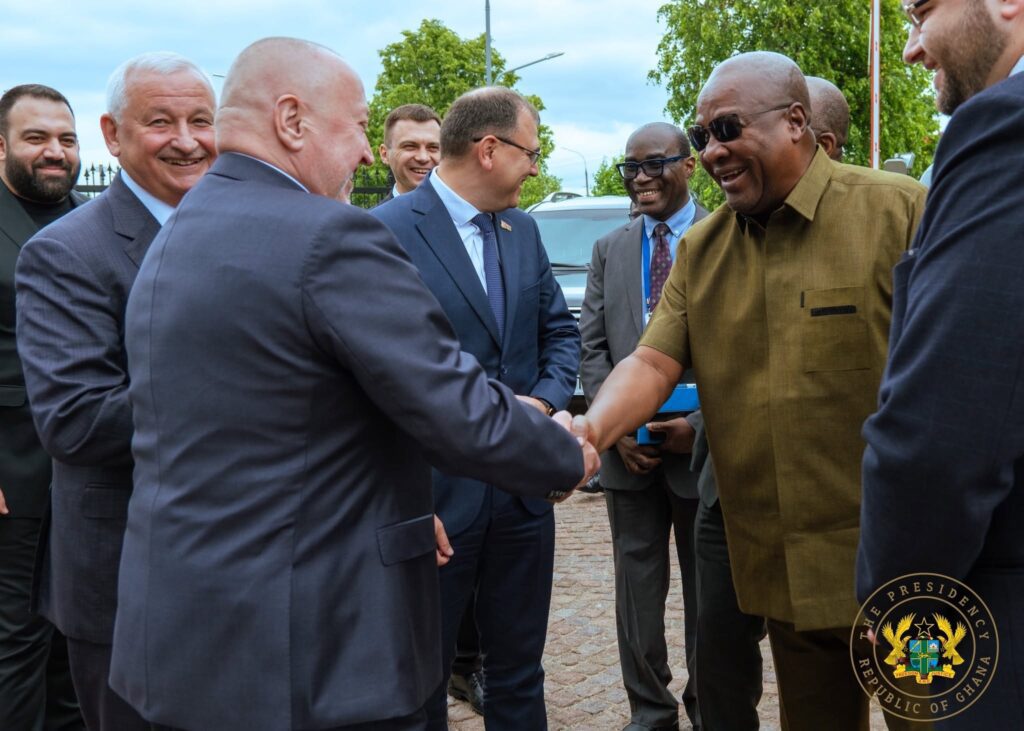
President Mahama noted that the government’s large-scale public and private capital investments in technological advancements, alongside the decentralized network of farmers’ service centers across every agricultural district in the country, are expected to translate into immediate field-level productivity.
The farmers’ service centers are to operate as localized operational stations, providing smallholders and commercial cooperatives with direct access to high-tech machinery, engineering support, and data-driven farming services, de-risking the cultivation process into a highly predictable, corporate-grade enterprise.
Direct Machinery Procurement
Demonstrating that this bilateral strategy has already bypassed simple policy discussions and moved directly into active commercial execution, the President revealed that Ghana has officially finalized an order for the procurement of 1,840 distinct pieces of advanced agricultural equipment and heavy machinery directly from Belarusian state manufacturers.
This initial equipment influx will serve as the logistical backbone for the newly built farmers’ service centers, providing the mechanized power necessary to expand cultivated acreage, eliminate harvest delays, and secure a consistent supply of raw crops for downstream processing plants.
The President framed this massive direct purchase as merely the opening “baseline for an expansive, long-term manufacturing partnership,” noting that the ultimate objective is to transition from importing fully assembled foreign machinery to establishing localized assembly lines, training centers, and spare-parts manufacturing hubs within Ghana’s industrial free zones.
This approach ensures that the technology transferred from Minsk is sustained by local technical expertise, creating thousands of skilled industrial jobs for Ghana’s youthful workforce while cutting long-term maintenance costs for domestic agro-operators.

“This is only the beginning. We are inviting Belarusian investors to participate in commercial farming, irrigation development, greenhouse production, fertilizer manufacturing, agriculture production, aquaculture, food processing, and agricultural logistics”
President John Dramani Mahama
This invite was underscored by a primary pillar of the President’s economic model – the aggressive eradication of raw, unprocessed agricultural exports. Ghana’s exceptionally fertile soil, stable tropical climate, and transparent land-governance frameworks provide an optimal environment for scaling multi-crop cultivation.
By establishing processing plants right next to production enclaves, incoming corporate investors can process raw crops into high-value, packaged food products, industrial starches, and animal feeds. This localized value addition ensures that the bulk of the economic wealth generated within the supply chain stays within domestic borders.
The long-term commercial profitability of these targeted agribusiness investments is heavily reinforced by two distinct competitive advantages: the $10 billion “Big Push” infrastructure program and unmatched continental market access under the African Continental Free Trade Area (AfCFTA).
Through the 5-year Big Push initiative, the Mahama administration is systematically directing immense capital into upgrading national highway corridors, expanding cargo rail networks, modernizing deep-water ports, and building dedicated agricultural logistics hubs.
These synchronized infrastructure investments are designed to drastically lower internal transport costs, reduce post-harvest waste, and allow processing plants to move finished goods from factory floors to international ports with maximum speed.

Furthermore, setting up an agro-industrial facility within Ghana unlocks direct entry into a massive, multi-tiered consumer marketplace. Beyond the immediate domestic market of 35 million citizens, factories operating within Ghanaian borders enjoy duty-free access to a regional West African market of over 400 million consumers.
Combining ironclad legal protections, an absolute statutory guarantee for the unrestricted repatriation of corporate profits, a $10 billion logistical framework, and a direct gateway to a multi-trillion-dollar trading bloc, President Mahama noted that his administration is successfully building a highly secure, high-yield environment for global agribusiness capital.
As the bilateral working sessions commence, Ghana’s showcase in Minsk is expected to convert global manufacturing inputs into long-term, sustainable regional wealth.