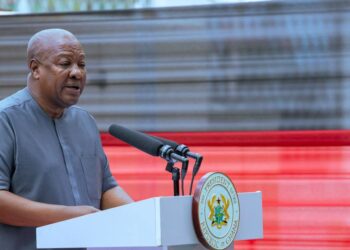

Renowned lawyer Tsatsu Tsikata has called on the National Democratic Congress (NDC) to use commemorations of former President Jerry John Rawlings as a platform for setting higher standards in governance and national development.
Delivering a keynote address at a public lecture organised in honour of Rawlings, Mr Tsikata stressed that such events must go beyond remembrance and become an opportunity for renewed commitment to national ideals.
He said it was appropriate for Ghanaians to gather to reflect on Rawlings’ legacy, but cautioned against turning such occasions into mere nostalgia or personality worship.
According to him, Rawlings himself would not have supported such an approach. He argued that the most meaningful way to honour the former leader is to continue advancing the principles he stood for in public life.
“His legacy serves as an inspiration at a time when there are attempts to reinterpret Ghana’s history in ways that risk distorting its national meaning for partisan or sectional purposes.”
Tsatsu Tsikata
Governance Expectations and Political Responsibility
Mr Tsikata emphasized that the Ghanaian people continue to place clear expectations on political leadership, including job creation, economic transformation, improved healthcare, strengthened education, and institutional reform. He said these expectations are legitimate and must remain central to governance priorities.
He urged the NDC to remain focused on delivering practical solutions that expand opportunities for young people, support businesses, reduce poverty, and improve living standards.
He cautioned that governance should not be reduced to comparisons with previous administrations, warning that such an approach could encourage complacency.
According to him, the decisive rejection of the New Patriotic Party in the December 2024 elections should be understood as a signal that citizens expect stronger performance, accountability, and integrity from those in power.
Rawlings’ Political Journey and Reform Agenda
Mr Tsikata traced Rawlings’ political journey from his emergence as a young Air Force officer in 1979 through the formation of the Armed Forces Revolutionary Council and later the Provisional National Defence Council. He described Rawlings’ rise as rooted in widespread public dissatisfaction with national decline at the time.
He highlighted that the early years of Rawlings’ leadership focused on attempts to reverse economic deterioration, particularly in sectors such as cocoa production, where incentives for farmers had significantly weakened.
He explained that policy changes under Rawlings sought to increase producer participation in national wealth creation and address structural imbalances in the economy.
Tsikata further noted that the economic recovery efforts under the PNDC were not solely externally driven, arguing that domestic policy initiatives preceded formal engagement with international financial institutions.
He said Ghana’s approach to economic reform involved mobilising both internal and external resources in pursuit of national transformation.
Economic Transformation and Infrastructure Development
The keynote speaker pointed to key areas of economic restructuring under Rawlings, including the revitalisation of mining and cocoa sectors, as well as the introduction of policies that encouraged foreign investment.
He explained that Ghana’s gold mining sector experienced renewed growth through a combination of policy reforms and strategic partnerships.
He also referenced developments in the oil and gas sector, noting that institutions such as the Ghana National Petroleum Corporation were established to facilitate collaboration with international investors while protecting national interests.
Tsikata further highlighted infrastructure expansion as a major legacy area, including electrification projects that extended power supply to previously underserved regions.
He noted that despite initial skepticism about demand and feasibility, such projects were pursued as part of a broader commitment to balanced national development.
Social Development and Institutional Reforms
According to Mr Tsikata, Rawlings’ governance approach also included significant investment in human capital development and institutional reform. He cited education reforms, decentralisation policies, and the creation of district assemblies as key steps toward strengthening grassroots participation in governance.
He explained that Rawlings’ administration promoted the idea of “true democracy,” which combined political participation with economic empowerment of productive citizens, particularly rural workers. He said this approach sought to shift resources away from rent-seeking structures and toward productive sectors of the economy.
Mr Tsikata also referenced reforms in telecommunications and broadcasting, noting that liberalisation of the media space created opportunities for private sector participation and expanded access to information. He said these changes laid the foundation for Ghana’s transition into the digital and communications era.
Accountability, Collective Leadership and National Unity
The lawyer stressed that Rawlings’ leadership style was rooted in collective effort rather than individual glorification. He said Rawlings consistently avoided personalising national achievements and instead emphasized teamwork and institutional development.
Tsikata highlighted the contributions of various individuals who served during the PNDC and early NDC period, noting that governance at the time was a collaborative national effort involving both civilians and military personnel.
He further underscored the importance of accountability and integrity in public service, stating that national development requires consistent hard work, institutional strength, and a commitment to public interest over private gain.
Call for Higher Standards and Legacy Preservation
Mr Tsikata concluded by urging the NDC to raise governance standards in honour of Rawlings’ legacy. He warned against lowering expectations or adopting minimal performance benchmarks in public administration.
He proposed the establishment of a dedicated Rawlings Legacy Centre to document historical records, speeches, and testimonies from individuals who worked with the former president. He said such an initiative would help preserve institutional memory and support future research and civic education.
He also appealed to younger generations of the Rawlings family to continue upholding their father’s legacy on both national and international platforms, describing their responsibility as significant in shaping how the legacy is carried forward.
Mr Tsikata reaffirmed that the Fourth Republic, which emerged from Rawlings’ political transition, remains Ghana’s longest period of constitutional stability. He said it must be protected through continuous commitment to accountability, institutional development, and national unity.