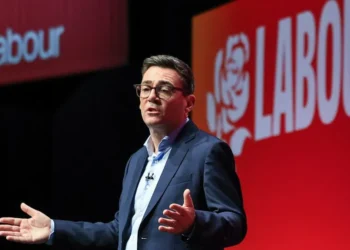
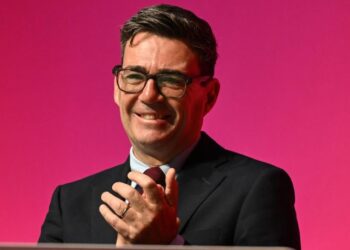
United States President Donald Trump has publicly weighed in on Britain’s evolving political landscape, describing Andy Burnham as “extremely liberal” in his first remarks about the man widely viewed as the frontrunner to succeed Sir Keir Starmer as the United Kingdom’s next Prime Minister.
The comments, delivered during a meeting at the White House with NATO Secretary General Mark Rutte, offered an early glimpse into how a future relationship between Washington and a Burnham-led government might unfold.
While Trump admitted that he knew little about the Greater Manchester mayor, his assessment quickly turned to ideological differences and Britain’s energy policies, issues that have increasingly defined transatlantic debates in recent years.
“I don’t know anything. I see that he was, I guess, the mayor of a town. I hear he’s extremely liberal.”
Donald Trump
Asked whether he would welcome an early meeting with Burnham, Trump replied: “No. But I think we’re of a different persuasion. He’s very liberal.”
Although brief, the comments are likely to attract significant attention in both Washington and London, particularly as political observers assess what a change in British leadership could mean for the long-standing special relationship between the two allies.
Moreover, Trump linked his criticism directly to Britain’s approach to energy policy, suggesting that Burnham would continue restrictions on oil and gas development in the North Sea.
“So that means he probably won’t open up the North Sea. The amazing thing is they buy their oil from Norway, which gets the oil from the North Sea. Think of it, and they pay a big premium. Norway’s got now $2tn (£1.5tn) in the bank, and the UK is dying.”
Donald Trump
Donald Trump’s remarks come after months of increasing friction between himself and Sir Keir Starmer, whom he has repeatedly chastised on matters ranging from immigration and defence spending to energy policy and Britain’s participation in NATO.
Relations between the two leaders deteriorated dramatically over disagreements over the use of Diego Garcia, a strategically important UK-US naval outpost in the Indian Ocean. Trump allegedly expressed frustration after Britain rejected to back some military activities related to the Iran dispute.
Since then, the US President has levelled increasingly personal criticisms against Starmer, accusing him of undermining the UK-US cooperation and mishandling critical domestic issues.
Before Starmer’s resignation, Trump claimed he had repeatedly warned the British leader about the political consequences of his policies.
“I told this guy 15 times, and he wouldn’t do it, I said, you’re going to lose your prime ministership, and he did. In fact, I called it about three days earlier, right? Remember, I said he was leaving. I wonder if that nudged him out.”
Donald Trump
This comments underline the extent to which relations between the two leaders had become strained, raising questions about whether similar tensions could emerge should Burnham eventually enter Downing Street.
NATO Tensions and Energy Politics Shape Trump’s European Agenda
Trump’s remarks about Burnham came during a wider discussion about NATO, European security and the future direction of Western alliances ahead of next month’s summit in Ankara.
Meeting with NATO Secretary General Mark Rutte at the White House, Trump used the occasion to revisit longstanding concerns about defence spending among alliance members. He has consistently argued that European countries rely too heavily on the United States for military protection and should contribute more to collective security.
Those concerns have intensified since the outbreak of conflict involving Iran earlier this year, with Trump openly expressing frustration at insufficient support from some NATO partners.
In recent months, he has even raised questions about America’s future commitment to the alliance, warning that continued imbalances in defence spending could have serious consequences for transatlantic security cooperation.
Against that backdrop, Rutte’s visit carried significant diplomatic importance. The NATO chief sought to reassure the US President ahead of the Ankara summit, highlighting increased defence spending commitments by alliance members and praising Trump’s role in encouraging greater military investment.
“This is the leader of the free world taking responsibility beyond the shores of the United States for the rest of the world, and this is what you did.”
Mark Rutte
Earlier, leaders from Germany, France, the United Kingdom, Italy and Poland met in Berlin to coordinate positions ahead of the NATO summit. Discussions focused on defence spending, regional security and efforts to support a potential peace process involving Iran.
German Chancellor Friedrich Merz emphasised the importance of maintaining transatlantic unity, while French President Emmanuel Macron expressed optimism about improving cooperation between Europe and the United States.
As Britain prepares for a potential leadership transition, the Trumps’s comments suggest that energy policy, defence commitments and ideological alignment could become central issues in any future relationship between a Burnham government and a Trump administration.
Whether those differences evolve into significant diplomatic tensions remains uncertain. However, Trump’s early assessment has already ensured that the prospect of a future Burnham premiership is attracting attention far beyond Britain’s borders, with implications for one of the world’s most consequential political alliances.
READ ALSO: Canada Qualify for WC Knockout Round For The First Time Despite Defeat