The African Development Bank (AfDB) has pegged Ghana’s unemployment at 13.1% and inequality at 43.5%, figures that have renewed discussions about the need for stronger interventions to improve opportunities for young people across the country. The statistics have placed youth development at the centre of national conversations as the Ministry works to address the employment challenges in Ghana.
The Minister of Youth Development and Empowerment of Ghana says the government established the ministry to provide focused attention to youth related issues that were previously handled across different institutions. Honourable George Opare-Addo explained that the creation of the ministry under President John Dramani Mahama’s administration was aimed at developing a coordinated approach to youth empowerment.

Speaking on the issue, the Minister revealed that the ministry’s first major task was to understand the realities facing young people through research and data collection. He indicated that the findings have helped the ministry design interventions based on evidence while improving the coordination of existing programmes.
According to the Minister, youth unemployment remains a complex challenge because young people require sustained investment to unlock their potential. He noted that supporting the youth should be viewed as a long-term investment that produces benefits for the country’s economy and future workforce.
“It is a very difficult and challenging journey. If you want to fix the problem with youth employment, investing in young people is an investment and you reap the dividends with time.”
Honourable George Opare-Addo
The Minister revealed that the ministry discovered several existing youth programmes across government institutions during its assessment of the sector. However, he stated that the main challenge was the lack of effective coordination, which resulted in similar initiatives operating separately without achieving the expected impact.
Building on this assessment, Honourable Opare Addo said the ministry has been working to harmonise youth programmes and bring various agencies under a more organised framework. He mentioned institutions such as the National Service Scheme, Youth Employment Agency, National Youth Authority and the National Entrepreneurship and Innovation Programme as key partners in delivering youth focused interventions.
From his perspective, improved coordination would allow government programmes to reach more beneficiaries while reducing duplication among institutions. He explained that the ministry’s approach is on creating a system where youth initiatives complement each other and produce measurable outcomes.

Additionally, the Minister acknowledged that the establishment of the ministry within the past one and a half years has involved significant challenges. He stressed that understanding the needs of young people and developing effective solutions requires careful planning, research and consistent implementation.
The Minister indicated that the ministry is still working to complete the process of aligning youth programmes across government. He expressed confidence that the reforms being introduced would strengthen youth development efforts and create a clearer pathway for young people seeking employment opportunities.
Meanwhile, Honourable Opare Addo stated that the government’s objective is to ensure youth development receives dedicated attention through a specialised institution. He added that the ministry would continue reviewing its strategies to respond effectively to changing employment conditions and the aspirations of Ghana’s young population.
Funding Gaps Challenge Youth Programmes Despite Increased Allocations
The Ministry of Youth Development and Empowerment indicated that budget allocations alone do not always represent the actual resources available for implementing youth programmes across the country. Honourable George Opare-Addo explained that although government approved funding for the ministry, releases depend on revenue performance and other national financial commitments.
Addressing the issue of funding for youth interventions, the Minister stated that the ministry’s 2026 budget allocation requires careful interpretation because it covers several agencies and operational expenses. He explained that the allocation includes institutions such as the National Service Scheme, Youth Employment Agency, National Youth Authority and the National Entrepreneurship and Innovation Programme.
Speaking on the implementation of key programmes, Honourable Opare-Addo disclosed that initiatives such as the Ejumapa programme and the National Apprenticeship Programme remain central to the ministry’s strategy of equipping young people with practical skills. He noted that these programmes are designed to help young people develop businesses and create employment opportunities for others.
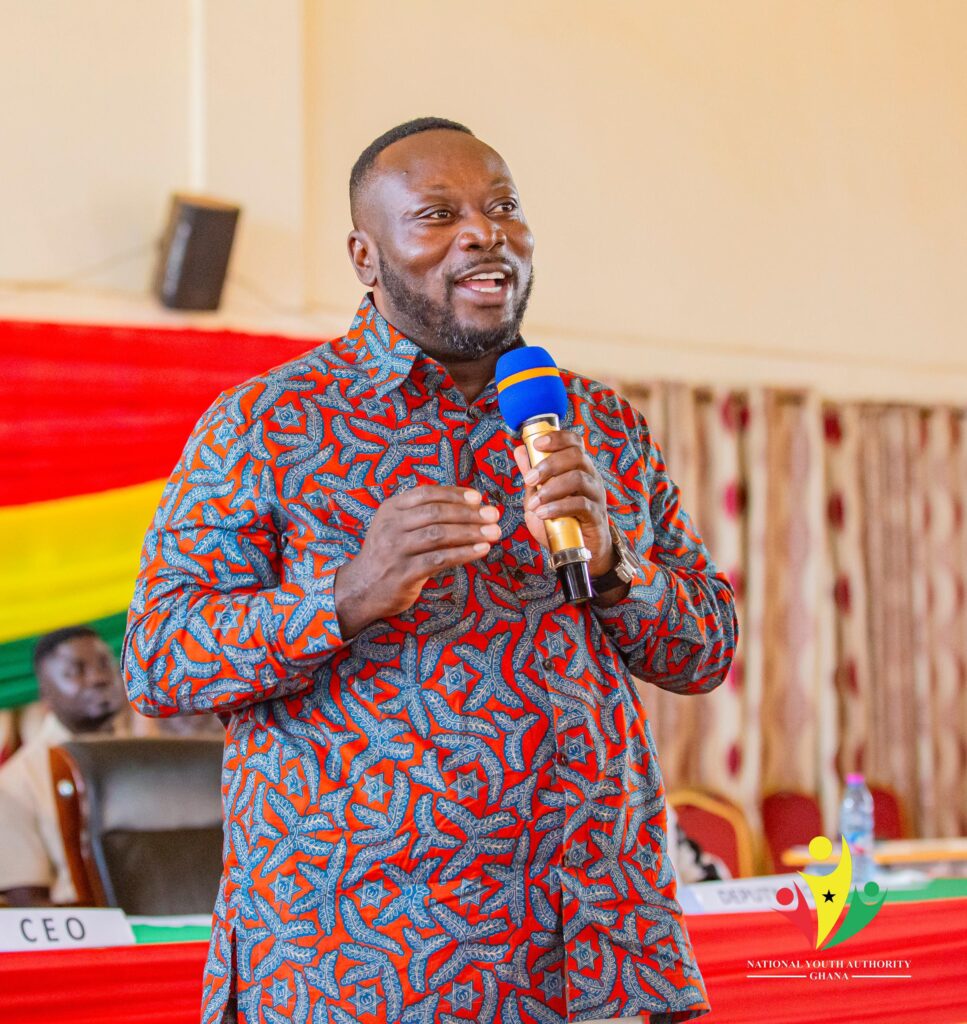
According to the Minister, the government’s youth empowerment approach seeks to change the perception that completing education must always lead to searching for employment. He explained that the ministry is working to encourage young people to become entrepreneurs who can contribute to job creation within their communities.
“The idea of always getting young people to finish school and go out and look for jobs has become a problem. What we want to do is that I have finished school and I have started a business where I can also employ other people.”
Honourable George Opare-Addo
The Minister further outlined the impact of existing interventions, noting that thousands of young people have already benefited from skills development and entrepreneurship support. He stated that under the Ejumapa programme, close to 11,000 young people received training, while about 14,000 others were trained through the National Apprenticeship Programme.
Supporting The Youth To Build Businesses
Beyond training, Honourable Opare-Addo explained that qualified participants also receive support to establish their businesses and strengthen their ability to operate independently. He indicated that these measures are intended to create an environment where young people can generate income and contribute to economic growth.
Meanwhile, the Minister acknowledged that some government programmes continue to face funding limitations due to shortfalls between approved budgets and actual releases. He explained that effective management requires prioritising important interventions while seeking additional support from development partners and private sector organisations.

From his perspective, government cannot carry the full responsibility of financing every youth initiative alone. He revealed that the ministry has engaged private sector partners and other stakeholders to secure additional resources for programmes, including research activities under the “Red Means Stop” campaign.
Furthermore, Honourable Opare-Addo disclosed that last year’s budget releases affected the pace of some activities because only a portion of approved allocations was made available. He noted that the ministry responded by adjusting implementation timelines and carrying forward unfinished activities into subsequent periods.
“The budget is not the actuals. When allocations are made in budgets, it does not mean the whole amount is coming to you because government also collects revenue and based on the revenue collected, allocations are made.”
Honourable George Opare-Addo
In addition, the Minister emphasised that responsible management remains essential when resources are limited. He argued that institutions must maximise available funding while exploring partnerships that can support national youth development objectives.
READ ALSO: Counselling First, Stigma Never — GAC Urges Careful HIV Response