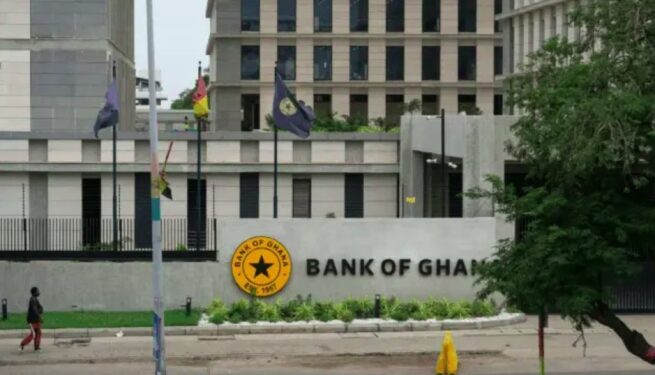
The Bank of Ghana (BoG) has renewed calls for commercial banks to list on the Ghana Stock Exchange (GSE), arguing that increased participation in the capital market could unlock long-term funding and transform the way businesses access credit.
The Governor of the Bank of Ghana, Dr Johnson Asiama, said a stronger presence of banks on the stock exchange could provide additional sources of long-term capital, enabling financial institutions to extend loans with significantly longer repayment periods.
His comments have reignited debate about the role of Ghana’s capital market in supporting businesses, industrialisation and sustainable economic growth.
BoG Eyes Longer-Term Financing for Businesses
Speaking at the 2026 edition of CEOs Connect organised by the Canada-Ghana Chamber of Commerce (CANCHAM), Dr Asiama explained that having more banks listed on the Ghana Stock Exchange would strengthen the financial system by bringing additional long-term capital into the banking sector.
According to him, the availability of such funding could eventually allow commercial banks to provide businesses with longer-term credit facilities.
He noted that banks could potentially provide loans spanning five or even ten years, giving businesses greater room to establish operations, expand production and implement long-term strategies.
The Governor’s comments come at a time when access to affordable and sustainable financing remains a major concern for businesses across Ghana.
Many enterprises, particularly those seeking to invest in factories, equipment, technology and large-scale expansion, require financing that extends beyond the short repayment periods traditionally associated with bank lending.
Ten-Year Loans Could Change Business Financing
The possibility of commercial banks offering loans for as long as ten years could represent a major shift for Ghanaian businesses.
For companies establishing factories or investing heavily in productive capacity, short-term loans can create significant pressure on cash flows. Businesses may be forced to begin making substantial repayments before their investments have generated enough revenue.
Longer-term loans could provide companies with breathing space to establish their operations and gradually generate returns.
Dr Asiama explained that businesses need adequate time to put their strategies in place before being required to fully repay loans.
Such financing could be particularly important for manufacturing, agriculture, infrastructure, logistics and other sectors where investments often require several years before achieving full commercial returns.
Why BoG Wants More Banks Listed
Listing more banks on the Ghana Stock Exchange could provide financial institutions with another avenue for raising capital.
Instead of relying heavily on deposits and other relatively short-term funding sources, banks could potentially raise equity capital from investors through the capital market.
This could strengthen their balance sheets while also increasing their capacity to support longer-term lending.
A broader banking presence on the GSE could also deepen Ghana’s capital market by increasing the number of large and actively traded companies available to investors.
For investors, bank listings could create additional opportunities to participate directly in the growth and profitability of financial institutions.
Transparency and Governance Could Receive Boost
Beyond raising capital, the Governor said increased participation in the capital market could strengthen transparency and corporate governance within the banking sector.
Listed companies are generally subject to additional disclosure and reporting requirements, providing investors and other stakeholders with greater access to information about their operations and financial performance.
For banks, stronger governance and transparency could improve investor confidence and contribute to a more resilient financial system.
The increased scrutiny associated with being listed could also encourage institutions to maintain stronger corporate governance structures and improve accountability to shareholders.
GSE Could Become More Important
The push from the Bank of Ghana could further strengthen the position of the Ghana Stock Exchange as an important source of long-term financing for the private sector.
A deeper capital market would give businesses more options beyond traditional bank borrowing.
Companies could potentially raise equity or debt capital through the market, while banks could strengthen their own capital positions through listings and other capital market activities.
This could ultimately reduce the pressure on banks to rely primarily on deposits when financing businesses.
A more diversified financial system could also improve the allocation of capital to productive sectors of the economy.
BoG Promises Stronger Collaboration
Dr Asiama said the Bank of Ghana would continue working with the Securities and Exchange Commission and the Ghana Stock Exchange to strengthen Ghana’s financial architecture.
The collaboration is expected to support efforts aimed at mobilising long-term capital and developing a deeper and more efficient capital market.
The central bank’s position signals that capital market development is increasingly being viewed as an important component of Ghana’s broader economic strategy.
If more banks respond positively to the call, the resulting increase in listed financial institutions could significantly reshape Ghana’s financial market.
A Potential New Era for Business Lending
The prospect of banks offering five-year or ten-year loans could be particularly significant for Ghana’s private sector.
Businesses need patient capital to invest, expand and create jobs. When financing is structured around short repayment periods, companies can face substantial pressure even when their underlying investments remain commercially viable.
Longer-term financing could therefore give businesses the opportunity to grow before facing heavy repayment obligations.
For the Bank of Ghana, encouraging banks to tap the stock exchange is not simply about increasing the number of listed companies. It is about creating a financial system capable of mobilising long-term capital and directing it toward productive investment.
If successfully implemented, the initiative could strengthen Ghana’s capital market, improve access to business financing and potentially usher in a new era of longer-term lending.
According to : a stronger connection between Ghana’s banks and the stock market could become a critical pathway to unlocking the capital businesses need to expand.
READ ALSO: 2026/2027 GPL Winners To Receive a Record GHS 3m Prize Money