
The government is reviewing the legal, fiscal and regulatory framework governing the Ghana National Petroleum Corporation as part of efforts to strengthen its commercial role and position the state-owned company for a more competitive future in Ghana’s petroleum industry.
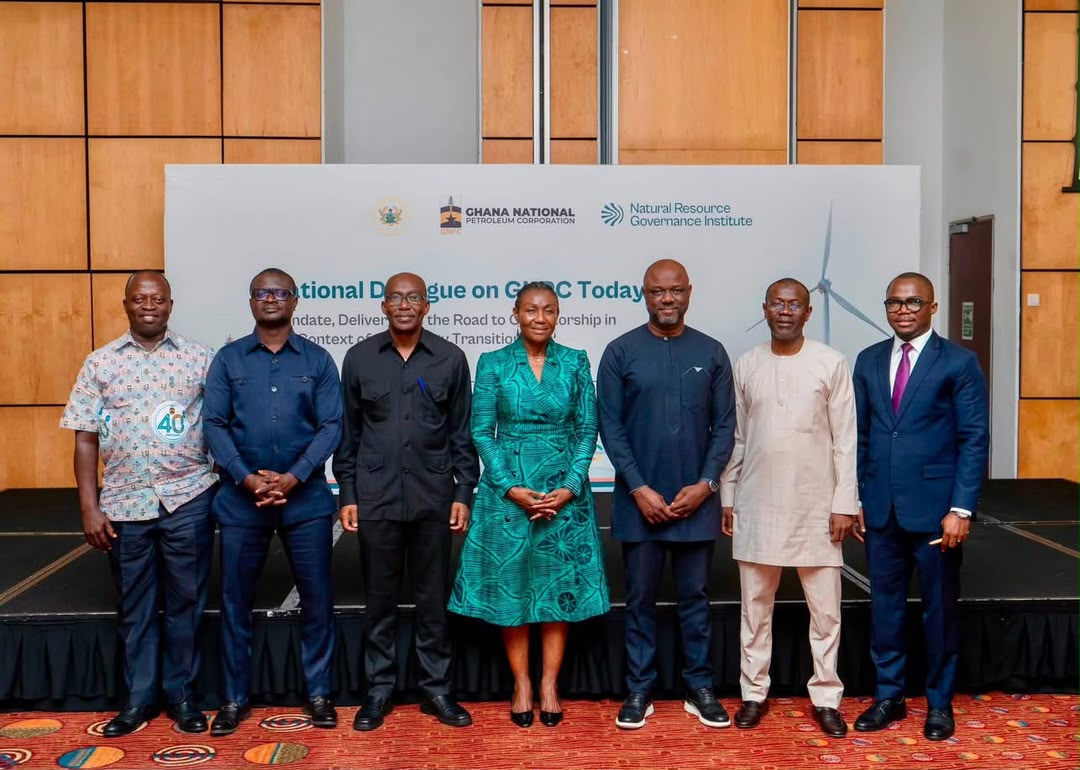
Mark Prempeh, Director of Petroleum at the Ministry of Energy and Green Transition, disclosed the ongoing review of PNDC Law 64, the legislation under which GNPC was established, during the GNPC Today stakeholder dialogue.
The review comes as Ghana seeks to reposition its national oil company from a largely participating institution into a stronger commercial and operating entity capable of generating greater value from petroleum resources.
“Government’s vision is for GNPC to take a greater commercial role in Ghana’s petroleum industry.”
Mark Prempeh, Director of Petroleum at the Ministry of Energy and Green Transition
The reform agenda is significant because GNPC’s original institutional framework dates back to 1983, while Ghana’s petroleum industry has since undergone substantial changes, including commercial offshore production, the emergence of domestic gas infrastructure, local-content requirements and the growing importance of national operatorship.
GNPC’s mandate and upstream role have subsequently been reinforced by later petroleum legislation, including Act 919.
Gas Becomes Central To Commercialisation
Gas emerged as one of the clearest areas where GNPC’s commercial role could have implications beyond the upstream petroleum sector.
Mr. Prempeh highlighted GNPC’s contribution to supplying gas for thermal power generation and reducing reliance on more expensive liquid fuels.
The issue matters because Ghana’s electricity system remains heavily dependent on thermal generation, making the availability and cost of natural gas a major determinant of electricity-sector costs.
“GNPC’s contribution to replacing more expensive liquid fuels for thermal power generation” remains important to Ghana’s energy security, Mr. Prempeh said, while stressing the need to strengthen that role.
GNPC is also Ghana’s national gas-sector aggregator, according to the Corporation’s official profile, placing it at an important intersection between upstream gas production, power generation and broader energy security.
That position gives commercialisation of gas a strategic dimension.
A more commercially effective GNPC could potentially improve the way domestic gas resources are contracted, aggregated and supplied to power producers and other consumers.
But commercialisation also requires stronger financial discipline because gas-sector obligations can create substantial exposures when supply contracts, power-sector payments and state-owned entities are not aligned.
This is where the government’s proposed legal and fiscal reforms become consequential.
The objective cannot simply be to give GNPC greater commercial freedom.
The Corporation also needs a framework that clearly separates its commercial responsibilities from the broader policy obligations assigned to it as a national institution.
Balancing Commercial Freedom And Public Interest
The central policy dilemma is that GNPC must operate differently from a conventional private oil company because its assets and strategic responsibilities ultimately belong to the Ghanaian state.
That means commercial performance cannot be measured only through short-term profitability.
Energy security, domestic gas availability, exploration of frontier acreage, technical capacity and national participation all carry public value that may not immediately appear on a corporate balance sheet.

At the same time, public-interest responsibilities cannot become a blanket justification for weak commercial performance.
That balance was reflected in the broader stakeholder discussion, where participants repeatedly returned to financing, operatorship and institutional resilience.
GNPC’s published strategy already identifies financial independence and commercial viability as major objectives, alongside increasing reserves, optimising production, building capacity and strengthening stakeholder relationships.
The Corporation has also publicly linked its operatorship ambitions to financial sustainability and technical competence.
For Ghana, that distinction is becoming increasingly important.
The country needs GNPC to take more responsibility for exploration at precisely the point when upstream investment is becoming more difficult to secure.
International investors are assessing petroleum opportunities against declining production in mature basins, global climate policy and competition from other oil-producing jurisdictions.

A commercially credible national oil company could therefore become an asset in attracting investment rather than a substitute for private capital.
GNPC’s role would be to identify opportunities, de-risk acreage, build technical capability and structure partnerships in ways that preserve Ghanaian interests while making projects investable.
The Voltaian Basin provides one example. GNPC’s investment in seismic and geological data has been aimed at reducing uncertainty around an underexplored basin before larger-scale investment is considered.
The same principle can apply to gas.
If GNPC can strengthen gas aggregation and commercial arrangements while ensuring reliable supply to the power sector, the benefits could extend beyond the Corporation’s own balance sheet to electricity reliability and the cost of thermal generation.
The ongoing review of PNDC Law 64 therefore arrives at a critical moment.
The reform should provide GNPC with enough commercial flexibility to operate effectively while preserving the accountability expected of a state-owned national oil company.
For Ghana, the success of the exercise will ultimately depend on whether a reformed GNPC can become commercially stronger without losing sight of why it exists in the first place: ensuring that Ghana derives sustainable value from its petroleum resources.
READ ALSO: Arsenal Begin PL Title Defence With Resounding Victory Over Coventry