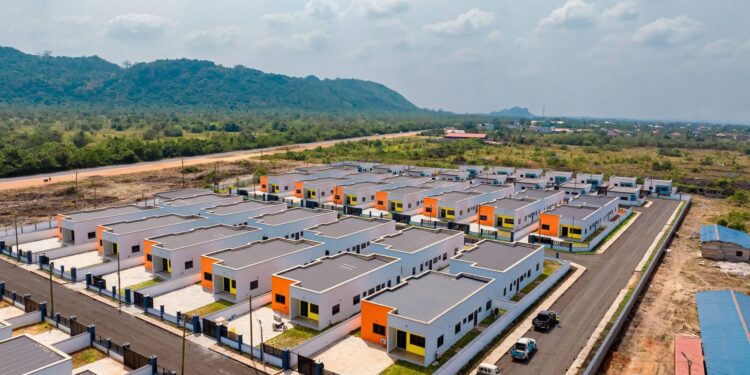
The Ghana Real Estate Developers Association, GREDA, has renewed its call on government to remove the 20 per cent Value Added Tax imposed on housing construction, warning that the levy is deepening Ghana’s housing affordability crisis.
According to the Association, prospective home owners are already struggling with high housing prices, and the new tax has added an extra layer of financial pressure that could push home ownership further out of reach for many Ghanaians while undermining the operations of developers.
GREDA President, Dr James Condua Orleans-Lindsay, made the call at the Association’s 2026 Annual General Meeting held in Accra. Addressing members, industry stakeholders, and representatives from the Ministry of Works, Housing and Water Resources.
Dr Orleans-Lindsay said GREDA had been consistently pushing for a partnership with government to make housing affordable, but the introduction of VAT on construction had worsened the situation.
“Prospective homeowners are already frustrated with high cost of housing and GREDA has been championing a collaboration and partnership with the government for making housing affordable for Ghanaians.”
Dr. Orleans-Lindsay
The new VAT Act, Act 1151, took effect on January 1, 2026. It introduced a unified VAT structure for all VAT-able supplies in Ghana, including housing construction. The law effectively brought real estate development fully into the VAT net, a move GREDA says was done without adequate consideration for the peculiarities of the housing sector.
The 2026 AGM was held on the theme “Reflect, Reconnect, Resolve. Building a stronger, greener tomorrow together.” The meeting provided a platform for the Association to review its activities and performance in 2025, discuss pressing challenges facing the real estate industry, and outline its strategic direction for 2026.
It brought together GREDA members, private developers, financial institutions, suppliers in the building industry and policymakers.
VAT Threatening Survival of Developers
Dr. Orleans-Lindsay warned that if the VAT issue is not urgently addressed, it could affect the viability of real estate companies and ultimately be passed on to homebuyers.
He explained that developers operate in an environment already burdened by high cost of land, expensive building materials, high interest rates, and delays in permitting. Adding a 20 per cent tax on construction, he said, makes it nearly impossible to deliver affordable housing.
“The association is concerned that treating every payment entering a company’s account as income subject to VAT could place an unsustainable burden on developers,’’ he said. He disclosed that GREDA has been engaging the Ministry of Works, Housing and Water Resources and the Ghana Revenue Authority, GRA, to seek clarity and resolution on the application of the tax.
“GREDA has continued to engage the government and relevant institutions over the tax and the association is awaiting a resolution from the Ministry of Works, Housing and Water Resources and the Ghana Revenue Authority.’’
Dr. Oleans-Lindsay
Dr. Orleans-Lindsay argued that the issue is not just about profit margins for developers but about the national housing deficit.
Ghana’s housing shortfall is estimated at over 1.8 million units, with annual demand far outstripping supply, especially for low and middle-income earners. The Association argues that taxing housing like any other commercial commodity contradicts government’s own affordable housing agenda.
Beyond taxation, Dr Orleans-Lindsay highlighted three persistent constraints that continue to hold back housing delivery in Ghana: difficulty in acquiring litigation free land, limited access to long-term affordable finance, and the high cost of building materials, most of which are imported.
He noted that cement, iron rods, and finishing materials have seen sharp price increases in the past year, driven by cedi depreciation and global supply disruptions. Without targeted incentives, developers cannot absorb these costs.
He therefore urged government to consider a broader package of incentives for the real estate sector, including tax reliefs on local building materials, support for local manufacturing, and a dedicated housing finance mechanism that offers lower interest rates and longer repayment periods.

Flooding and Demolitions Need Smarter Solutions
On recent flooding and demolition exercises in parts of Accra and other urban areas, the GREDA President called for a more comprehensive and sustainable approach. He argued that pulling down structures without fixing the root causes of flooding, poor drainage systems, unplanned urban sprawl, and weak enforcement of building regulations would not solve the problem.
He stressed on the fact that demolition alone will not resolve the country’s flooding problems without addressing the underlying drainage and urban planning challenges. He revealed that GREDA’s research and development focus for 2026 will centre on flood-resilient designs, green buildings and smart cities.
The aim, he said, is to promote sustainable urban development that adapts to climate change while improving liveability.
“GREDA’s research and development activities is, therefore, focusing on flood prevention, green buildings and smart cities, with the aim of contributing to more sustainable urban development.’’
Dr. Orleans-Lindsay
Ministry of Works, Housing and Water Resources Addressing GREDA
Responding to GREDA’s concerns, the Acting Director of Housing at the Ministry of Works, Housing and Water Resources, Mr Chris Pobee Abbey, reaffirmed government’s commitment to working with the Association to reduce the housing deficit.
He said government’s housing policy is shifting from just increasing supply to ensuring affordability, use of local materials, and decentralization of housing projects beyond Accra and Kumasi.
“Housing remains one of Ghana’s most pressing development challenges, with a housing deficit of over 1.8 million units. We must provide the right homes in the right locations at the right prices that an ordinary Ghanaian can afford.”
Mr. Abbey
He acknowledged that housing delivery must embrace modern construction technologies, energy-efficient designs and local building materials to cut costs and reduce environmental impact. On the 20 per cent VAT, Mr Abbey assured GREDA members that the Ministry has taken note of their concerns and would engage the Ministry of Finance and the GRA to find a workable solution.
Mr Abbey said government recognises the private sector as the main driver of housing delivery and will continue to create an enabling environment for developers who are committed to affordable and sustainable housing.
GREDA assures it members and the entire Ghanaians that it will continue to advocate for policies that make housing accessible to the average Ghanaian while promoting professionalism, quality and environmental sustainability in the real estate sector.
READ ALSO :Bokpin Pushes Value Addition to End Ghana’s Raw Commodity Dependence