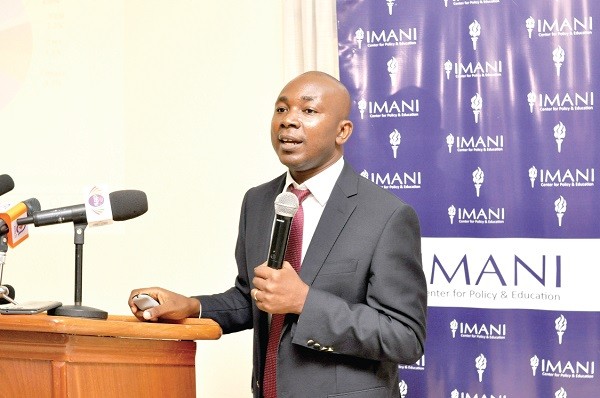
Professor Godfred A. Bokpin of the University of Ghana Business School has argued that Africa continues to operate an economic structure designed by colonial powers to serve their own interests, calling for a fundamental re-engineering of African economies at the Students and Young Professionals African Liberty Academy in Accra.
Speaking under the theme “Resilient Economies,” Professor Bokpin traced the continent’s current economic architecture directly to the 1882 Berlin Conference, arguing that the system Africa inherited was never intended to deliver development for Africans and cannot do so without deliberate restructuring.
Professor Bokpin asked participants to consider a colonial-era map of the continent, describing it as a set of colonial masses implanted within the world rather than a natural political geography.
“This is Africa without Africa,” he said, arguing that the borders and economic relationships Africa operates within today were drawn to extract value for European powers rather than to serve the populations living within them.
He said the deepest legacy of that design was a shift in Africa’s basic economic orientation.
“One of the fundamental things colonisation did for us was to change our economic model from self-sufficiency to dependence,” he said, noting that African economies had produced their own food before colonial administrations redirected agricultural production toward export crops destined for European industry.
A Continent That No Longer Feeds Itself
Professor Bokpin pointed to Africa’s current food import bill as the clearest legacy of that switch.
He said the continent spent in excess of $115 billion on net food imports in 2025, despite holding more than 60 per cent of the world’s unused arable land and hosting two of the world’s longest rivers, both capable of supporting year-round agriculture. “Why can’t we feed our country?” he asked. “Because the economic model has been changed.”
He argued that this reversal illustrates why simply operating within the inherited system cannot produce African-centred development, regardless of effort. “If somebody has designed a car to move backwards, suddenly, when it becomes a driver, it will not move forward,” he said. “You certainly need to reconfigure it.“
Professor Bokpin noted that Ghana and Malaysia won independence in the same year, and urged participants to compare how the International Monetary Fund visually represents each country’s economic trajectory on its website, an exercise he has used in previous lectures.
He said the comparison illustrates starkly different outcomes from a shared starting point, attributing Malaysia’s divergence to a deliberate decision in the 1950s and 1960s to move away from commodity dependence, a conversation he said Africa is only having now, decades later.
He argued that despite winning formal independence, African states largely continued operating the economic structure left behind.
“More than 70 percent of our export earnings across the continent, on average, is still driven by primary world commodities,” he said, describing this as the direct continuation of a system built to produce raw materials for growing industries elsewhere.
Geopolitics Layered on an Old Structure
Professor Bokpin situated the colonial legacy within present-day geopolitical competition, arguing that Africa’s abundant natural resources continue to shape how outside powers engage with the continent.
He said traditional development partners began scaling down aid roughly three decades ago, creating space that China and Russia moved into through what he characterised as a new form of engagement built on debt and trade relationships.
He cautioned that the global financial architecture itself was designed in ways that keep the continent positioned as a resource base rather than an industrial partner, a dynamic he said predates the modern era.
He closed the historical portion of his address with a challenge directed squarely at the room. “We need to redesign an economic system that works for us,” he said, describing that redesign as the only route out of a structure Africa has operated for more than six or seven decades since independence.
READ ALSO: Bokpin Pushes Value Addition to End Ghana’s Raw Commodity Dependence