
Kofi Bentil, Senior Vice President at the IMANI Centre for Policy and Education, has warned young Africans against unchecked political power, arguing that development depends on governments that operate within established laws and respect fundamental freedoms rather than concentrating authority in a single leader, however capable that leader may appear.
Speaking at SYPALA 2026 in Accra, Mr Bentil drew a careful distinction between limited government and small government, arguing that the African version of the libertarian principle he was describing requires an effective state rather than a weak one, even as it insists on constraints against arbitrary power.
Mr Bentil offered a blunt heuristic for assessing a country’s development trajectory. “The most developed countries in the world are the places where there are no soldiers on the street,” he said. “And the least developed countries in the world are the places where there are soldiers on the street.”
He framed this observation as a direct challenge to anyone, including military figures, who argues that African countries need greater discipline or a stronger security presence to progress. “If someone tells you that what we need in Africa is greater discipline, tell them you are illiterate,” he said, adding more diplomatically, “don’t say that. But think it.”
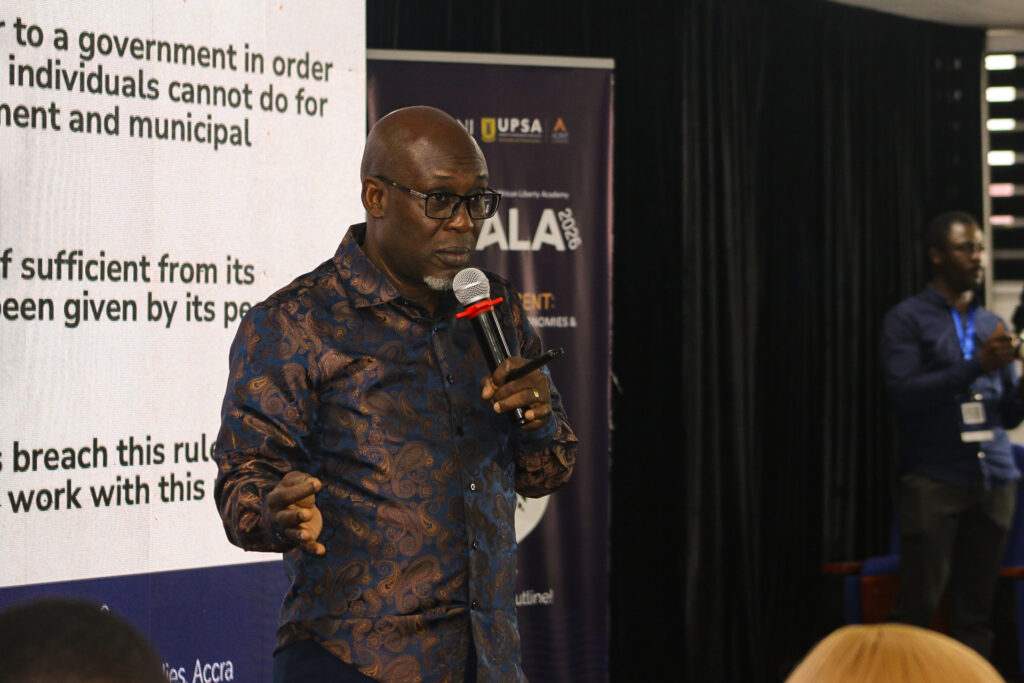
He argued that this position rests on centuries of tested historical evidence rather than untested theory, and challenged participants to recognise when a policy prescription, however sincerely offered, repeats an approach that has already failed elsewhere.
Power Does Not Confer Wisdom
Mr Bentil pressed the audience to resist deference toward leaders simply because they hold office. He argued that a person’s judgement and character do not improve upon election or appointment to power, and that citizens have both the right and the responsibility to continue questioning and confronting leaders after they take office.
“The stock of a man’s wisdom does not increase simply because he becomes elected,” he said, warning against the tendency to begin worshipping politicians once they assume power.
He argued that the test for any leader’s conduct should be whether it breaches what he called the fundamental rules human beings have agreed upon over roughly 4,000 years, rather than whether the leader’s stated intentions sound persuasive or well-meaning.

Mr Bentil addressed a common misunderstanding of the libertarian position on the size of government, distinguishing the American conservative framing of small government from what he described as the African libertarian view.
He said the classical Western view holds that government should be as small as possible, but argued that framing does not fit African conditions. “If being small means being weak, sometimes the government is useless because it can’t do anything because it’s too small,” he said. “A government must be effective.”
He grounded this in a social contract framework, arguing that citizens form governments specifically to accomplish collectively what they cannot achieve individually, which requires the state to have sufficient capacity and resources to function, even as its power remains bounded by law and subject to challenge.
A Culture That Slows or Speeds Development
Mr Bentil argued that formal institutions, rule of law, limited but effective government, free markets, only determine the ceiling on a country’s development, while culture determines how quickly a society actually reaches it.
He said cultural norms shape what a society tolerates in everyday behaviour, using examples ranging from informal roadside commerce to how differently societies handle abandoned or broken-down vehicles to illustrate how deeply ingrained habits can either accelerate or slow institutional reform.
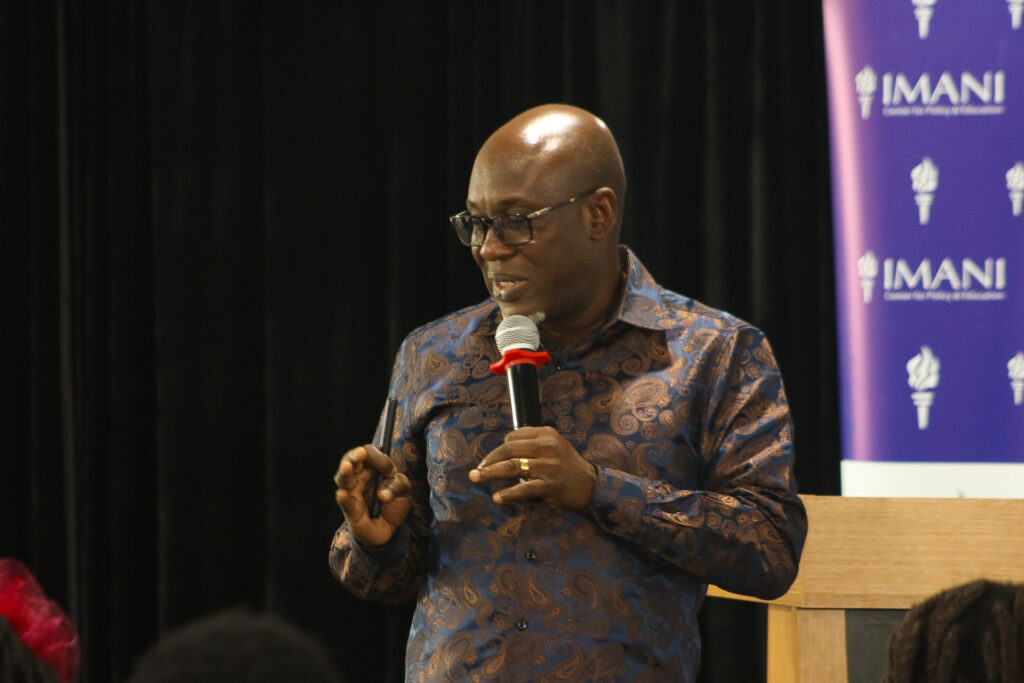
He closed by framing the entire discussion as a call to vigilance rather than resignation, arguing that while development can be slowed or even reversed, as he said Ghana’s own history demonstrates, it cannot be permanently stopped once a society commits to institutions that respect rule of law and constrain arbitrary power.
READ ALSO: IMANI Boss Blames Policy Indiscipline for Africa’s Weak Economic Resilience