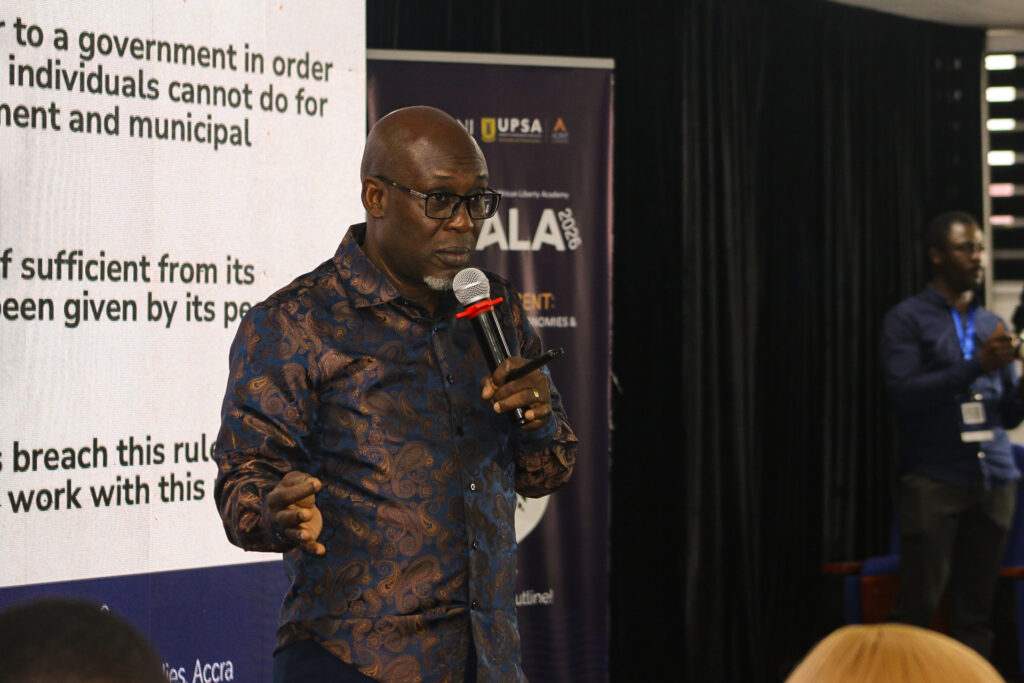
Senior Vice President at the IMANI Centre for Policy and Education, Kofi Bentil, has told young Africans that free markets, economic freedom and free enterprise, not political discipline or strong leadership, are what separate prosperous nations from stagnant ones, citing China, Malaysia and Ghana’s own economic history at the Students and Young Professionals African Liberty Academy in Accra.
Speaking on the second day of SYPALA 2026 under a session covering limited government, rule of law, property rights and economic freedom, Mr Bentil argued that the pattern holds across radically different cultures and time periods, and warned participants against a common instinct to blame Africa’s problems on a lack of discipline rather than a lack of liberty.
Mr Bentil opened with a comparison between Russia and the United States to illustrate his central claim. He said Russia possesses formidable military capability, including nuclear weapons, and a strong central authority, yet lacks the prosperity and cultural output that free markets produced in America.
“That is why Russia doesn’t have Michael Jackson. Only that Russia has a strong man. They have all kinds of nuclear weapons. They have everything. They don’t have prosperity.”
Senior Vice President at the IMANI Centre for Policy and Education, Kofi Bentil
He extended the argument to China, describing it as an ancient, sophisticated civilisation that experimented with numerous economic systems over centuries, including periods of severe hardship in which he said 35 million people died.
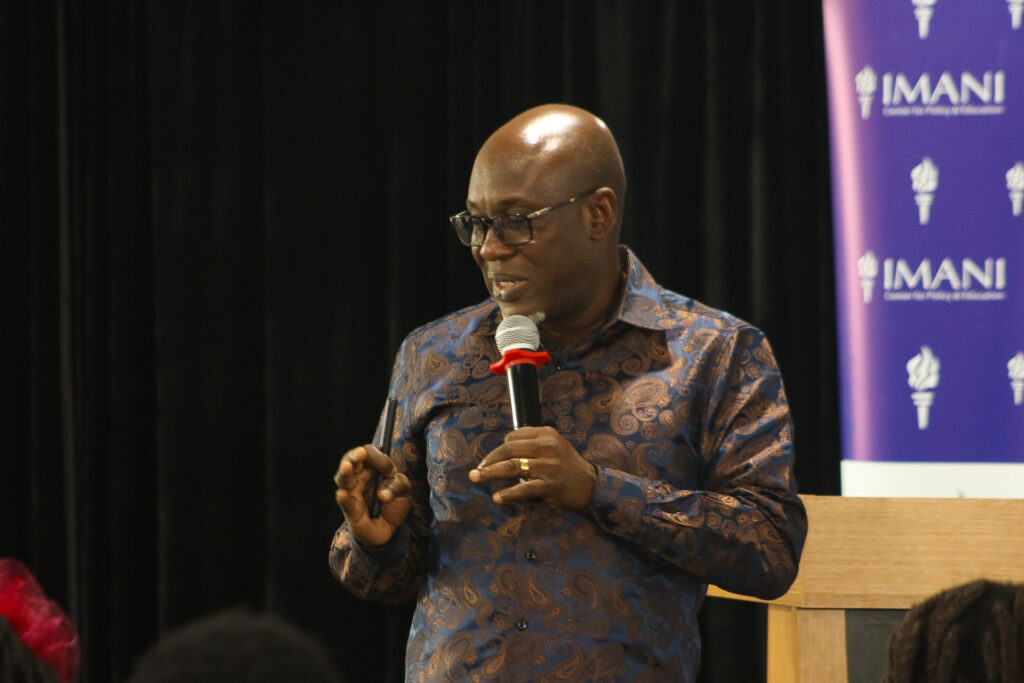
He said the one factor that transformed China into the most prosperous state in its history was the adoption of free markets. “If you ask me, is this what Africa needs? Yes,” he said.
Ghana’s Own History as Evidence
Mr Bentil turned to Ghana’s economic record to make the same point closer to home. He argued that the country’s strongest periods of economic growth came under democratic rather than autocratic governance, contrasting the roughly two decades of Jerry John Rawlings’s rule with Malaysia’s trajectory over the same period.
He said Rawlings originally overthrew President Hilla Limann on the grounds that the economy was stagnant and Ghana had been forced into an IMF programme, yet after 19 years of his own rule, Ghana experienced slow growth, a currency devaluation and another IMF arrangement.
Over that identical span, he said, Malaysia under Mahathir Mohamad transformed into a developed economy by pursuing free markets while Ghana operated under a system that restricted free trade. He argued Ghana’s growth only accelerated once the economy was liberalised and Rawlings left power.
“Democracy and freedom lead to economic development. That’s the truth, and the opposite is true: Autocracy leads to economic underdevelopment and then wars.”
Senior Vice President at the IMANI Centre for Policy and Education, Kofi Bentil
A Warning About Burkina Faso
Mr Bentil used Burkina Faso’s current military government as a live example of the pattern he described, predicting that unchecked power under the country’s junta would eventually damage its economy regardless of early appearances of progress.
“The laws of economics are laws of nature. You can’t just get up and spend the money and do things anyhow.” He forecast that economic stress would follow within a decade, prompting public complaints that would in turn invite repression, since, in his framing, a leader who holds power through force does not need to negotiate with the people he governs.
He was careful to distinguish this prediction from personal admiration for any particular leader, arguing that holding power, whether through election or force, does not increase a person’s underlying wisdom.
“The stock of a man’s wisdom does not increase simply because he becomes elected,” he said, urging young people to continue questioning and challenging leaders rather than deferring to them once they assume office.
Free Markets and Culture Working Together
Mr Bentil argued that the institutions he was describing, free markets, rule of law and limited government, form the foundation for national development, but acknowledged that culture shapes how quickly a society can benefit from them.
He described culture as a regulating force that determines what a society tolerates, using an example of how differently societies treat an abandoned broken-down car left in the road, tolerated in Ghana, penalised elsewhere, to illustrate how cultural norms either accelerate or slow development independent of formal institutions.
He argued that development itself cannot be permanently halted once begun, though it can be slowed or, as he said Ghana’s own history demonstrates, reversed.
He credited his own generation with successfully rebuilding the country’s institutions and constitutional order after what he described as the failures and disruptions of his father’s generation, and challenged the young audience to carry that project forward using the same free market and rule-of-law principles he laid out.
READ ALSO: Bokpin Pushes Economic Re-engineering to Break Ghana’s Colonial Development Model