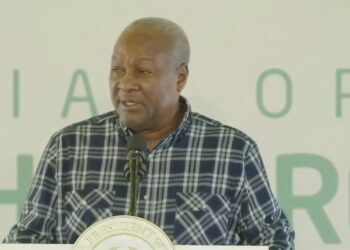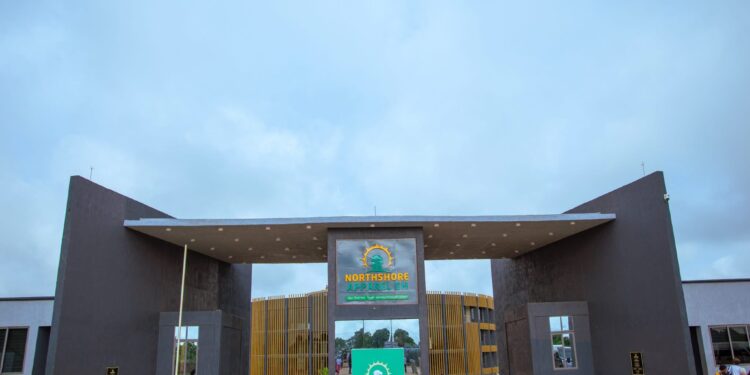
President John Dramani Mahama has commissioned the Northshore Apparel 24-Hour Economy Factory at Savelugu in the Northern Region, describing it as the first living proof that his government’s flagship 24-Hour Economy policy is not a slogan but an actionable industrial strategy.
The President said the factory perfectly embodies the two core objectives of the policy of, mass job creation and accelerated exports for foreign exchange.
“And so the 24-hour economy is designed to achieve the creation of jobs and accelerated export. The Northshore certifies both because it has created at least 2,000 jobs already and the bulk of its products are going to be exported to bring foreign exchange into Ghana.’’
President Mahama
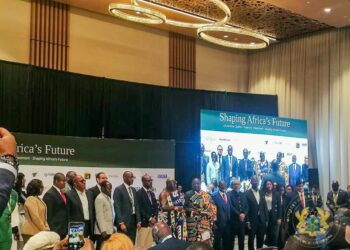
The ceremony, attended by the Yaa-Na, traditional leaders, the Coordinator of the 24-Hour Economy Secretariat, government officials, and workers of the factory, marks the first major factory to be commissioned under the 24-Hour Economy initiative.
President Mahama disclosed that Northshore will run multiple shifts that is the central principle of the 24-hour economy and to maximize productivity and employment.
He stressed that Northshore is going to run several shifts and it means several more young people will get jobs to do. And it’s not only Northshore, there are several other factories that are coming up that are going to run multiple shifts and create businesses for our people.
24- Hour Economy Enables 3 Shifts, Not Forced Night Work
He explained that the 24-Hour Economy is not about forcing every worker to work at night, but about creating an enabling environment, reliable power, security, tax incentives and efficient regulation for enterprises that have the capacity and market demand to operate three shifts.
‘’For Northshore Apparel, which produces garments for the export market, running 24 hours means it can meet large international orders competitively while employing more hands locally.’’
President Mahama
President Mahama further announced that Northshore is registered under the Ghana Free Zones programme and will enjoy all benefits under the scheme.
“And so Northshore is registered under the free zones and so it will benefit from all incentives that the free zones have to offer.”
President Mahama
These incentives include tax holidays, duty free import of machinery and raw materials, and simplified export procedures – key to making Ghanaian apparel competitive against Asian producers. This is significant because Ghana’s garment sector has struggled for years due to high cost of production and preference for imports.
A2 Free Zones status coupled with guaranteed shift incentives under the 24-Hour Economy policy could reposition the country as an apparel hub in West Africa. The President used the occasion to outline a broader industrial vision.
He announced that Northshore is only the anchor tenant of a much larger industrial park to be known as the Northshore Industrial Hub.
“Like the coordinator of the 24-hour economy said, it’s just the beginning. Northshore is the anchor tenant. This is going to become an industrial hub and I know that Yaa-Na is going to give us much more land for all the other industries that are going to come here.”
President Mahama
At full capacity, the hub is projected to employ at least 30,000 young people.
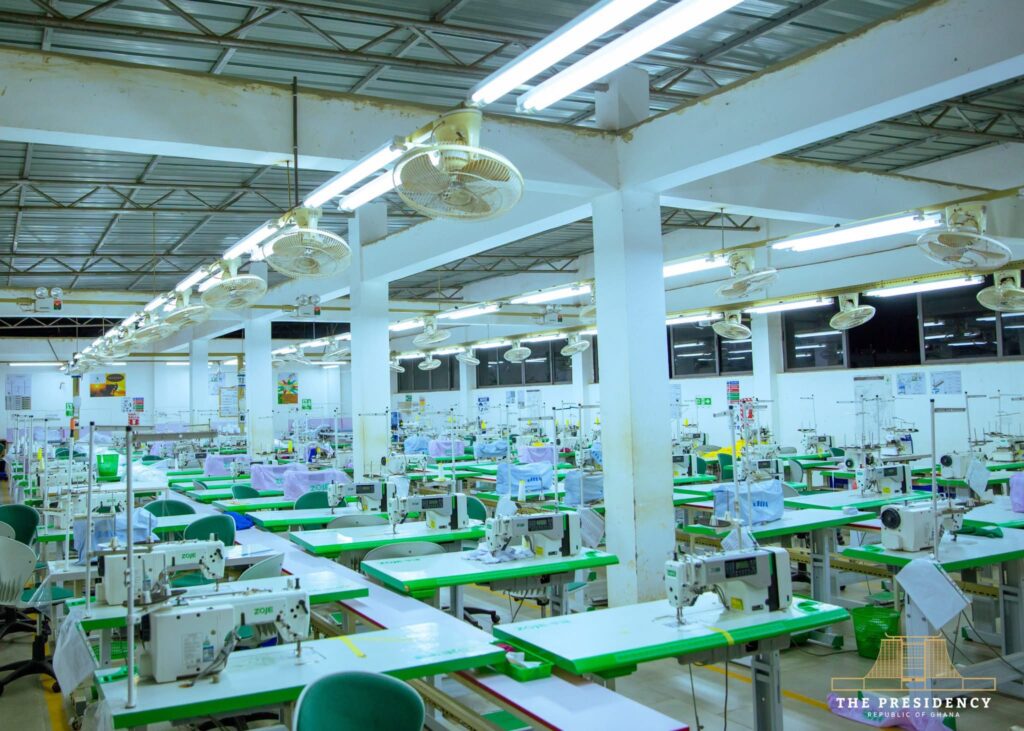
“This is going to become a major employment centre and job creation centre for the whole of Northern Ghana. We believe that at full strength this hub which we have named the Northshore Industrial Hub will be able to provide employment to at least 30,000 young people.”
President Mahama
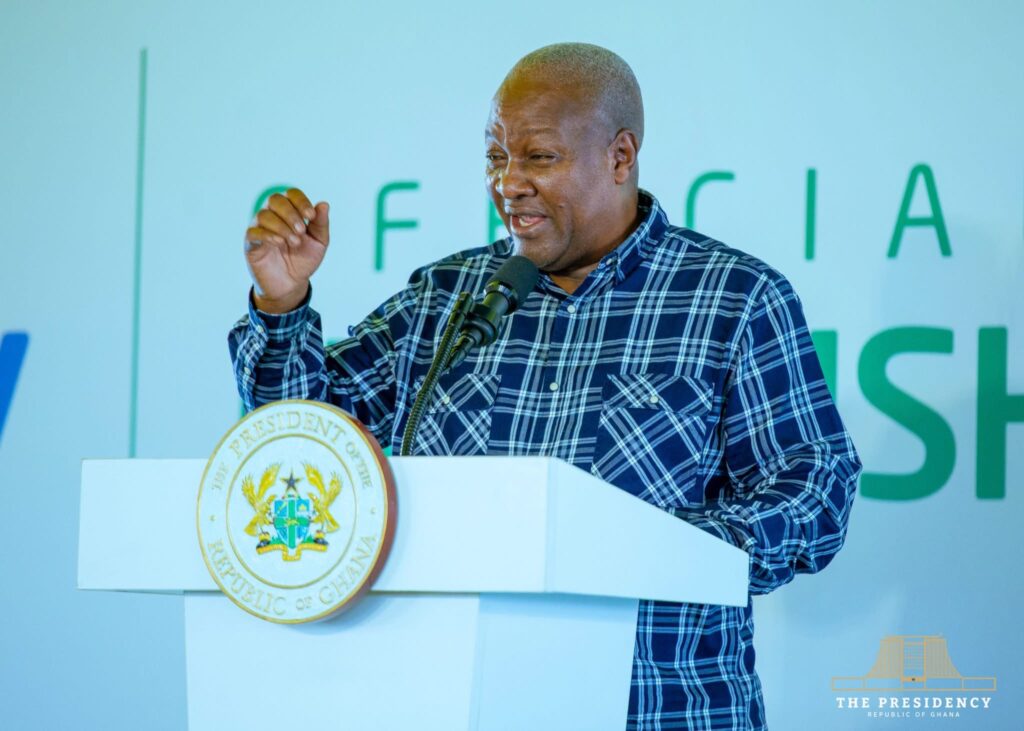
President Mahama Announces a firm Procurement Reform to Protect Factories like Northshore
President Mahama also announced a firm local procurement reform to protect factories like Northshore. He recalled how the revamped Kumasi Shoe Factory, which was producing quality boots for the Ghana Armed Forces under his previous administration, collapsed because state institutions refused to patronize it and continued importing boots from China.
“We did a PPP and set up the Ashanti, the Kumasi shoe factory. We revamped it and it was producing beautiful boots for the army. But because people prefer to import, they know why they prefer to import rather than buy from a government factory, they refused to buy the Kumasi shoe factory boots and rather kept importing the boots from China.’’
President Mahama
To end that cycle, the President said his government is amending the Public Procurement Act. A new schedule will be added, based on a list certified by the Ghana Standards Authority of all licensed made-in-Ghana products.
“A list of all licensed Ghanaian products and any government agencies, schools, hospitals that has to procure any product on that list would have to procure from the company and the factory that produces it. And every year they will publish a recommended list for all their products so that this is not a matter of going for competitive tender, this company produces it, this is their recommended price you must go and buy this product instead of buying an imported product.”
President Mahama
He further directed that in the next phase of the hub, Ghana will stop importing uniforms and boots for the security services. “Uniforms we can produce here, boots we can produce here, protective gear for industry we can produce here,’’ he mentioned
He went on to say that the next phase he wants to see the production of protective gear, military uniforms, police uniforms, prisons uniforms, immigration uniforms. That Ghana will not go and buy the uniforms from anywhere. ‘Our commanders and all will wear made-in-Ghana military uniforms,” he said,’’
President Mahama Vows to Support Efforts to Recover Public Funds
President Mahama also touched on accountability, vowing to support efforts to recover misappropriated public funds.
“Group are running after so many people who took the money and have not paid. And I will continue to support them to take the money back from those who have taken our money.”
President Mahama
The 24-Hour Economy Secretariat says more factories in the garment, pharmaceutical, and agro-processing sectors are expected to be commissioned before the end of the year.
READ ALSO:BoG Bets on Ratings Upgrade as Economy Strengthens