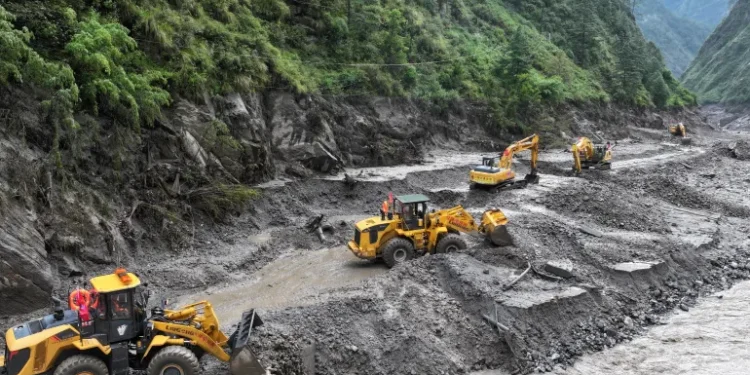
Nepal has warned residents in flood-affected districts to remain on high alert after water levels rose in the Bhotekoshi River, raising fears of further flooding as rescue and recovery efforts continue following Wednesday’s devastating floods along the Nepal-China border.
Flood warnings were sent to residents’ mobile phones early Sunday after Chinese authorities alerted Nepal to increased water flow upstream, according to Dharam Raj Uprety, Chief Executive of Nepal’s National Disaster Risk Reduction and Management Authority.
The warning came as rescue crews worked to reopen a major highway linking the capital, Kathmandu, with one of the areas hardest hit by Wednesday’s floods. The route is a vital transport corridor for delivering emergency supplies and reaching communities affected by the disaster.
The latest flooding concerns are linked to unstable conditions in the mountains following the glacial collapse that triggered Wednesday’s disaster. China’s state news agency, citing the country’s Ministry of Water Resources, said that a lake that formed after the floods had largely drained. However, authorities warned that another crater located about 5.6 kilometres upstream still posed a potential risk. The crater was estimated to contain approximately 1.4 million cubic metres of water and would require continued monitoring, according to the report.
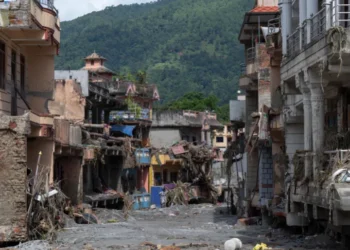
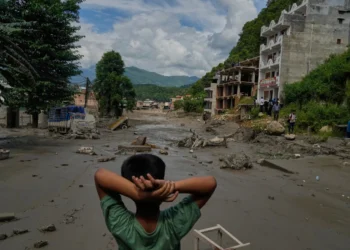
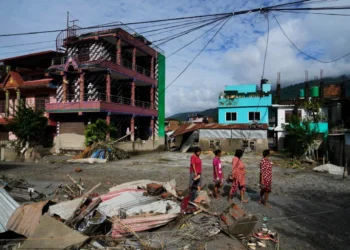
In Dhading, one of Nepal’s worst-affected regions, some residents began returning to their damaged homes to search for belongings and assess what could be salvaged. Homes have been left covered in thick mud and debris, with some buildings suffering extensive structural damage. Residents were seen clearing sludge and rubble from balconies and window frames while others searched through the mud for personal possessions.
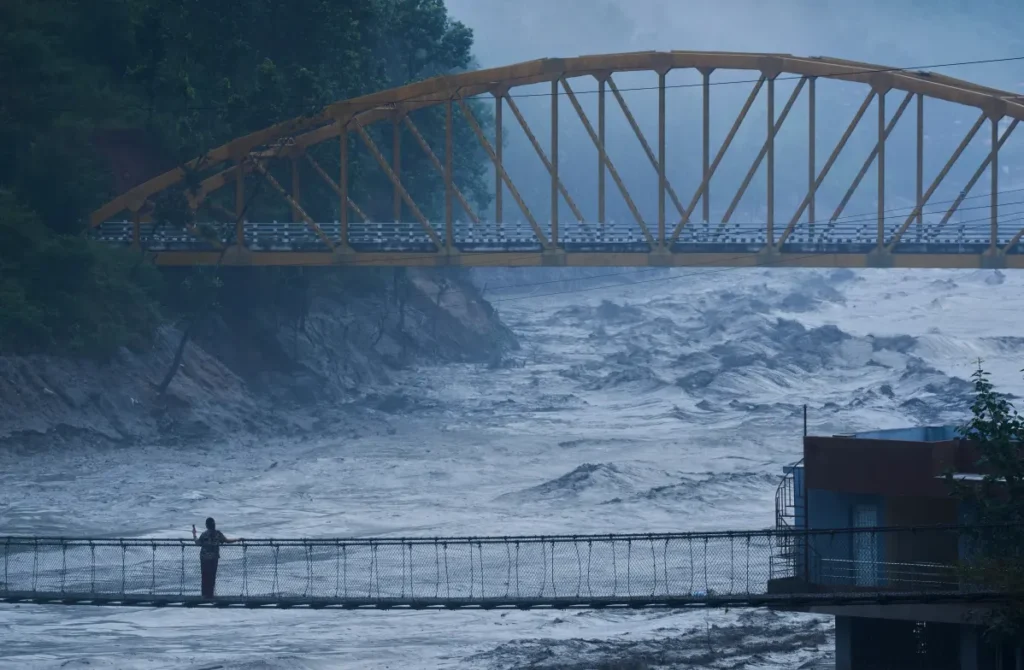
At a major power plant affected by the disaster, workers began inspecting the facility on Sunday to assess the extent of the destruction. The plant supplies electricity to more than 20,000 people across four districts, making its restoration an important priority for the affected communities.
Wednesday’s floods began after a glacial collapse high in the Himalayas. Scientists examining satellite imagery said bedrock beneath a glacier had collapsed, carrying part of the glacier with it.The scale of the rockfall was such that it registered as a magnitude 5.2 seismic event.
The falling rock and melted ice entered mountain waterways, rapidly increasing the volume and force of water flowing through valleys in Tibet and Nepal. The resulting torrent swept away buildings, bridges, roads and other infrastructure, leaving remote communities isolated and complicating access for emergency responders.
The disaster has also renewed concerns about the vulnerability of Himalayan communities to climate-related hazards. Nepal’s Foreign Minister Shisir Khanal called for stronger international action to address climate change, arguing that the country is experiencing severe consequences despite contributing relatively little to global emissions. “Despite having only 0.1% contribution to the global emissions, people of Nepal have become major victims of climate change,” Khanal said on Saturday.
Scientists have warned that warming temperatures can contribute to the destabilisation of glaciers and increase risks associated with glacial lake outburst floods and other hazards in mountainous regions. However, the precise causes of individual glacial collapses can involve several interacting geological and climatic factors.
Death Toll Rises
Nepal’s disaster agency disclosed today that at least 788 people had been confirmed dead and 2,502 remained missing. Chinese authorities reported 16 deaths and 546 people missing on the Chinese side of the border.
The figures emphasize the scale of the disaster, which has affected communities across the Himalayan region and left thousands of people unaccounted for. The missing include hundreds of foreign nationals who were in the region for work, tourism, trekking or religious pilgrimages. Chinese state media reported Sunday that 261 foreigners remained missing in Tibet, including more than 100 Nepali nationals.
Meanwhile, Malaysia’s Prime Minister Anwar Ibrahim said today that his country would send a search-and-rescue team to Nepal to assist with relief operations and help evacuate Malaysian nationals affected by the disaster. Malaysia has also pledged $1 million in financial assistance to Nepal, Ibrahim said in a statement.

Malaysia’s support comes as Nepal continues to face the immediate challenge of reaching isolated communities, accounting for missing people and providing shelter and essential supplies to those displaced by the floods.
Emergency agencies are continuing to monitor water levels and conditions in the mountains while rescue teams work to clear access routes. As Nepal and China continue monitoring unstable water bodies and damaged river systems, authorities remain concerned that additional flooding could further complicate an already severe humanitarian crisis.
READ ALSO: Bawumia’s Gold Program Boosted Foreign Reserves Without External Eurobond Borrowing – Gideon Boako