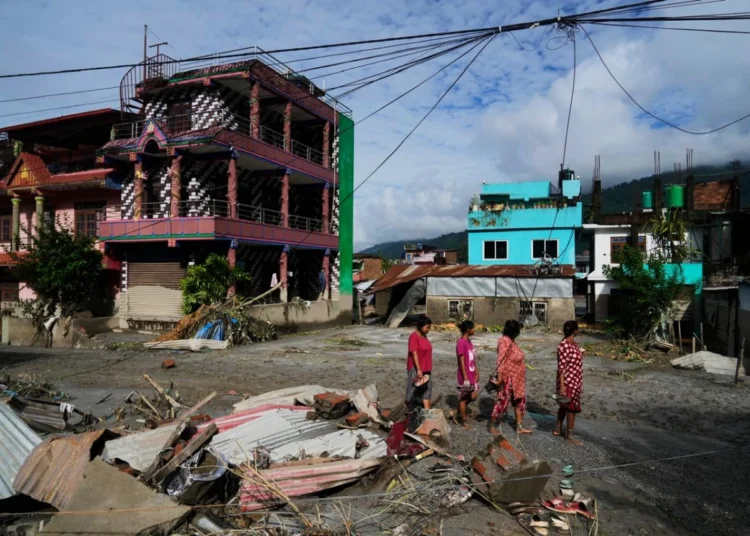
Rescue teams intensified their search today for hundreds of people missing along the Nepal-China border after catastrophic floods and mud swept through communities in the Himalayan region, leaving at least 168 people dead and causing widespread destruction.
The disaster struck yesterday after what officials and experts have linked to a glacier collapse, sending a powerful torrent of water, mud and debris through several communities in Nepal and neighbouring Tibet. Authorities said the scale of the disaster continued to emerge as rescue teams reached affected areas and assessed the damage.
In Nepal, at least 165 people were confirmed dead and 826 others remained missing, according to officials. Across the border in Tibet, Chinese authorities reported three deaths and 558 people missing. The combined figures put the death toll at 168, while more than 1,300 people remained unaccounted for across the Himalayan border region.
Among those missing are local residents, foreign tourists and pilgrims travelling through the mountainous region, including people heading towards Mount Kailash in Tibet, a site regarded as sacred by Hindus. The disaster has also displaced hundreds of people and severely damaged critical infrastructure, making it difficult for rescue teams to reach isolated communities.
Nepalese officials said dozens of bridges had been destroyed, while nearly 40 kilometres, or about 25 miles, of roads were damaged. The destruction of roads and bridges has complicated efforts to transport rescuers, equipment and emergency supplies into some of the worst-hit areas.
The Nepalese army has been using helicopters to reach communities cut off by the floods and mudslides. Army Spokesperson Brigadier General Raja Ram Basnet said more than 100 people had been rescued from flood-affected areas through helicopter operations this morning. He noted that “At least eight foreign nationals” were among those airlifted to Nepal’s capital, Kathmandu.
Army teams also evacuated people trapped inside facilities linked to the Trishuli hydropower project, where the flooding affected infrastructure and left people unable to leave safely. Rescuers have continued searching downstream as floodwaters carried debris and victims far from the original disaster zone.
Bodies were found about 100 kilometres, or 60 miles, downstream in Nepal’s Chitwan district, highlighting the force of the torrent that swept through the Himalayan valleys. Dozens of injured people have also been transported to Kathmandu for advanced medical treatment as hospitals in the affected areas face pressure from the scale of the emergency.
A Shift From Emergency Rescue Operations To Relief Efforts
As the immediate search continues, humanitarian organisations are shifting attention towards the growing needs of displaced communities. Bishal Kumar Bhandari, Chairman of the Nepal Red Cross Society, said that the organisation had begun moving from emergency rescue operations towards large-scale relief efforts in the districts affected by the disaster.
According to Bhandari, around 1,200 people have been displaced from at least three villages. The disaster has also triggered concern among foreign governments as efforts continue to establish the whereabouts of their citizens.
Earlier reports indicated that hundreds of foreign nationals were among those missing in Nepal, including Indian pilgrims travelling towards Mount Kailash. Australia’s Foreign Minister Penny Wong said today that at least 34 Australians participating in pilgrimages and hiking tours remained missing.
Malaysia’s Foreign Ministry also reported difficulties in contacting its citizens, saying that 55 Malaysians in Kathmandu had become unreachable as severe damage to infrastructure disrupted communications. New Zealand’s Foreign Ministry said that five of its nationals were believed to have been in the affected area, although their whereabouts remained unclear.
The disruption to roads, bridges and communication networks has made it difficult for authorities and foreign embassies to confirm the status of many people who were travelling through the region when the disaster struck.
The Nepal-China border region is known for its dramatic mountain landscape, but its steep valleys and rivers are also highly vulnerable to floods, landslides and other natural disasters. Scientists and disaster experts have increasingly warned that changes in the Himalayan environment, including rising temperatures and the instability of glaciers and glacial lakes, can increase the risk of sudden and destructive flooding.
Wednesday’s disaster is among the latest major emergencies to affect communities dependent on mountain roads, hydropower facilities and tourism in the Himalayan region. Rescue operations are expected to continue as authorities search villages, riverbanks and areas downstream from the initial flooding.
However, with more than 1,300 people still missing and access to some communities severely restricted, officials have warned that the scale of the human and material losses may take time to establish. For now, the immediate priorities remain locating survivors, providing medical treatment to the injured and delivering food, shelter and other essential assistance to displaced families.
Foreign governments are also continuing to work with Nepalese and Chinese authorities to locate their citizens as communication and transport networks are gradually restored.
READ ALSO: US Sanctions Three Groups Over Far-Left Extremism